
The Legend of the Trajan’s Path
History whispers from every stone here. Nearly 2,000 years ago, the Roman Emperor Trajan used this narrow passage to conquer Dacia. Legend says that the Roman soldiers had to carve the road directly into the steep cliffs, often working suspended by ropes over the rushing waters. Today, you can still see traces of the ancient Via Traiana, a testament to human ambition carved into the heart of the mountain.
Biodiversity: The Vertical Jungle
The defile is the core of the Cozia National Park, a sanctuary for rare species:
-The Flora of the Cliffs: Here grows the Stipo-Pulsatilletum, a rare association of plants that clings to the limestone walls. In spring, the cliffs are dotted with wild flowers that seem to grow out of solid rock.
-Wild Neighbors: The dense forests surrounding the defile are home to the Chamois (Capra Neagră) (see more), which can sometimes be spotted on the highest crags, and the Eurasian Lynx, which prowls the silent ravines above the river.
Fun Facts & Curiosities for Travelers
- The Longest Passage: It is the only place where a river completely crosses the Southern Carpathians from north to south, linking Transylvania to Wallachia.
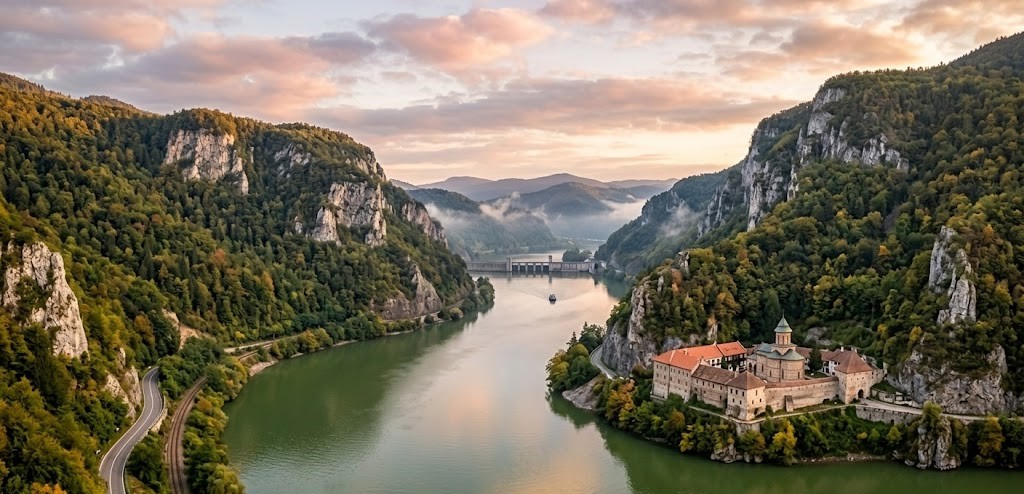
- The Floating Monastery: The famous Cozia Monastery (see more), built by Mircea the Elder (see more) in 1388, sits right on the riverbank. Its reflection in the Olt during a quiet sunrise is one of the most iconic images of Romania.
- Engineering Marvel: Besides the natural beauty, the defile hosts a series of impressive dams and hydroelectric power plants that have transformed the wild river into a sequence of mirror-like lakes.
In Romanian folklore, the Olt and the Mureș were not rivers, but the twin sons of a powerful king who lived in a castle atop the Hășmaș Mountains. Though they were brothers, they had completely different personalities.
The Departure: One day, their father left for a great war and never returned. Their mother, the Queen, crying in her loneliness, decided to send her sons to find him. Before they left, she made them swear they would stay together forever, no matter what happened.
The Conflict: As soon as they left the castle, the brothers began to argue. Mureș was calm, wise, and wanted to travel north, toward the gentle plains. Olt was fiery, rebellious, and wanted to rush south, toward the jagged peaks of the Carpathians.
The Separation: Unable to agree, they broke their oath and went separate ways. Mureș flowed north with a quiet whisper, while Olt charged south with a roar.
The Eternal Tears: When the Queen saw her sons had separated, she fell to her knees and wept. Her tears were so bitter and plentiful that they turned the two brothers into rivers.
The Defile's Creation: It is said that the Olt Defile exists because Olt was so desperate to reach the sea and find his father that he didn't go around the mountains—he used his wild fury to smash through them, creating the spectacular canyon we see today.
To this day, the Olt remains "the troubled brother," muddy and rushing, while the Mureș remains clear and peaceful.
Why Visit?
Driving or taking the train through the Olt Defile is an unforgettable experience. Whether you stop to visit the medieval monasteries, hike the trails of Mount Cozia for a bird's-eye view of the canyon, or simply enjoy a boat ride near Călimănești, the defile offers a raw, powerful connection to Romania's geography and soul.
A beautiful video which present Olt Defile and Olt valley:
Frequently Asked Questions: Olt Defile (Defileul Oltului)
1. How long is the Olt Defile and where does it start?
The Olt Defile is approximately 47 kilometers long, making it the longest canyon in Romania. It starts near the city of Tălmaciu (near Sibiu) in Transylvania and ends near Călimănești-Căciulata (see more) in Wallachia, effectively cutting through the Southern Carpathians.
2. What is the best way to experience the defile?
There are three main ways to enjoy the scenery:
-By Car: Driving on the DN7 (E81) highway offers constant views of the river and cliffs, though it can be busy with traffic.
-By Train: One of the most scenic railway routes in Romania runs right along the riverbank, offering perspectives you can't see from the road.
-By Boat: Near Călimănești, you can take small leisure cruises on the Olt River to see the monasteries and cliffs from the water.
3. Are there any historical sites in the canyon?
Yes, the defile is a treasure trove of history. The most famous is the Cozia Monastery (14th century). You can also find the ruins of the Arutela Roman Castrum (see more), built by Roman soldiers around 137 AD, located right next to the river near the Cozia Dam.
4. Is it safe to hike in the mountains surrounding the defile?
The Cozia National Park offers spectacular trails, but they are quite steep. As always in the Romanian Carpathians, wild animals are unpredictable. Bears and vipers (specifically the Horned Viper) are present in the area. Stay on marked trails and wear appropriate hiking boots.
5. Can you see the "Roman Road" today?
While most of the original Via Traiana is now covered by the modern road or the rising waters of the dams, you can still see sections of the ancient path carved into the rock near the Lotru confluence and several commemorative plaques.
6. What is the "Turnu" area famous for?
The Turnu area is known for the Turnu Monastery, situated at the foot of Mount Cozia. It is famous for the small caves carved into the rock by hermits centuries ago, which can still be visited today.
7. Are there places to stay within the defile?
While the defile itself is narrow, the southern end opens up into the Călimănești-Căciulata spa resorts, where you can find numerous hotels, guesthouses, and thermal water pools.
