A Ruler of Great Borders
During his reign, Wallachia reached its greatest territorial extent. Mircea styled himself as: "I, in Christ God, the faithful and Christ-loving and self-ruling Prince... Duke of Amlaș and Făgăraș, Count of Severin, and Despot of the Lands of Dobruja and Lord of Silistra." He was the first to give Wallachia a direct outlet to the Black Sea.
The Strategist: The Battle of Rovine (1395)
Mircea’s most famous military feat was the Battle of Rovine. Facing the overwhelming force of Sultan Bayezid I "The Thunderbolt," Mircea used the terrain to his advantage.
- Scorched Earth: He burned the crops and poisoned the wells to exhaust the Ottoman army as they advanced.
- The Ambush: In a marshy, forested area (Rovine), his archers and cavalry devastated the Ottoman ranks, forcing the Sultan to retreat. This victory resonated across all of Europe.
The Great Builder and Diplomat
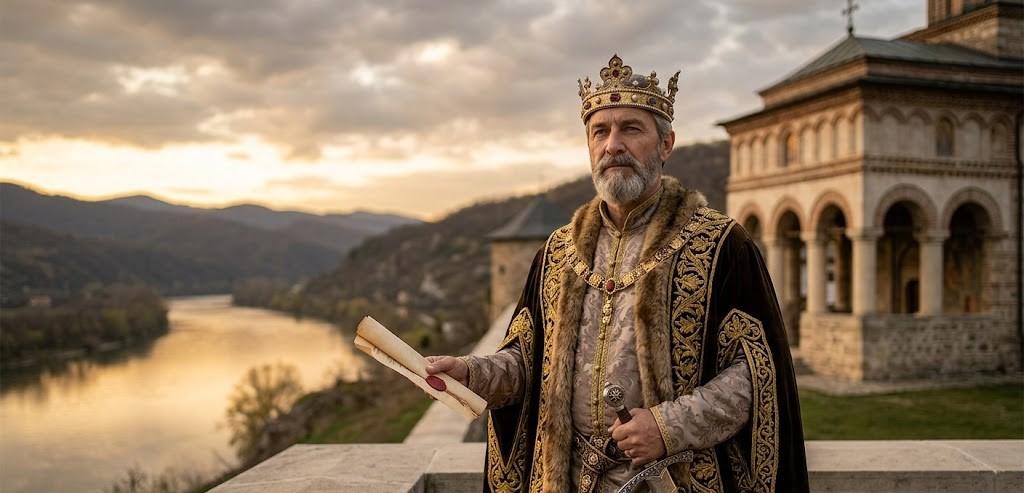
- Cozia Monastery (see more): His most beautiful legacy, Cozia, stands today as a masterpiece of Byzantine-influenced architecture and serves as his final resting place.
- European Alliances: He was a key player in European politics, forming alliances with Poland and Hungary to create a united front against the Ottoman threat.
Many people mistakenly think "The Elder" refers only to his age. In Romanian tradition, the title has a deeper meaning:
-The Wisdom: It was given by later generations to distinguish him from his grandson, Mircea II, but also as a sign of respect for his wisdom and ancient-like authority.
-The Immortality of Cozia: Legend says that Mircea chose the location for Cozia Monastery after a dream where he saw a "pillar of light" rising from the Olt River. He vowed that as long as the bells of Cozia rang, Wallachia would never fall. To this day, the monastery stands strong, surviving wars and floods, just as the memory of the "Old Prince" remains unshaken.
Frequently Asked Questions: Mircea the Elder (Mircea cel Bătrân)
1. Why is he called "The Elder" (cel Bătrân)?
In medieval Romanian, the term "Bătrân" didn't just mean "old" in terms of age. It was used as a title of respect, meaning "The Ancient One" or "The Wise One." Historically, it was also used by chroniclers to distinguish him from his grandson, Mircea II, who ruled later.
2. What was his greatest military achievement?
His most celebrated victory was the Battle of Rovine in 1395. Facing a much larger Ottoman army led by Sultan Bayezid I, Mircea used guerrilla tactics and the marshy terrain to decimate the invaders. This battle remains one of the most important defensive victories in Southeast European history.
3. Is it true that Wallachia reached its peak size under his rule?
Yes. Mircea was a master of territorial expansion and diplomacy. Under his reign, Wallachia stretched from the Southern Carpathians to the Black Sea (Dobruja) and included several regions north of the mountains, like Amlaș and Făgăraș. He was truly the "Prince of the Two Mountains and the Coast."
4. Where can I see his legacy today?
The most iconic site is Cozia Monastery in the Olt Valley. He founded it in 1388, and it remains one of the best-preserved examples of Byzantine-style architecture in Romania. You can also visit the ruins of the Royal Court in Târgoviște, which he established as a secondary capital.
5. How did he deal with the Ottoman Empire?
Mircea was a realist. After years of fierce fighting, he realized that Wallachia couldn't defeat the Ottoman Empire indefinitely on its own. He was the first Romanian ruler to sign a treaty (capitulation) with the Turks, which involved paying a tribute (haraci) in exchange for keeping the country's autonomy and Christian faith—a strategy that saved the state from becoming a Turkish province.
6. Was he related to Vlad the Impaler (Dracula)?
Yes! Mircea the Elder was the grandfather of Vlad the Impaler. Vlad Dracul (the father of the Impaler) was one of Mircea's sons. The military and political foundation Mircea built allowed his descendants to continue the resistance against the Ottoman expansion.
