
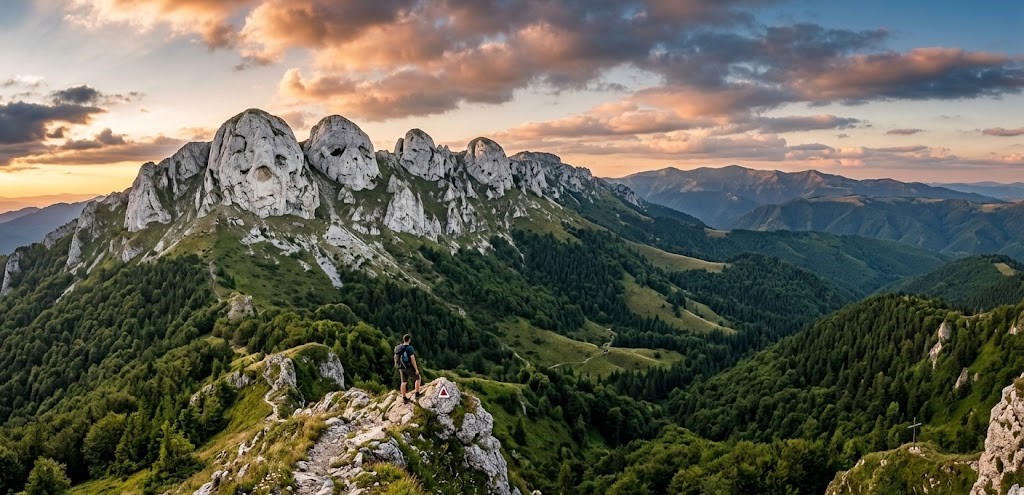
If you are looking for the untamed heart of the South Carpathians, the Căpățânii Mountains offer a landscape where time seems to hold its breath. Nestled between the Lotru and Parâng ranges, these mountains are not just a trekking destination; they are a sanctuary of limestone ridges, deep canyons, and vast alpine pastures that stay green well into the autumn.
The Legend of the "Skull" Mountains
The name "Căpățânii" translates literally to "The Skulls." While it might sound intimidating, the legend behind it is deeply rooted in the local history of the shepherds.
- The Shepherd's Sight: Locals say that from a distance, the rounded, white limestone peaks of the main ridge resemble a row of giant, bleached skulls resting against the sky.
- The Giants' Rest: An older folklore tale suggests these were the heads of giants who once guarded the passage between Transylvania and Oltenia, eventually turning to stone to form the protective barrier we see today.
The Căpățânii Mountains are part of the Buila-Vânturarița National Park (the smallest but one of the most biodiverse in Romania).
- The Rare Edelweiss (see more): On the steep limestone cliffs, you can find the protected Leontopodium alpinum (Edelweiss), the "star of the mountains."
- Wildlife: This is prime territory for the Chamois (Capra Neagră), which can be seen leaping across the jagged rocks of the Buila Ridge. The dense forests at the base are home to brown bears, wolves (see more), and the elusive lynx.
- Virgin Forests: The area boasts some of the last remaining virgin beech forests in Europe, providing a glimpse into what the continent looked like thousands of years ago.
Fun Facts & Curiosities for Travelers
-The "Living" Stones: In the nearby village of Costești, at the foot of these mountains, you can find the Trovants (Growing Stones)—geological formations that "grow" and "multiply" after heavy rain.
-The Monastic Path: This range is unique because it hides some of Romania's most secluded monasteries, like Arnota and Pătrunsa, where monks live a life of total isolation high up on the mountain slopes.
-The Longest Ridge: The main ridge trail is nearly 50 kilometers long, offering a continuous panoramic view without many modern shelters, making it a favorite for "wild" camping enthusiasts.
Why Visit?
For a foreigner, the Căpățânii Mountains represent the ultimate off-the-beaten-path experience. There are no cable cars or crowded tourist traps here. It is just you, the whistling wind through the limestone gaps, and the ancient traditions of the mountain shepherds who still produce some of the best alpine cheese in the region (see more).
A beautiful video presenting Tarnovul Mare preak in Căpățânii Mountains:
Frequently Asked Questions: Căpățânii Mountains
1. Where are the Căpățânii Mountains located?
The Căpățânii Mountains are part of the Southern Carpathians in Romania, situated between the Lotru and Parâng ranges. They overlook the northern part of the Oltenia region, near the town of Horezu and the city of Râmnicu Vâlcea.
2. What does the name "Căpățânii" mean?
The name literally translates to "The Skulls." It is derived from the rounded, white limestone peaks along the main ridge that resemble giant skulls when seen from the valley below.
3. Is it a difficult mountain range for hiking?
It varies. While there are accessible trails near the monasteries (like Arnota), the main ridge is quite long (approx. 50 km) and can be physically demanding. It is considered a "wild" range with fewer mountain huts compared to the Făgăraș or Bucegi Mountains, making it perfect for experienced hikers seeking solitude.
4. Can I see wild animals in the Căpățânii Mountains?
Yes! The area is part of the Buila-Vânturarița National Park, which is home to Chamois (Capra Neagră), brown bears, wolves, and lynx. Because it is less crowded than other massifs, the chances of spotting wildlife (from a safe distance) are higher.
5. Are there any unique natural attractions nearby?
Absolutely. At the foot of these mountains, you can find the Trovants Museum in Costești, featuring the famous "Growing Stones." Also, the area is famous for the Horezu Ceramics, a UNESCO Intangible Cultural Heritage craft.
6. What is the best time of year to visit?
The best time for hiking is from late May to October. In the winter, the ridge becomes dangerous due to heavy snow and the risk of avalanches, requiring professional mountaineering equipment and experience.
7. Is camping allowed in the Căpățânii Mountains?
Wild camping is a popular way to experience these mountains, but it is important to follow "Leave No Trace" principles. Within the boundaries of the Buila-Vânturarița National Park, camping is only permitted in specifically designated areas to protect the local biodiversity.
