
The Architecture of the Abyss
The Humpleu Cave system is a maze of active and fossil galleries that stretch for over 40 kilometers.
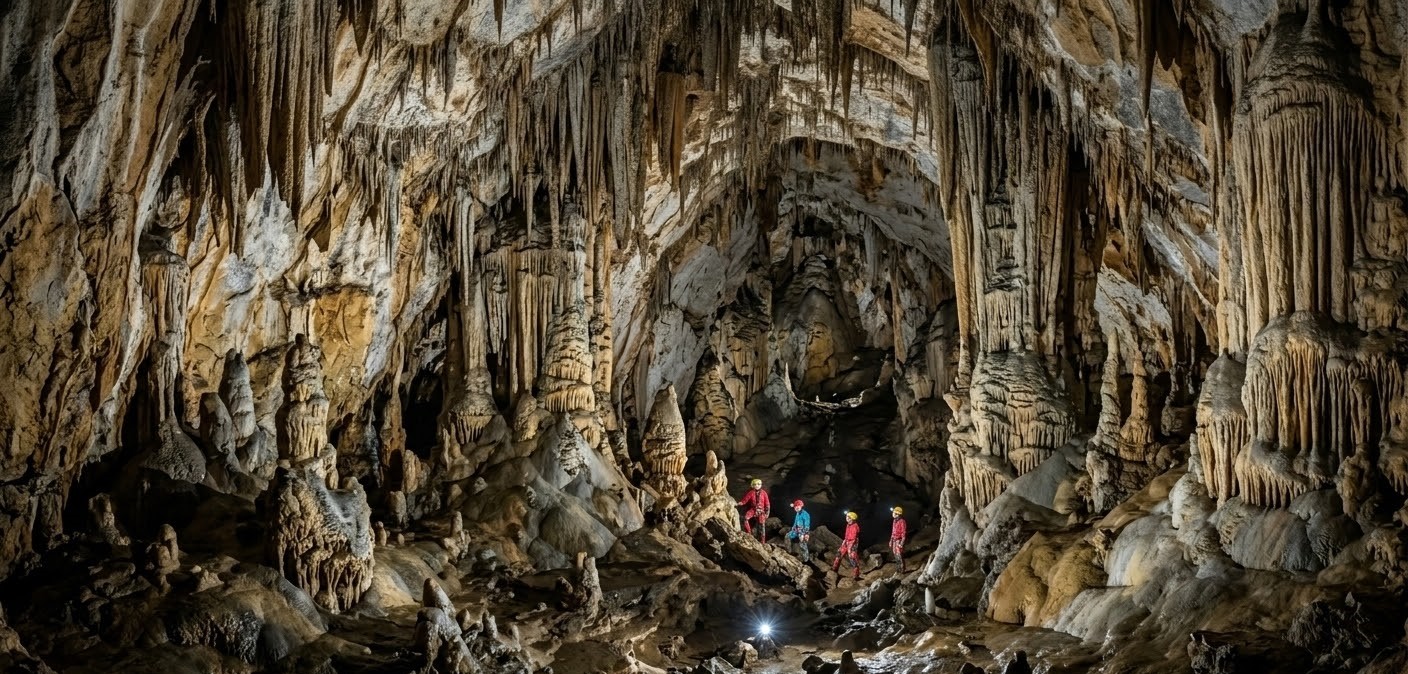
- The Hall of Giants (Sala Giganților): This is the crown jewel of the cave. It is one of the largest underground chambers on the continent, measuring approximately 600 meters in length and reaching heights that could easily fit a skyscraper.
- The Crystal Galleries: Unlike the massive halls, these narrower passages are decorated with delicate calcite formations, transparent aragonite crystals, and massive stalactites that have grown over hundreds of thousands of years.
- The Underground River: The Firez Valley disappears into the limestone, flowing through the cave and carving out the smooth, white walls that characterize the Humpleu system.
Even in the absolute darkness of Humpleu, life finds a way.
- Cave Beetles: The cave is home to endemic species of troglobitic beetles that have evolved to live without eyes or pigment.
- The Bat Colonies: Humpleu serves as a vital hibernation spot for several species of bats, including the Greater Horseshoe Bat. These colonies are strictly protected to ensure their survival.
- Microbial Life: Scientists have discovered unique biofilms on the cave walls that "feed" on the minerals in the limestone, a process that is still being studied for its biological significance.
The Legend of the Mountain Spirits (Vâvele Muntelui)
In the folklore of the Apuseni Mountains, locals believed that massive caves like Humpleu were the dwellings of "Vâvele" — powerful female spirits who guarded the gold and precious crystals hidden deep within the earth.
According to the legend, the "Vâva Muntelui" would appear as a beautiful woman or a flickering light to guide lost travelers or miners. However, if someone entered her "palace" (the massive chambers like the Hall of Giants) with greed in their heart, she would confuse their senses. The vast, dark halls would become an endless maze, and their torches would mysteriously blow out, leaving them trapped in the silence of the mountain forever.
The elders of the Firez Valley used to say that the loud echoes and the sound of the underground river in Humpleu are actually the voices of the spirits whispering to the mountain, making sure that its hidden treasures remain untouched by those who do not respect the silence of the earth.
Fun Facts for the Curious
- A Hidden Giant: Despite its massive size, the main entrance is relatively discreet, tucked away in the dense forest of the Apuseni Nature Park.
- Total Darkness: Inside the Hall of Giants, the space is so vast that even the most powerful professional flashlights struggle to reach the ceiling or the distant walls.
- Speleological Importance: It is considered the second-largest cave system in Romania, and new galleries are still being discovered by explorers every few years.
- Total Length: Approximately 40 kilometers explored.
- Maximum Altitude: Located at about 1,000 meters above sea level.
- Vertical Drop: Over 300 meters from the highest to the lowest point.
- Access Status: Access is strictly regulated and usually reserved for professional speleologists or guided groups with specialized equipment.
Frequently Asked Questions: Humpleu Cave (Peștera Humpleu)
Is Humpleu Cave open to the general public?
No. Unlike caves like Scărișoara Cave (see more) or Bear’s Cave (see more), Humpleu is a "wild" cave classified as a Class A protected site. This means it is reserved for scientific research and experienced speleologists. There are no paved paths, stairs, or artificial lighting installed.
How big is the Hall of Giants?
The Hall of Giants (Sala Giganților) is truly massive. It measures roughly 600 meters in length, 100 meters in width, and over 90 meters in height. To give you a perspective, you could fit several large cathedrals or a 30-story building inside this single underground chamber.
Where is the cave located?
The cave is located in the Bihor Mountains (see more) (part of the Apuseni range), in the Firez Valley area. The nearest access point is typically through the Măguri-Răcătau or Padiș regions, but the entrance itself is hidden and difficult to find without GPS coordinates or a local guide.
Do I need special equipment to enter?
Yes, absolutely. Entering Humpleu requires full speleological gear: helmets with high-power lighting, waterproof suits, boots with high grip, and, for certain sections, technical rope equipment (harnesses, descenders, and ascenders) for vertical climbs or descents.
What is the "Firez" mentioned in relation to the cave?
Firez is the name of the valley and the stream that carved the cave over millions of years. The cave system acts as a giant drain for the Firez Valley, where the water disappears underground (a "ponor") and travels through the galleries before reappearing elsewhere.
Are there bats (see more) in Humpleu Cave?
Yes, the cave is an important sanctuary for several bat species. Because bats are sensitive to noise and light during their hibernation period (winter), access to certain galleries is strictly forbidden during those months to protect the colonies.
Can I see the cave's famous crystals?
The most beautiful formations, such as the "macaroni" stalactites and transparent crystals, are located in remote galleries far from the main entrance. Reaching them requires hours of difficult crawling and climbing through narrow passages.
