
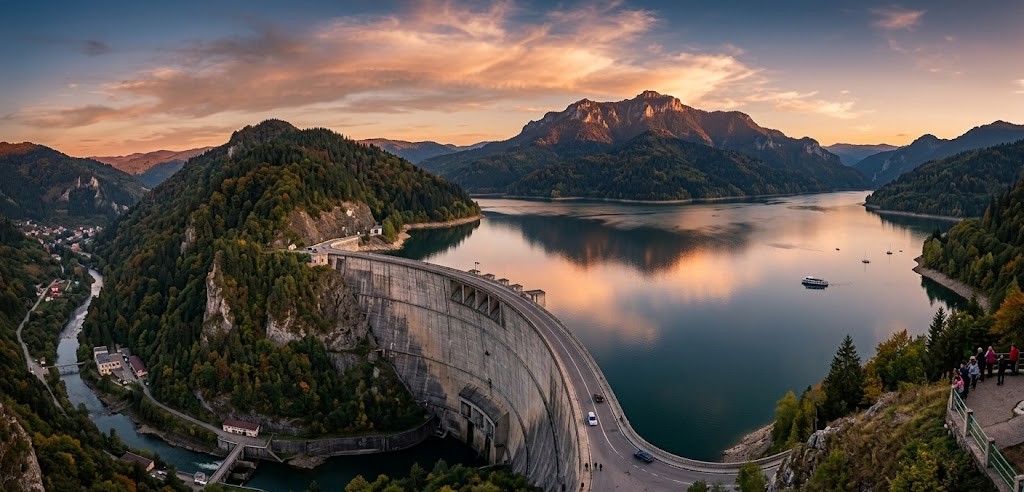
Rising like a massive stone wall between the Gicovanu Mountain and the Horștei Ridge, the Bicaz Dam is more than just a hydroelectric structure; it is a symbol of human ambition and sacrifice. Standing at 127 meters high, it is the largest gravity dam on Romania's interior rivers, holding back the vast waters of Lake Izvorul Muntelui, also known as "The Sea between the Mountains."
The History: Triumph and Tragedy
The construction of this "artificial mountain" took place between 1950 and 1960. It was the first major site of the communist era, requiring the labor of over 15,000 people.
-The High Price of Progress: To make room for the 1.3 billion cubic meters of water, 22 villages had to be partially or totally displaced. Over 18,000 residents were forced to leave their ancestral homes, dismantling their houses beam by beam to rebuild them on higher ground.
-The "Road of the Dead": In a somber effort to preserve their heritage, locals had to disinter their ancestors from two village cemeteries that were about to be flooded, carrying the remains to a new common grave in Chirițeni.
Legend: The Sunken Church of Hangu
The most haunting legend of Bicaz involves the old church of Hangu. Too large to be moved, the massive stone structure was eventually dynamited as the waters rose.
- The Ghostly Ruins: Locals say that during very dry summers, when the water level drops significantly, the ruins of the church's foundation emerge from the depths like a ghost from the past.
- The Bells of the Deep: A popular local myth claims that on quiet nights, if you listen closely near the shore, you can still hear the muffled echoes of the church bells ringing from beneath the waves.
Biodiversity: Life in the Shadow of Ceahlău
The lake created by the dam has become a thriving ecosystem, declared a Natural Aquatic Reserve in 2000.
- The Underwater World: The depths are home to diverse fish species, including trout (indigenous, lake, and rainbow), lostriță (Danube salmon), and pike-perch.
- Reflections of a Giant: On sunny days, the lake acts as a massive mirror for the Ceahlău Massif (see more), Romania's "Holy Mountain," creating a breathtaking visual symphony of blue water and jagged gray peaks.
- Cousteau’s Visit: Fun fact—in 1984, the famous marine explorer Jacques-Yves Cousteau visited the biological research station at Potoci, on the shores of Lake Bicaz, fascinated by the underwater life here.
For an international traveler, the Bicaz Dam offers a unique blend of industrial grandeur and wild nature. You can take a boat trip from the Bicaz Port to witness the scale of the dam from the water or drive along the winding DN15 road for panoramic views that rival the famous fjords. It is a place where you can feel the weight of history while surrounded by the serene beauty of the Moldavian Carpathians.
A beautiful video presenting Bicaz Dam (Barajul Bicaz):
Frequently Asked Questions: Bicaz Dam (Barajul Bicaz)
1. Is it safe to walk or drive on the dam?
Yes, the top of the dam is a public road (DN15). There are designated pedestrian sidewalks on both sides, offering a spectacular 127-meter drop view on one side and the vast lake on the other.
2. Can I go inside the dam or the power plant?
Currently, the interior of the dam and the Stejaru Hydroelectric Power Plant are restricted areas for security reasons. However, the exterior is fully accessible for photography and sightseeing.
3. What is the "Sea between the Mountains"?
This is the nickname given to Lake Izvorul Muntelui (the lake created by the dam). It earned this name because of its massive size—it is 35 kilometers long and covers an area of over 32 square kilometers, making it feel like an inland sea surrounded by the Carpathians.
4. Are there boat tours available on the lake?
Yes. You can head to Bicaz Port (Portul Bicaz), located right next to the dam. There are large tour boats that run on a schedule, as well as smaller motorboats and pedal boats available for rent.
5. Can I see the "Sunken Church" today?
The ruins of the Hangu Church are usually submerged under tens of meters of water. They only become visible during extreme droughts when the lake level drops significantly (usually once every few decades).
6. Is the water safe for swimming?
While swimming is not officially prohibited in all areas, it is not recommended near the dam due to very deep waters (up to 90 meters) and cold undercurrents. There are, however, specially arranged floating piers and guest houses along the shore with safer access to the water.
7. How do I get to Bicaz Dam?
The most scenic route is by car from Piatra Neamț (about 30 minutes) or from Transylvania via the famous Bicaz Gorges (Cheile Bicazului) (see more). It is a must-see stop on any road trip through the northern part of Romania.
