
Key Natural Features
- The Altar Stone (Piatra Altarului): A massive rocky massif (1,120m) that dominates the skyline, a favorite for professional rock climbers.
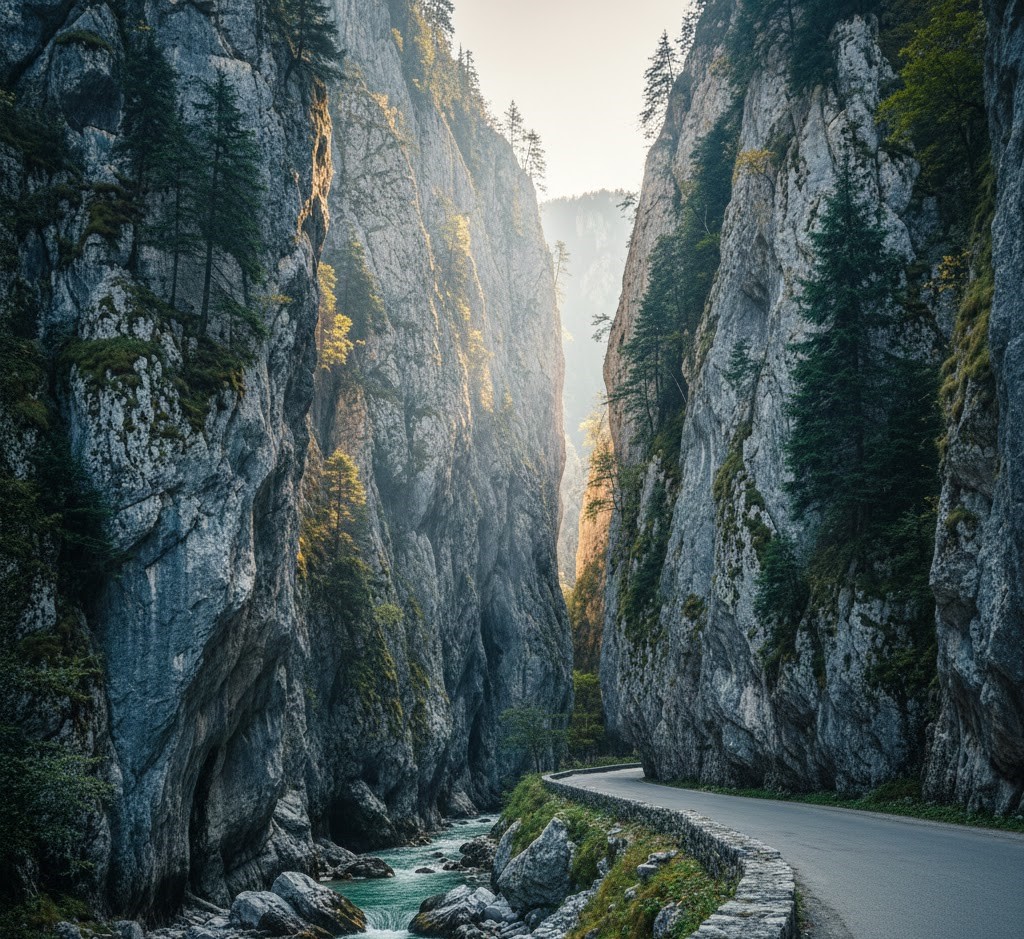
- The Hell's Neck (Gâtul Iadului): The narrowest and most spectacular sector, where the vertical cliffs almost touch each other above the road.
Legends of the Rocks
Local folklore is rich here. One of the most famous legends says that the massive rocks were formed when a group of giants tried to stop the river, but the water's force was so great that it split the mountain in two, creating the gorge we see today.
Technical Specifications
- Length: The gorge stretches for approximately 6–8 kilometers along the Bicaz River.
- Verticality: The limestone walls rise to heights of up to 300 meters (984 feet) in several sections.
- Formation: It was carved into Jurassic limestone by the erosive force of the Bicaz River over millions of years.
- Protected Status: It is a central part of the Bicazului Gorges-Hășmaș National Park, covering a protected area of over 6,500 hectares.
- Road Connectivity: It is traversed by the national road DN12C, which connects the cities of Bicaz (Neamț) and Gheorgheni (Harghita).
- "The Neck of Hell": One of the narrowest and most intimidating sections is famously known as Gâtul Iadului (The Neck of Hell), where the towering cliffs almost seem to touch overhead, blocking out much of the sunlight.
- A Rock Climber’s Paradise: The gorge is home to Piatra Altarului (The Altar Stone), a massive cliff standing at 1,147 meters above sea level. It is considered one of the most iconic and challenging climbing spots in the country.
- Natural Air Conditioning: Due to the massive stone walls and the constant flow of the river at the bottom of the ravine, the temperature inside the gorge remains significantly cooler than the surrounding areas, even in the middle of summer.
- The "S" Curves: The road consists of serpentines and hairpins so tight that large coaches and trucks often have to navigate them with extreme precision, making for a very dramatic drive.
- Legendary Surroundings: Just a few kilometers away lies Lacu Roșu (The Red Lake), which was formed in 1837 after a massive landslide blocked the valley. The dead tree trunks still piercing the water’s surface give it a hauntingly beautiful appearance.
Bicaz Gorge stands as one of the most visited natural wonders in Romania, attracting hundreds of thousands of explorers every year. It is a place where the sheer scale of the vertical cliffs reminds us of nature's raw power. Whether you are a photographer chasing the perfect light, a rock climber tackling the limestone walls, or a traveler on a road trip, this passage offers an unforgettable experience.
A superb video which presenting Bicaz Gorge (Cheile Bicazului):"The Bicaz Gorge is more than just a passage through stone; it is a masterpiece of persistence where the river has spent millennia carving its soul into the heart of the mountain, creating a gateway that humbles every traveler."
FAQ: Bicaz Gorge (Cheile Bicazului)
- Why is Bicaz Gorge considered a "must-see" in Romania?
It is one of the most spectacular driving and hiking routes in Europe. The massive limestone walls are so close in some areas (like "Hell's Neck") that the sky almost disappears, creating a unique, immersive natural cathedral. - Can I explore the gorge on foot?
Absolutely. While most people drive through, the best way to experience the scale of the cliffs is by walking. There are designated spots to park your car, allowing you to walk among the 300-meter high walls and listen to the rushing Bicaz River. - Is there a fee to enter the gorge?
No, there is no entry fee to drive or walk through the main gorge road (DN12C). However, if you choose to explore specific hiking trails within the Hasmas National Park, some small park fees might apply during the summer season. - What should I buy from the local artisans?
The area is famous for its traditional markets. You can find authentic Romanian wood carvings, handmade ceramics, and traditional wool products crafted by local artisans from the surrounding Neamț and Harghita regions. - Are there any safety tips for the road?
The road is winding and can be very narrow. Be mindful of the "falling rocks" warning signs and stay alert for other tourists who might be walking on the edge of the road, especially in the tightest corners. - What is the legend of the Red Lake (Lacu Roșu) nearby?
Just 5 km away, the Red Lake (see more) was formed in 1837 after a landslide blocked the valley. Legend says the lake got its name (and color) from the blood of a group of people who were caught under the mountain when it collapsed, though the red tint actually comes from the iron-rich soil.
