
The Legend of the Bottomless Lake (Vulturilor Lake)
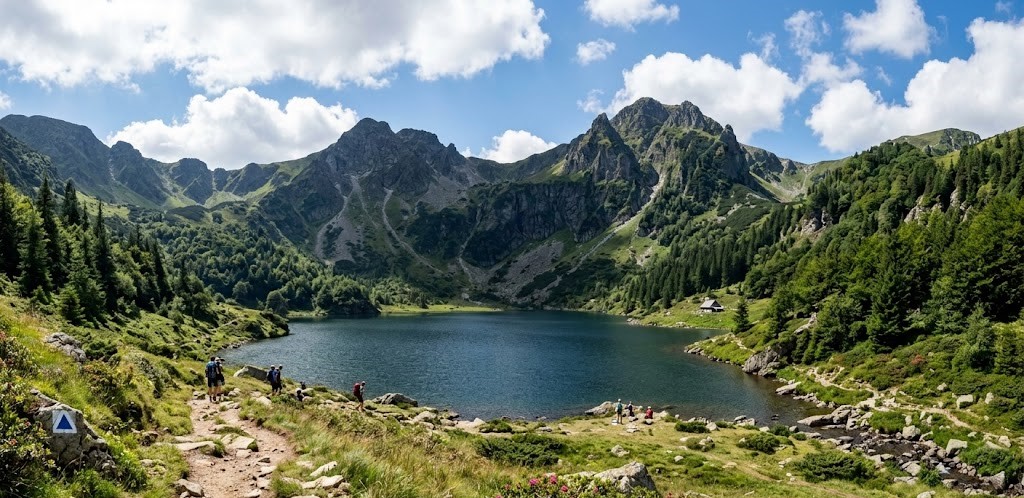
The most famous spot in Siriu is Lacul Vulturilor (The Eagles' Lake) (see more). It is also known as the "Bottomless Lake," and it comes with two fascinating stories:
- The Rejuvenation of Eagles: The great Romanian writer Alexandru Vlahuță wrote that eagles come here in the spring to drink the water and bathe to regain their youth.
- The Shepherd's Staff: Local legend says a shepherd once dropped his staff into the lake, only to find it later in the Danube. This sparked the myth that the lake has no bottom and is connected directly to the great river through subterranean veins.
Biodiversity: A Wild Sanctuary
The Siriu Mountains are a haven for wildlife. Because the area is less trafficked than the nearby Bucegi, the ecosystems remain remarkably intact:
- The Large Carnivores: This is prime territory for the Brown Bear, the Wolf, and the elusive Lynx.
- Flora: In early summer, the ridges are covered in Rhododendron (smârdar), turning the slopes into a vibrant pink carpet. You can also find the rare Edelweiss on the steeper rocky sections.
- The Chamois: If you are quiet and reach the "Poarta Vânturilor" (The Gate of the Winds), you might spot the Black Goat (Capra Neagră) jumping effortlessly across the cliffs.
- Mălâia Peak: At 1,662 meters, it offers a 360-degree panorama that, on clear days, lets you see all the way to the Bucegi and Vrancea Mountains.
- Siriu Dam and Lake (see more): At the foot of the mountains lies a massive man-made emerald lake. The road winding around it (DN10) is considered one of the most scenic drives in Romania.
- Cultural Authenticity: You will still find active sheepfolds (stâne) where shepherds live much as they did centuries ago.
-The Wind's Gate: There is a specific mountain pass called Poarta Vânturilor. It is the meeting point of several air currents, and the wind here almost never stops blowing, regardless of the season.
-Drowned History: When the Siriu Dam was built in the 1980s, an entire village (Siriu-Băi) was submerged. Some locals say that when the water level is very low, you can still feel the history of the lost settlement.
Tip for Travelers: The best time to hike Siriu is between June and October. Always check the weather at the "Gate of the Winds" before heading to the summit!
A nice aerial video presenting Siriu Mountains (Munții Siriu):
Frequently Asked Questions about the Siriu Mountains
1. Where are the Siriu Mountains located?
The Siriu Mountains are part of the Curvature Carpathians in Romania. They are situated in the southeastern part of the mountain chain, mainly in Buzău County, about 80 km from the city of Buzău and 150 km from Bucharest.
2. How can I reach the famous "Eagles’ Lake" (Lacul Vulturilor)?
There are several hiking trails, but the most popular start from:
- Crasna Village: A moderate hike of about 3.5–4 hours.
- Valea Neagră: A steeper but shorter route.
- Siriu Dam: A longer, scenic route for experienced hikers.
3. Is it safe to hike alone in Siriu?
While the trails are generally well-marked, we recommend hiking in groups. The Siriu Mountains are a wild habitat for brown bears and wolves. Always make noise while walking to avoid surprising wildlife and carry bear spray if possible.
4. Can I camp near the lake?
Yes, wild camping is permitted and very popular near Lacul Vulturilor. However, there are no organized facilities (toilets or trash bins), so it is crucial to follow "Leave No Trace" principles and protect the mountain water sources.
5. What is the best time of year to visit?
June – July: For the blooming Rhododendrons and lush green landscapes.
September – October: For the spectacular "Rusty" autumn colors of the beech forests.
Winter: Only for experienced hikers with professional equipment, as the ridges are prone to heavy snow and strong winds at "Poarta Vânturilor."
6. Is there mobile signal in the mountains?
Mobile reception is very spotty and often non-existent once you leave the main DN10 road and head up the trails. It is highly recommended to download offline maps (like Maps.me or Muntii Nostri) before starting your hike.
7. Why is it called "The Bottomless Lake"?
This is a local nickname based on a legend that the lake is connected to the Danube River through underground tunnels. In reality, the lake is quite shallow (about 2.5 meters deep), but the dark, peat-filled water makes it look deep and mysterious.
8. Are there any mountain huts (cabane) nearby?
The infrastructure is minimal compared to the Bucegi Mountains. There are a few guesthouses in Siriu Village and Gura Teghii, but up on the mountain, there are only basic shelters (refugii) and shepherd huts.
