
Biodiversity: A Kingdom of Wings
Șura Mare is a strictly protected site primarily because of its incredible biodiversity:
The Bat Sanctuary: Inside its massive galleries, over 100,000 bats (see more) from several species (including the Long-winged bat) hibernate during the winter. It is one of the most important maternity and hibernation spots in all of Europe.
Cave Fauna: The cave's river system is home to unique, microscopic crustaceans and insects that have adapted to a life of perpetual darkness.
Legend & History
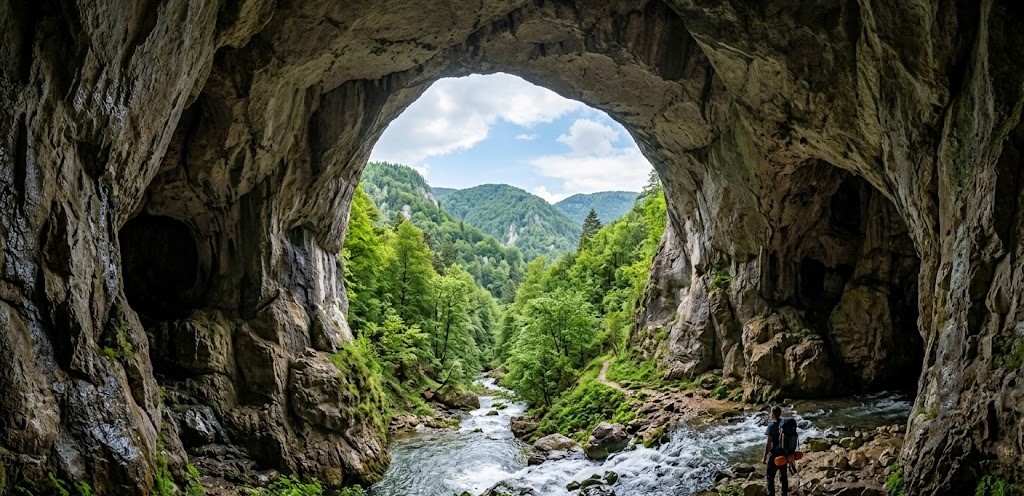
-Local lore calls it the "Great Barn" (Șura Mare) because of its sheer size—the entrance is a staggering 37 meters high and 12 meters wide.
-Ancient legends suggest that these mountain openings were seen as "breathing holes" for the earth. More practically, the cave has been known to locals for centuries as a place of refuge. The surrounding area is also rich in Dacian history, with the sacred capital, Sarmizegetusa Regia, located in the same mountain range.
Fun Facts for Explorers
- The "Skyscraper" Entrance: To give you an idea of scale, the entrance is roughly as tall as a 12-story building.
- The Underground River: A powerful stream flows out of the cave, creating a series of waterfalls and deep pools (gururi) inside.
- For Professionals Only: Unlike tourist caves (like Peștera Muierilor), Șura Mare is not electrified. It is an active water cave, meaning exploration requires specialized equipment, neoprene suits, and official permits. Most visitors come just to admire the breathtaking entrance.
Even if you don't go deep inside, the walk to the cave's mouth is like stepping into a prehistoric world. The sheer scale of the limestone walls and the sound of the rushing water make it a must-see for anyone visiting the Hunedoara region.
A superb video from foreign explorers inside of The Great Barn Cave (Peștera Șura Mare):
Frequently Asked Questions: Șura Mare Cave
1. Can I explore the inside of the cave?
Unlike "show caves" (like Peștera Muierilor (see more) or Scarisoara (see more)), Șura Mare is a wild, active water cave. Entry beyond the portal is strictly for experienced cavers with professional equipment (neoprene suits, helmets, lights) and usually requires a permit from the Natural Park administration. Most tourists visit to marvel at the massive entrance, which is impressive enough on its own.
2. How do I get to the cave entrance?
The cave is located near the village of Ohaba-Ponor in Hunedoara County. From the village center, there is a marked trail that leads you to the cave. It is a pleasant walk of about 15-20 minutes through a beautiful valley.
3. Is it safe to visit with children?
The walk to the cave's mouth (the portal) is safe for children and very spectacular. However, you should not let them enter the water or go deep into the dark zones, as the rocks are extremely slippery and the water current can be surprisingly strong.
4. Why are the bats so important here?
Șura Mare hosts one of the largest and most diverse bat colonies in South-Eastern Europe. These tiny mammals are crucial for the ecosystem (one bat can eat thousands of mosquitoes in a single night!). Because they are sensitive to light and noise, visitors are asked to stay near the entrance to avoid disturbing their hibernation or breeding cycles.
5. Can I visit the cave in winter?
You can visit the entrance, but it is highly discouraged to enter the cave during winter. This is the hibernation period for the 100,000+ bats. Any disturbance can cause them to wake up, burn their fat reserves, and potentially die before spring.
6. Are there other attractions nearby?
Yes! Since you are in the Grădiștea Muncelului-Cioclovina Natural Park, you are very close to:
- Cioclovina Cave (see more): Another spectacular site nearby.
- Sarmizegetusa Regia (see more): The ancient Dacian capital (UNESCO World Heritage Site).
- Fundătura Ponorului: Often called "The Palm of God," a stunningly beautiful karst plateau where a river simply disappears into the ground.
