
The Legends of the Maramureș Mountains
1. The Lost Gold of the "Pintea the Brave" (Pintea Viteazul)
The Legend: Pintea is the Robin Hood of Maramureș, a legendary outlaw with supernatural powers. The Story: It is said that Pintea used the dense forests of the Maramureș Mountains to hide from the Austrian Empire’s armies. Legend has it that he had a "flying horse" and a shirt that made him bulletproof. He supposedly hid his massive treasures in secret caves throughout these mountains, sealing the entrances with giant boulders and magic spells. Locals say that if you find a rock with a horseshoe mark on it, you are standing on a fortune—but the gold is guarded by his ghost.
2. The "Fata Pădurii" (The Forest Maiden)
The Legend: A mystical and dangerous creature that haunts the deep valleys. The Story: This is a classic Maramureș myth. The Fata Pădurii is a beautiful woman with long hair who lures lonely woodcutters or shepherds deep into the thicket. Once they follow her, she reveals her true, terrifying form. It’s a legend used for centuries to teach people to respect the deep forest and never wander off the path after sunset.
3. The Giants of the Vaser Valley
The Legend: Before humans, the narrow valleys like the Vaser were the homes of the "Jidovi." The Story: Old stories tell of giants who lived in the Maramureș Mountains and used the pine trees as walking sticks. When humans first arrived, the giants weren't mean, but they were so big they could accidentally crush a house with one step. It is said that when the giants finally left this world, they turned into the massive, oddly shaped cliffs that travelers can still see today from the Mocănița steam train.
The Peaks of Silence
Dominating the landscape at 1,961 meters, Farcău Peak offers panoramic views that stretch deep into Ukraine. Unlike the crowded trails of central Romania, Maramureș provides a rare luxury: solitude. Here, the ridges are wide, the forests are ancient, and the only sound you might hear is the call of a golden eagle.
The Legend of the Mocănița (Click HERE to see more)
No presentation of this region is complete without the Vaser Valley. Home to the famous Mocănița, it is the last remaining steam-powered forestry railway in Europe. Imagine puffing through narrow gorges and lush emerald forests on a train that feels like it belongs in the 19th century. It’s not just a ride; it’s a journey back in time.

Why Maramureș?
- Untamed Wildlife: One of the few places in Europe where wolves, lynx, and brown bears roam freely in a truly vast habitat.
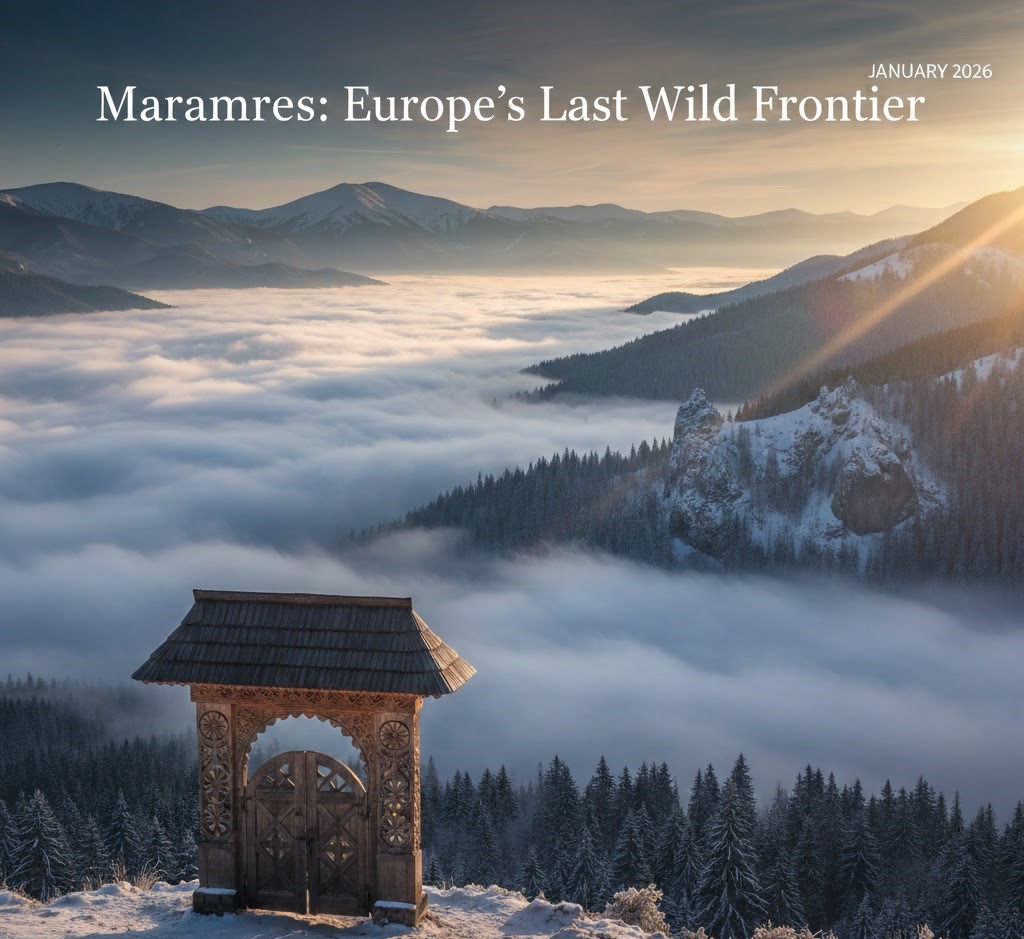
- Cultural Heritage: At the foot of the mountains, you’ll find the world-famous wooden churches (UNESCO World Heritage sites) and the iconic carved wooden gates.
- The "Poloninas": Vast alpine pastures where local shepherds still practice transhumance, making traditional cheese (see more) just as their ancestors did.
Beyond the ridges, the Maramureș region offers a unique blend of cultural landmarks and hidden natural gems. Here are the "must-see" spots for your itinerary:
- The Vaser Valley (Valea Vaserului): Board the Mocănița, the world-famous steam train. This 60km journey takes you through wild canyons and dense forests where no roads exist, offering a glimpse into the traditional timber industry.
- The Merry Cemetery of Săpânța (Cimitirul Vesel) (Click HERE to see more): Located just a short drive from the mountains, this is perhaps the most unique cemetery in the world. Its colorful wooden crosses feature witty poems and paintings that celebrate the lives (and quirks) of the deceased.
- Barsana Monastery (Click HERE to see more): A masterpiece of Maramureș wooden architecture. This monastic complex is a sanctuary of peace, featuring some of the tallest wooden structures in Europe, surrounded by impeccably manicured gardens.
- The Memorial to the Victims of Communism (Sighetu Marmației) (Click HERE to see more): For history buffs, this former prison turned museum provides a powerful, sobering look into Romania’s 20th-century political history.
- The Horses’ Waterfall (Cascada Cailor) (Click HERE to see more): Located near Borșa, it is the tallest waterfall in Romania (90 meters high). Legend says a herd of horses jumped from the mountain top to escape a bear attack, giving the fall its dramatic name.
- Ieud and Poienile Izei: Home to some of the oldest wooden churches in the region (UNESCO sites). Inside, you can find 14th-century frescoes that are remarkably well-preserved, painted on wood and linen.
- The Blue Lake (Lacul Albastru) (Click HERE to see more): Situated near Baia Sprie, this unique lake is famous for changing its color depending on the light and water temperature, ranging from emerald green to deep turquoise due to its mineral content.
"Maramureș is a place where the clock ticks differently. It is where the mountain doesn't just challenge your legs, but speaks to your spirit."
Travel Essentials
- Best time to visit: Late May to October for hiking; January to March for winter sports in nearby Borșa.
- Ideal for: Backpackers, landscape photographers, and slow-travel enthusiasts.
- Pro Tip: Always carry a map and check in with the Border Police, as the main ridge marks the frontier with Ukraine!
 Frequently Asked Questions
Q: How do I get to the Maramureș Mountains? A: The most common way is by flying into Cluj-Napoca or Baia Mare airports and then renting a car. You can also take a train to Vișeu de Sus or Sighetu Marmației, though a car is highly recommended for exploring the remote villages.
Q: Is it safe to hike in this region? A: Yes, but preparation is key. These are some of Romania’s wildest mountains. Always carry a GPS or a physical map, as phone signal can be spotty. Because of the large brown bear population, we recommend hiking in groups and making noise on the trails.
Q: Do I need a permit to hike near the border? A: Since the mountain ridge forms the border with Ukraine, you should technically inform the local Border Police (Poliția de Frontieră) about your route. Usually, showing your ID/Passport at their local office in Vișeu or Poienile de sub Munte is enough.
Q: When is the best time to see the "Mocănița" steam train? A: The steam train runs year-round, but the most magical experiences are in Autumn (for the foliage) and Winter (for the snowy "Polar Express" vibe). It is highly recommended to book your tickets online in advance, as they sell out quickly!
Q: Is English widely spoken in the area? A: In hotels, guest houses (pensiuni), and tourist spots, yes. In remote mountain villages, younger people will speak English, while with the elderly, you might need to rely on "pantomime" and a warm smile—the universal language of Maramureș hospitality!
Q: What should I wear? A: Weather in the mountains is unpredictable. Even in summer, bring a waterproof jacket and sturdy hiking boots. If you plan on visiting the wooden churches, a decent dress code (covering shoulders and knees) is appreciated.
