
Biodiversity and Natural Setting
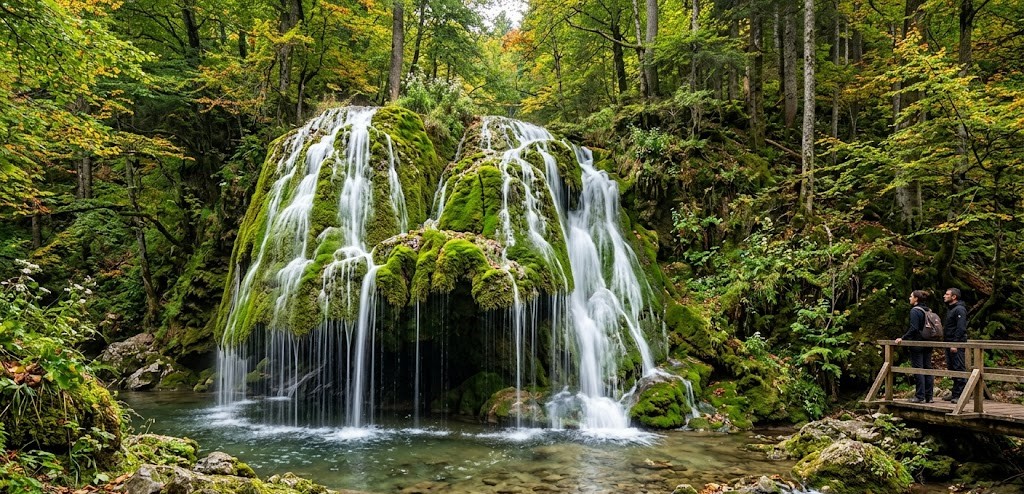
The waterfall is fed by the Modăvița stream and flows over a massive, rounded limestone formation entirely covered in emerald-green moss.
- The Karst Phenomenon: Similar to other Banat waterfalls, it is a "tufa" (travertine) waterfall. The calcium-rich water continuously deposits minerals, literally "growing" the rock over centuries.
- Flora: The surrounding area is dominated by dense beech and oak forests, creating a microclimate that keeps the moss vibrant even in drier seasons.
- A Seasonal Chameleon: In spring or after heavy rains, the waterfall is a roaring, wide curtain of white foam. In dry summers, it transforms into delicate, silver threads, revealing the intricate lace-like structure of the mossy rock behind it.
The "Altar" and Local Perspective
Locals often describe Modăvița as an "Altar of Nature." Unlike waterfalls that drop into deep pools, Modăvița spreads its waters across a wide, irregular face, creating a visual effect that resembles a stepped sanctuary.
The Legend of Silence: While many Romanian waterfalls have tragic legends of lovers like Bigăr waterfall (see more), Modăvița is known in local lore as a place of healing and "clean energy." It was said that shepherds would bring their flocks near these waters to calm them, believing the sound of Modăvița has a unique frequency that clears the mind.
Fun Facts for the Curious Traveler
- The Easy Discovery: Despite its wild appearance, it is incredibly accessible. It sits just 40-50 meters away from the DC49 road connecting Moldova Nouă to Padina Matei.
- Double Wonder: Just 2 kilometers away, on the same route, you can find the Burăul Mare Waterfall (see more), making this valley a "two-for-one" destination for waterfall hunters.
- Educational Hub: The waterfall is frequently used as an "outdoor classroom" by park rangers to teach students about geology and how limestone shapes the landscape of the Banat.
- Location: Caraș-Severin County, near the village of Padina Matei.
- Height: Approximately 20 meters.
- Access: Easy (a short 2-minute walk from the roadside).
- Geology: Travertine (calcareous tufa) formation.
- Proximity: ~8.5 km from Moldova Nouă.
Frequently Asked Questions: Modăvița Waterfall
Where is Modăvița Waterfall located?
The waterfall is situated in Caraș-Severin County, in the southern part of the Banat region. It lies within the Iron Gates National Park (Parcul Național Porțile de Fier), along the road (DJ49) that connects the town of Moldova Nouă to the village of Padina Matei.
How do I get there?
By Car: It is roughly a 15-minute drive (approx. 9 km) from Moldova Nouă. The road is asphalted and in good condition.
By Foot: You don't need to hike! The waterfall is located just 40-50 meters off the main road. You can park your car on the shoulder and reach the base of the falls in less than 2 minutes.
When is the best time to visit?
Spring (March–May): This is the peak season. Due to melting snow and spring rains, the water volume is at its highest, creating a massive "liquid curtain."
Winter: If the temperatures drop enough, the waterfall freezes into spectacular ice organ pipes, making it a favorite for photographers.
Summer: The flow is gentler, but the moss is at its most vibrant green.
Is there an entrance fee?
No. Unlike some other famous waterfalls in Romania, visiting Modăvița is free of charge, and there are no opening hours—nature is open 24/7.
What should I wear?
Since you are right next to the road, casual clothing is fine. However, if you want to get close to the mossy base or climb slightly higher to see the spring (a 10-minute walk upstream through the beech forest), waterproof shoes with good grip are recommended as the limestone rocks can be very slippery.
Are there facilities nearby?
The area is wild and undeveloped. There are no restaurants or shops at the waterfall itself. For food and supplies, it is best to stop in Moldova Nouă or Oravița. It’s a perfect spot for a quick picnic, provided you leave no trace behind.
What else can I see in the area?
Burăul Mare Waterfall: Located just 1–2 km further down the same road. It’s taller and has a completely different "vibe."
The Danube Gorge (Clisura Dunării) (see more): Only a few minutes away, offering stunning views of the Danube River and the Serbian shore.
Gaura cu Muscă Cave (see more): A nearby cave with historical importance and a unique ecosystem.
