
The Spirit of the Peaks: Legends and Lore
The Locva Mountains are steeped in the folklore of the Banat. One of the most enduring stories involves the legend of the "Giant's Footprint." Locals tell tales of ancient giants who once stepped across the Danube, using the Locva peaks as mere stepping stones.
Another layer of mystery comes from the "Zburător"—a folkloric being described as a handsome, wandering spirit or a flying dragon that visits the villages at night. In the deep, limestone valleys of Locva, the whistling wind through the caves is often attributed by elders to these restless spirits guarding hidden Dacian treasures buried within the karst.
A Biodiversity Hotspot
The proximity to the Danube creates a unique microclimate that allows Mediterranean and Balkan species to thrive here.
- Flora: You can find the Banat Peony and various species of wild orchids. The forests are a dense mix of beech, oak, and the rare Turkish hazel.
- Fauna: This is one of the few places in Romania where you might spot the Horned Viper (Vipera ammodytes) (see more) sunning itself on limestone rocks. Birdwatchers frequently visit to see the Egyptian Vulture or the Golden Eagle soaring above the Danube Gorges (see more).
- The Cave Life: The mountains are riddled with caves that house some of Europe's most diverse bat colonies.
- The Sun’s Reflection: Because of the specific angle of the limestone cliffs facing the Danube, the "Iron Gates" area near the Locva Mountains receives a level of solar radiation that makes it feel much warmer than the rest of Romania—almost like a sub-tropical pocket.
- Village Life: Many villages in the area, like Sfânta Elena, are inhabited by ethnic Czechs (Pemi), who have preserved their unique language and 19th-century traditions for over 200 years.
- Underwater History: Beneath the surface of the Danube, at the foot of these mountains, lie the remains of the island Ada Kaleh, a "sunk Atlantis" that was once an Ottoman enclave.
- Highest Peak: Cornetu Mare (735 meters)
- Geology: Primarily Limestone, Crystalline Schists, and Magmatic Rocks
- Location: Caraș-Severin County, inside the Iron Gates Natural Park
- Climate: Moderate Continental with sub-Mediterranean influences
- Access Points: Moldova Nouă, Pojejena, or Sfânta Elena
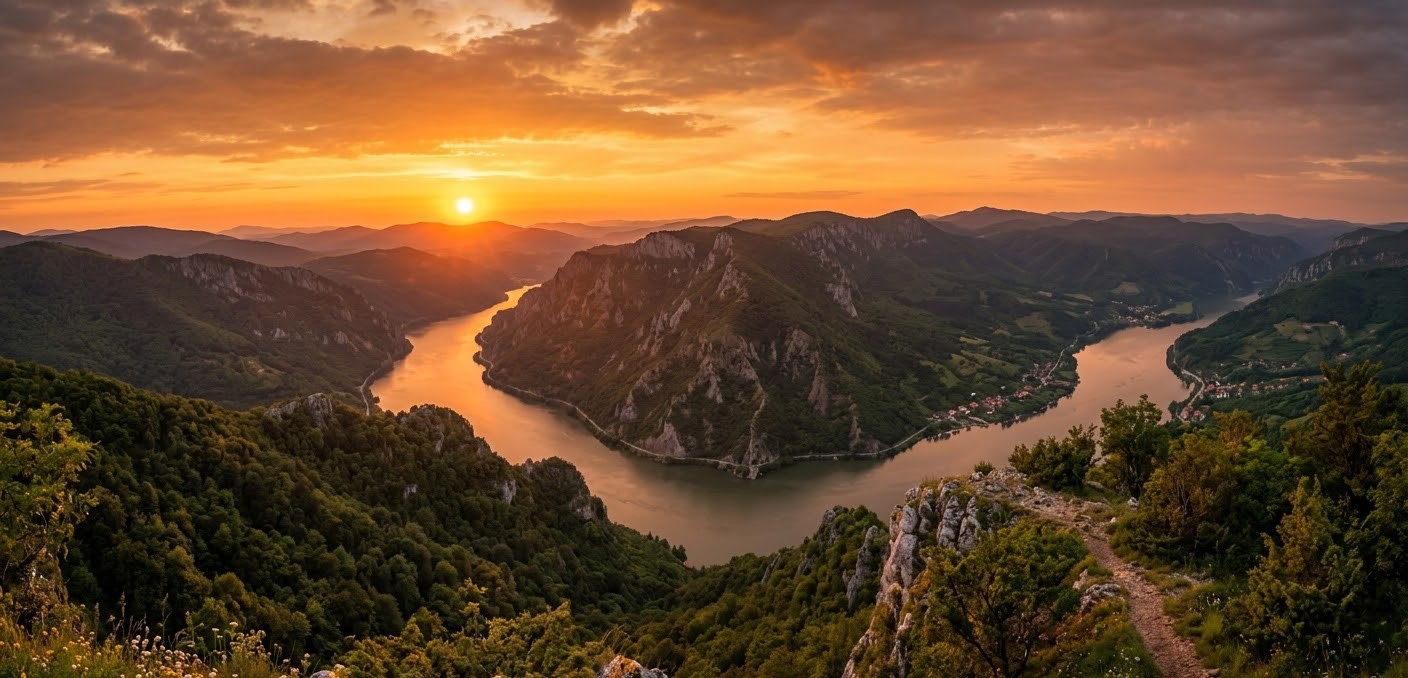
The Locva Mountains are perfect for those who prefer "Slow Travel." It is not about conquering high altitudes; it is about hiking through wild meadows, discovering karst springs, and looking down at the massive blue vein of the Danube from a quiet, limestone ridge.
A video which present Romanian tourists hiking in Locva Mountains (Munții Locvei):
Frequently Asked Questions: Locva Mountains
1. Where are the Locva Mountains located?
The Locva Mountains are situated in southwestern Romania, in Caraș-Severin County. They form part of the Banat Mountains and are bordered by the Danube River (see more) to the south and west, creating the famous Iron Gates Natural Park.
2. How high are these mountains?
They are considered low-altitude mountains. The highest point is Cornetu Mare, reaching 735 meters. This makes them ideal for hiking throughout the year, as they don't have the extreme alpine conditions of the Southern Carpathians.
3. What is the best time to visit?
Spring (May-June) and Autumn (September-October) are the best times. In spring, the wild peonies and orchids are in bloom. In autumn, the limestone cliffs provide a stunning contrast against the rusty colors of the beech forests and the deep blue of the Danube.
4. Are there any dangerous animals?
The area is known for the Horned Viper (Vipera ammodytes). While they are shy and usually flee from humans, hikers should wear high boots and stay on marked paths. You might also encounter wild boars or deer in the denser forest areas.
5. Can I see the Danube from the peaks?
Yes! One of the biggest draws of the Locva Mountains is the panoramic view of the Danube Gorges. From several viewpoints near the villages of Sfânta Elena or Moldova Nouă, you can see across the river into Serbia.
6. Is it a good place for cultural tourism?
Absolutely. The region is a melting pot of cultures. You can visit villages inhabited by the Czech minority (Pemi), such as Sfânta Elena, where the locals have preserved their 19th-century language and customs.
7. What are the most popular activities?
- Hiking: Easy to moderate trails.
- Birdwatching: The area is a corridor for migratory birds.
- Caving: There are numerous small, wild caves in the limestone sections.
- Photography: Especially at sunrise or sunset over the Danube.
