
The Legend of the "Guardian of the Stone"
Locals from Casa de Piatră tell stories of a mountain spirit that guards the waters disappearing into Coiba Mică. It is said that this spirit decides how much water to release to the villages in the valley below. On stormy nights, the roaring sound of the water crashing against the narrow cave walls is believed to be the voice of the mountain, warning hikers to stay away. Ancient folklore also suggests these caves were the last refuges for giants, who used the monumental portals as gateways to their hidden underground cities.
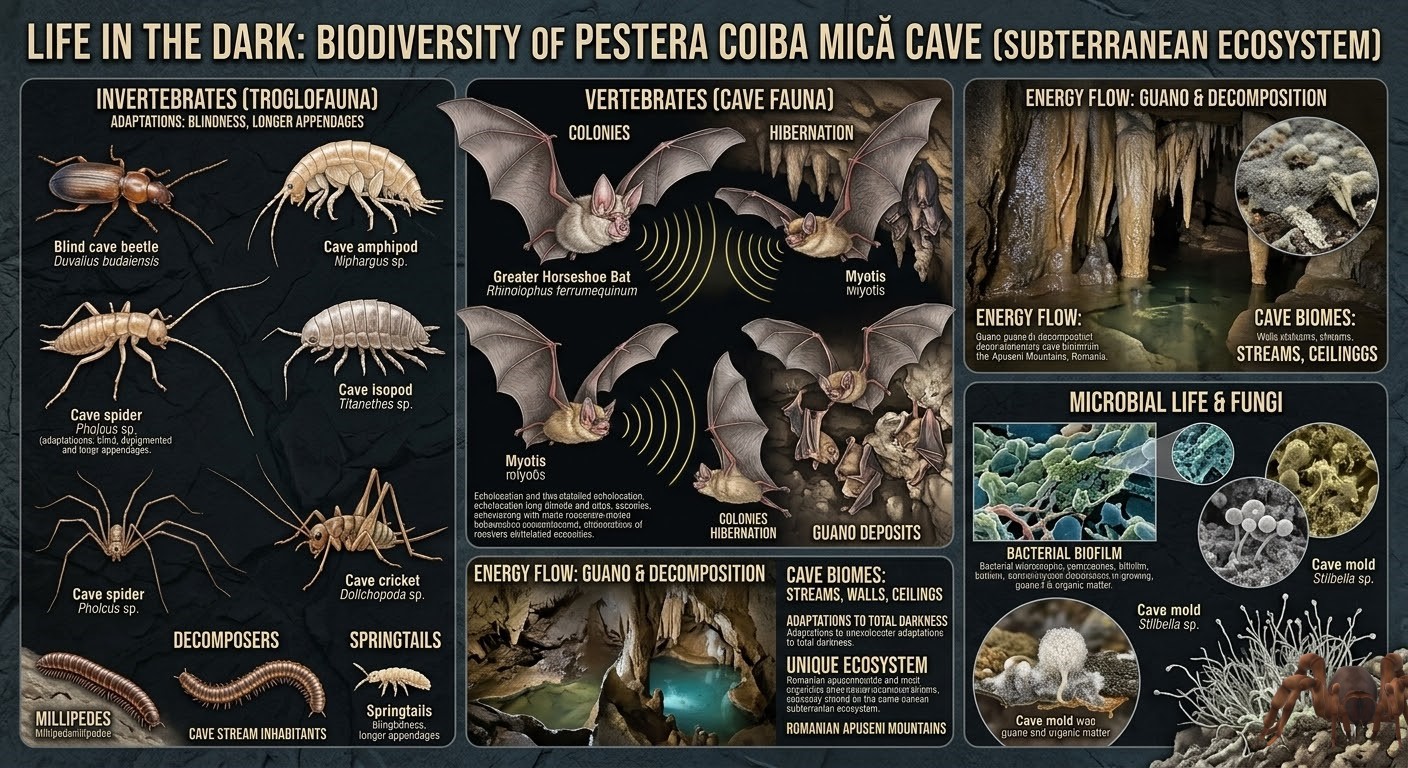
Biodiversity: Life in the Dark
Despite the harsh, damp environment, the cave shelters a discreet and fascinating ecosystem:
- Cave Fauna: The cave is a vital sanctuary for several bat species that rely on the constant temperature and absolute silence of the inner galleries.
- Adapted Microorganisms: In the small pools formed within the cave, specialized species of tiny underground crustaceans can be found, perfectly adapted to total darkness.
- Portal Vegetation: Due to the high humidity, the cave’s entrance is draped in rare mosses and ferns that thrive in the cool shade, creating a vibrant green frame against the white limestone.
- The Water Swallower: Coiba Mică acts as a massive natural siphon. The waters of the Gârda Seacă stream are literally "swallowed" by the rock here, only to reappear on the surface kilometers away.
- The Underground Mystery: The cave is hydrogeologically connected to the Coiba Mare system, forming a complex labyrinth of flooded galleries that still hide many secrets from speleologists.
- Spring Ice: Because of its "cold-trap" shape, the cave retains cold air for a very long time; it’s not uncommon to find ice formations near the entrance even in early summer.
- Location: Gârda de Sus, Alba County (Apuseni Mountains)
- Type: Active cave (contains a permanent water course)
- Difficulty: The entrance is accessible for photos, but exploring the interior is for experts only due to the high risk of flash floods.
- Proximity: Located just a few hundred meters from the larger Coiba Mare cave (see more).
Frequently Asked Questions: Coiba Mică Cave
1. Where is Coiba Mică Cave located? The cave is situated in the Apuseni Mountains (Bihor Mountains) (see more), specifically in the Casa de Piatră hamlet, Gârda de Sus commune, Alba County.
2. How does Coiba Mică differ from Coiba Mare? While Coiba Mare has a wider, more monumental portal, Coiba Mică is famous for its narrower, more dramatic entrance where a stream is actively "swallowed" by the earth. It is considered more technically challenging and dangerous for explorers than the main chambers of Coiba Mare.
3. Is it safe to enter the cave? Visiting the portal (entrance) is safe and highly recommended for photography. However, entering the cave galleries is extremely dangerous and should only be done by professional speleologists. The cave is a "swallow hole," meaning it can flood entirely within minutes during a rainstorm.
4. What is the best time of year to visit? Late spring and summer are the best times. In early spring, you can often see ice remaining at the entrance due to the cave's microclimate. Avoid visiting during heavy rain, as the access trail and the cave entrance become very slippery and prone to flooding.
5. Do I need a guide to find it? The cave is located near a well-known trail, but the area is remote. While a guide isn't strictly necessary to reach the entrance, having one is recommended if you want to learn more about the complex hydrographic system of the Gârda Seacă valley.
6. Are there other attractions nearby? Yes, the area is a karst paradise. Within walking distance or a short drive, you can visit Coiba Mare Cave, Huda Orbului, Ghețarul de la Vârtop (Vârtop Ice Cave), and the stunning Tauz Spring, where the water swallowed by Coiba Mică finally resurfaces.
