
The Legend: The Poet’s Silent Witness
Legend says that Mihai Eminescu, the "Morning Star" of Romanian poetry, used to walk the alleys of Copou Park and rest beneath this specific linden tree. It was here, amidst the heavy scent of lime blossoms, that he would meet his muse, Veronica Micle, or discuss philosophy with his best friend, the storyteller Ion Creangă.
For over a century, the tree has been a place of pilgrimage for lovers and dreamers, who believe that a wish made under its branches during the flowering season will come true.
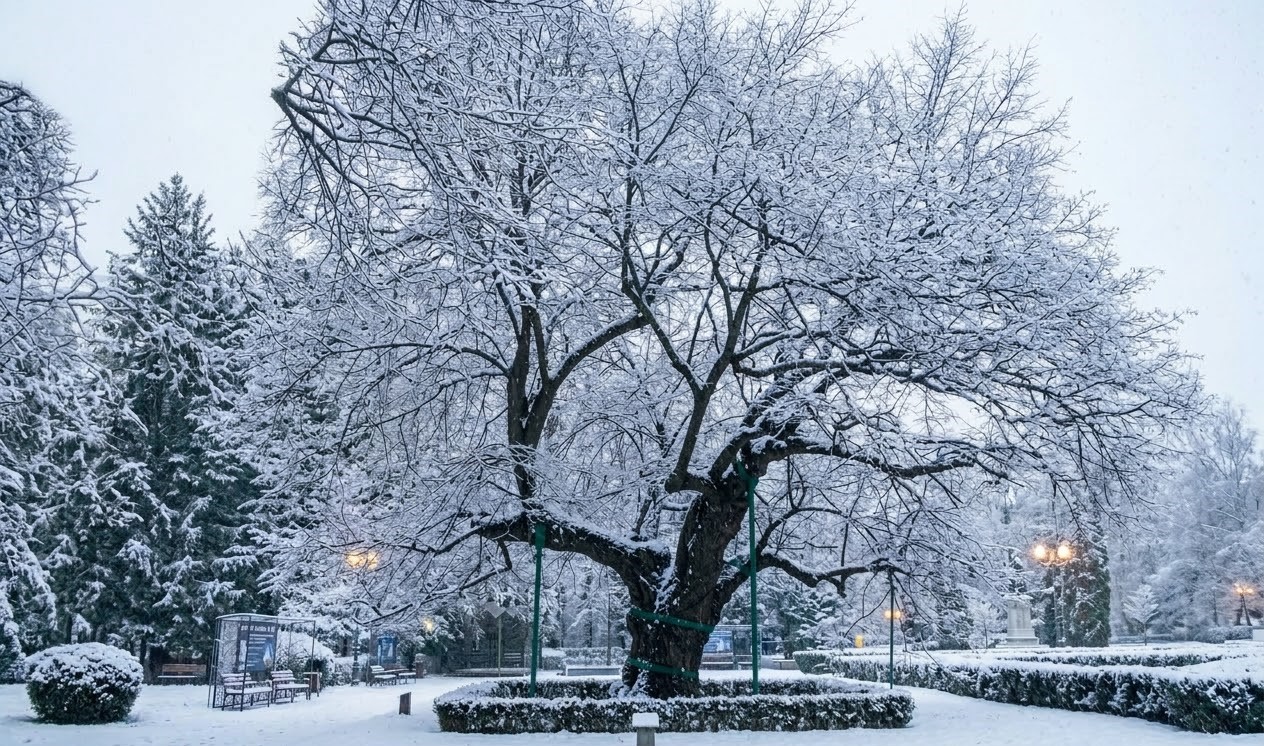
Biodiversity & Survival: A Biological Miracle
This silver lime (Tilia tomentosa) is a survivor.
- Age: It is estimated to be approximately 500 years old, making it one of the oldest trees in Romania.
- Resilience: Throughout the decades, the tree has survived heavy storms, fungal infections, and the passage of time.
- Scientific Care: Today, the tree is kept alive through a unique method: its hollow trunk is reinforced with specialized supports, and its roots are carefully monitored by botanists to ensure its longevity.
- The Scent of Iași: In June, when the linden trees bloom, the entire city of Iași is filled with a sweet, unmistakable perfume. This tree is the "king" of that fragrance.
- Global Recognition: It is one of the most photographed and painted trees in Southeast Europe.
- Cultural Hub: Every year, cultural events and poetry readings take place right next to the tree to celebrate the poet’s legacy.
Location: Copou Park (Parcul Copou), Iași, Moldavia region.
Species: Silver Lime (Tilia tomentosa).
Estimated Age: 500 years.
Status: Natural and Cultural Monument of Romania.
A nice video presenting Eminescu’s Linden Tree (Teiul lui Eminescu):
Frequently Asked Questions: Eminescu’s Linden Tree (Teiul lui Eminescu)
1. Is the tree still alive after 500 years?
Yes, the tree is still biologically active. Although its trunk is hollowed by age and supported by metal reinforcements, it continues to bloom every year, defying the typical lifespan of its species.
2. When is the best time to see it in bloom?
The most magical time to visit is in mid-June. This is when the silver lime blossoms open, and the entire Copou Park is filled with an incredible, sweet fragrance that has become the "signature scent" of the city of Iași.
3. Why is this specific tree so famous?
It was the favorite spot of Romania's national poet, Mihai Eminescu (see more). He often sat on a bench beneath its branches to write and reflect. For Romanians, the tree is a living link to their greatest literary figure and a symbol of romanticism.
4. Where exactly is it located?
The tree is located in Copou Park (Parcul Copou) in the city of Iași, in northeastern Romania. It is easy to find, as it is situated in the heart of the park and marked by a nearby bust of the poet.
5. Are there any fees to visit?
No, entrance to Copou Park is free. It is a public space where you can enjoy the gardens, visit the small Eminescu Museum nearby, and see the tree at any time of the day.
6. Can I sit under the tree like the poet did?
While there are benches nearby, the area immediately around the trunk is protected by a small fence to preserve the roots and prevent soil compaction. You can still get very close to admire its ancient bark and massive canopy.
7. What else should I see in Copou Park?
Besides the Linden Tree, you should see the "Obelisk of Lions" (the oldest public monument in Romania) and the various statues of famous Romanian writers that line the park's alleys.
