
The Last Great Romantic of Europe
Eminescu is considered the last great representative of European Romanticism. His poetry explores universal themes through a deeply Romanian lens:
- The Infinite and the Cosmos: In his masterpiece, "Luceafărul" (The Morning Star), he tells the story of an immortal being who falls in love with a mortal princess, exploring the tragic gap between genius and the common man.
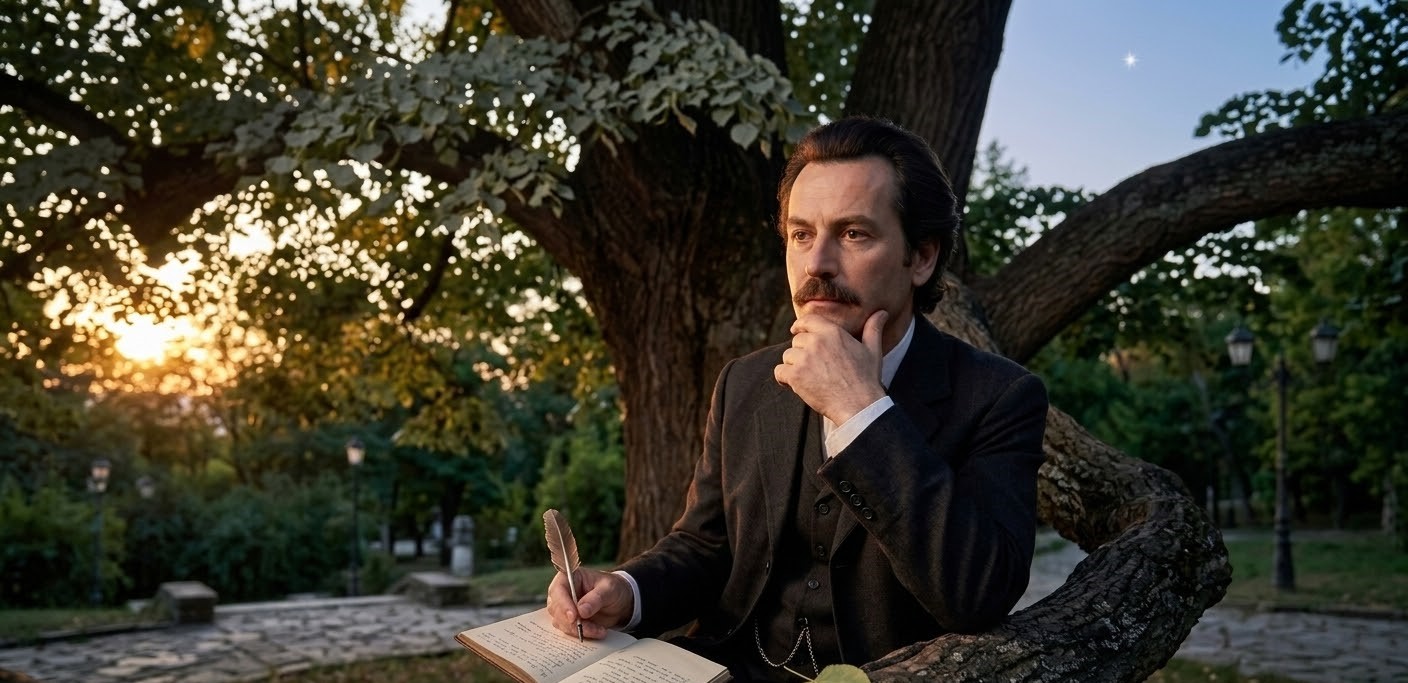
- Nature and Love: His poems often feature the serene landscapes of the Romanian forests, the silver light of the moon, and the "ancient" linden trees (teiul) (see more), which became a symbol of his lyrical world.
- Deep Nostalgia (Dor): Eminescu captured the unique Romanian feeling of dor—a complex blend of longing, nostalgia, and love—better than anyone else in history.
Beyond his poetry, Eminescu was a brilliant intellectual:
- Philosophical Roots: He was deeply influenced by German philosophy (Schopenhauer and Kant) and ancient Indian texts, which he integrated into his verses.
- National Identity: As a journalist, he was a fierce defender of Romanian identity and culture, working tirelessly to define what it meant to be Romanian in a rapidly changing 19th-century Europe.
The Legend of the Two Friends
The friendship between the melancholy, brilliant Eminescu and the boisterous, witty Creangă is one of the most touching stories in our history. They were opposites who completed each other—Eminescu gave Creangă the confidence to write, while Creangă gave Eminescu a place of warmth and laughter at his humble "Bojdeuca" cottage.
Biography: Mihai Eminescu – The Architect of the Romanian Language
1. Early Life and Origins
- Born: January 15, 1850, in Botoșani (though he spent much of his childhood in Ipotești).
- Roots: He was the seventh of eleven children born to Gheorghe Eminovici, a minor nobleman (căminar).
- Childhood: Much like his friend Creangă, Eminescu was deeply attached to the nature of Northern Moldavia. His early experiences in the vast forests and by the quiet lakes of Ipotești later became the foundational imagery of his poetry.
- Cernăuți: He began his studies at the National Hauptschule in Cernăuți, where he was mentored by the scholar Aron Pumnul.
- The Wanderer: At a young age, he left school to join various theater troupes as a prompter and actor, traveling across all Romanian provinces (Transylvania, Wallachia, and Moldavia), which gave him a deep understanding of the unified Romanian spirit.
- University Years: He studied Philosophy and Law in Vienna (1869–1872) and Berlin (1872–1874). It was in Vienna where he met the love of his life, the poet Veronica Micle, and his lifelong friend, Ioan Slavici.
- The Junimea Circle: Upon returning to Romania, he moved to Iași, where he joined the influential literary society Junimea. Here, he worked as a librarian, school inspector, and editor of the newspaper Curierul de Iași.
- Journalism: In 1877, he moved to Bucharest to become the editor-in-chief of Timpul, the official newspaper of the Conservative Party. His political articles were fierce, brilliant, and deeply patriotic, often criticizing the social injustices of the era.
- Health Struggles: In 1883, at the age of 33, Eminescu suffered the first major breakdown of his mental and physical health. He spent the following years in and out of sanatoriums in Romania and abroad.
- Passing: He died on June 15, 1889, in a clinic in Bucharest. He is buried in the Bellu Cemetery, under a weeping willow, near the "Writer's Alley."
How it Began
They met in 1875 in Iași, while Eminescu was working as a school inspector. At the time, Creangă was a simple teacher and a former deacon, known for his incredible talent for telling stories but having written almost nothing.
Eminescu was the first to recognize that Creangă’s spoken words were, in fact, high literature. He famously told him: "Creangă, you are a great writer! You must write down everything you tell us."
The "Bojdeuca" Sanctuary
Creangă lived in a very humble, two-room cottage in the Țicău neighborhood, which he called his "Bojdeuca." This became Eminescu’s sanctuary.
Whenever the poet was exhausted by the noise of the city or his grueling work as a journalist, he would flee to Creangă’s cottage.
There, they would sit on the wooden porch, eating traditional Moldavian food, drinking a glass of wine, and talking about philosophy, folklore, and life until the sun came up.
A Tragic Parallel
Their bond was so deep that their lives ended almost simultaneously.
- When Eminescu passed away on June 15, 1889, Creangă was devastated. He was seen crying like a child, unable to accept that his "Bădie Mihai" (his dear brother Mihai) was gone.
- Broken by grief and his own failing health, Ion Creangă followed his friend to the afterlife only six months later, on December 31, 1889.
(A Fragment by Mihai Eminescu)
I have but one desire left:
That in the silence of the night
To let me die
Beside the sea,
Where waves are breaking on the shore...
And over me the branches weave
A leafy bower of green.
The stars above
Shall brightly shine,
A distant lamp for me...
FAQ: Mihai Eminescu – The Eternal Voice of Romania
1. Why is he called "The Morning Star" (Luceafărul)?
The title comes from his masterpiece, "Luceafărul", one of the longest and most famous love poems in world literature (98 stanzas). In the poem, the Morning Star represents the absolute genius—immortal but lonely—who falls in love with a mortal princess. This name has since become a synonym for Eminescu himself, symbolizing his unmatched brilliance in the Romanian literary sky.
2. What is "Eminescu’s Linden Tree" (Teiul lui Eminescu) (see more)?
Located in Copou Park, Iași, this silver linden tree is over 500 years old and is the most famous tree in Romania. Eminescu used to sit under its branches to find inspiration for his poems. To this day, it is a site of "pilgrimage" for lovers and tourists, and it is a living symbol of the poet’s connection to nature.
3. What was his relationship with Ion Creangă?
They were the best of friends, despite being very different. Eminescu was the intellectual, melancholy dreamer, while Creangă was the jovial, earthy storyteller. It was Eminescu who recognized Creangă's genius and encouraged him to write his "Childhood Memories." Their friendship represents the perfect union between high philosophy and folk wisdom.
4. Is National Culture Day related to him?
Yes. Romania celebrates National Culture Day on January 15th, which is Mihai Eminescu's birthday. This choice honors his role in modernizing the Romanian language and his immense influence on all aspects of Romanian art and thought.
5. What are the main themes of his poetry?
Eminescu’s work is a blend of European Romanticism and deep philosophical inquiry. His main themes include:
- The Cosmos: Stars, the moon, and the birth of the universe.
- Nature: The "ancient" Romanian forests and quiet lakes.
- History: A nostalgia for the glorious past of the Romanian ancestors.
- Love: Often portrayed as a fragile, lost, or impossible dream.
His notebooks, containing over 14,000 pages of handwritten poetry, prose, and philosophical notes, are kept at the Library of the Romanian Academy. They are considered a national treasure and show the immense hard work behind his seemingly effortless verses.
