
The Legend of the Killer Lake
The lake's original name was "Lacul Ucigaș" (The Killer Lake). According to local folklore, during the massive storm that caused the mountain to collapse, a group of shepherds and their entire flock were resting in the valley below. They were buried alive by the landslide, and it is said their blood turned the waters red, giving the lake its chilling name and unique color.
Another legend tells of a beautiful girl named Estera who was kidnapped by an outlaw. She prayed to the mountains for rescue; the rocks shattered in a violent storm, burying both the captor and the girl, and the lake formed over their final resting place.
Biodiversity: Life Among the Stumps
- The ecosystem of Lacul Roșu is shaped by its high mineral content and the unique geological event that created it.
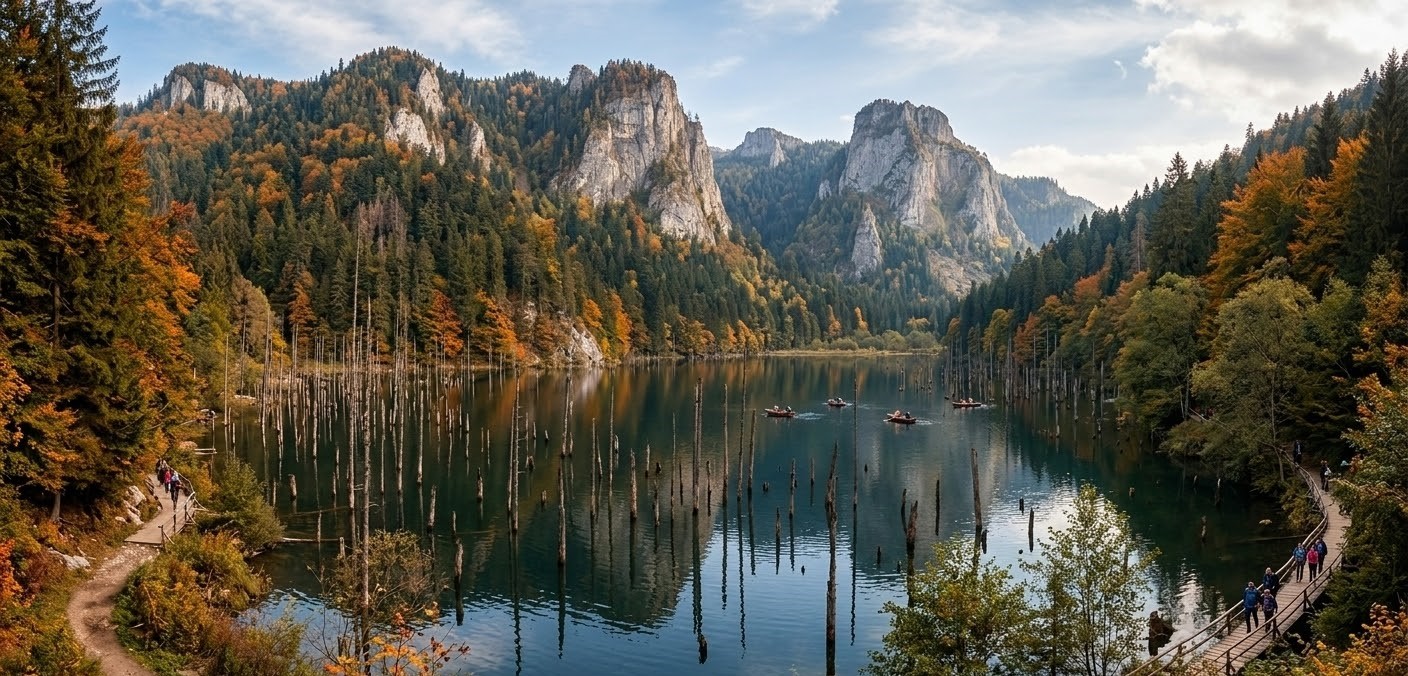
- The Petrified Forest: The most striking feature is the forest of spruce stumps. Because the water is rich in calcium carbonate and iron oxides, the wood has been "mineralized" rather than rotting, allowing the trunks to stand for nearly two centuries.
- Aquatic Life: The lake is a habitat for common trout and various species of mountain crustaceans that thrive in the cool, mineral-rich waters.
- Surrounding Flora: The lake is framed by the Hasmasu Mare mountains, where you can find rare orchids and dense pine forests that reflect perfectly on the water's surface.
Fun Facts for the Curious
- The Accidental Lake: It wasn't formed by a glacier or a volcano, but by a massive earthquake in 1837 that caused the Ghilcoș Mountain to slide and block the Bicaz River.
- A Natural Time Capsule: The lake is slowly filling with sediment. Scientists estimate that in a few centuries, the lake might disappear entirely, becoming a marshy meadow.
- The Color Shift: While it doesn't always look bright red, the lake often takes on a reddish-brown or purple hue after heavy rains, when the iron-rich soil from the surrounding slopes is washed into the basin.
- Formation Year: 1837.
- Altitude: 983 meters.
- Maximum Depth: 10.5 meters (though this varies due to sedimentation).
- Surface Area: Approximately 11 hectares.
- Water Source: Fed by four main streams, including the Verescheu and Licaș.
Frequently Asked Questions: The Red Lake (Lacul Roșu)
Why is it called the "Red Lake"?
The name comes from the reddish-purple iron oxides and silicates carried into the lake by the Verescheu stream, especially after heavy rains. The iron-rich soil from the surrounding "Ghilcoș" (Killer) mountain washes into the basin, occasionally giving the water its distinct tint.
What are the tree stumps sticking out of the water?
Those are the remains of a spruce forest that was flooded when the lake was formed in 1837. A massive landslide blocked the valley, and the rising water trapped the trees. Because the water is rich in calcium and iron, the wood became mineralized, preventing it from rotting for nearly 200 years.
Can I go boat rowing on the lake?
Yes, boat rowing is the most popular activity at Lacul Roșu. You can rent a small rowing boat and navigate between the ancient tree stumps. It is a unique experience, but you must be careful not to hit the wood pillars just below the surface.
Is it safe to swim in the Red Lake?
Swimming is strictly discouraged and often prohibited. The main danger comes from the sharp, petrified tree trunks hidden underwater, which can cause serious injury. Additionally, the water temperature remains quite low even in summer.
How did the lake actually form?
It is a natural dam lake. In July 1837, following a series of heavy storms and an earthquake, a large portion of Mount Ghilcoș collapsed, sliding down and creating a natural wall across the Bicaz River valley.
When is the best time to visit for photography?
The "Golden Hour"—just after sunrise or before sunset—is best. During autumn, the contrast between the white limestone peaks, the colorful forest, and the dark water with its vertical stumps is particularly dramatic.
Are there hiking trails around the lake?
Yes, there is a very accessible path that goes entirely around the lake (about 5 kilometers). It takes roughly 1 to 1.5 hours to complete and offers multiple perspectives of the sunken forest and the surrounding Suhardu Mic peak.
