
Technical Details
- Location: Roșia village, Bihor County - Pădurea Craiului Mountains.
- Length: 251 meters (including mine galleries and the natural cave section).
- Temperature: A constant 9°C to 12°C year-round.
- Geology: It is a geode cave discovered by accident in 1987 during mining operations.
- Altitude: Situated at approximately 375 meters on Farcu Hill.
- While the cave is famous for its minerals, it is also a quiet refuge for specialized mountain life.
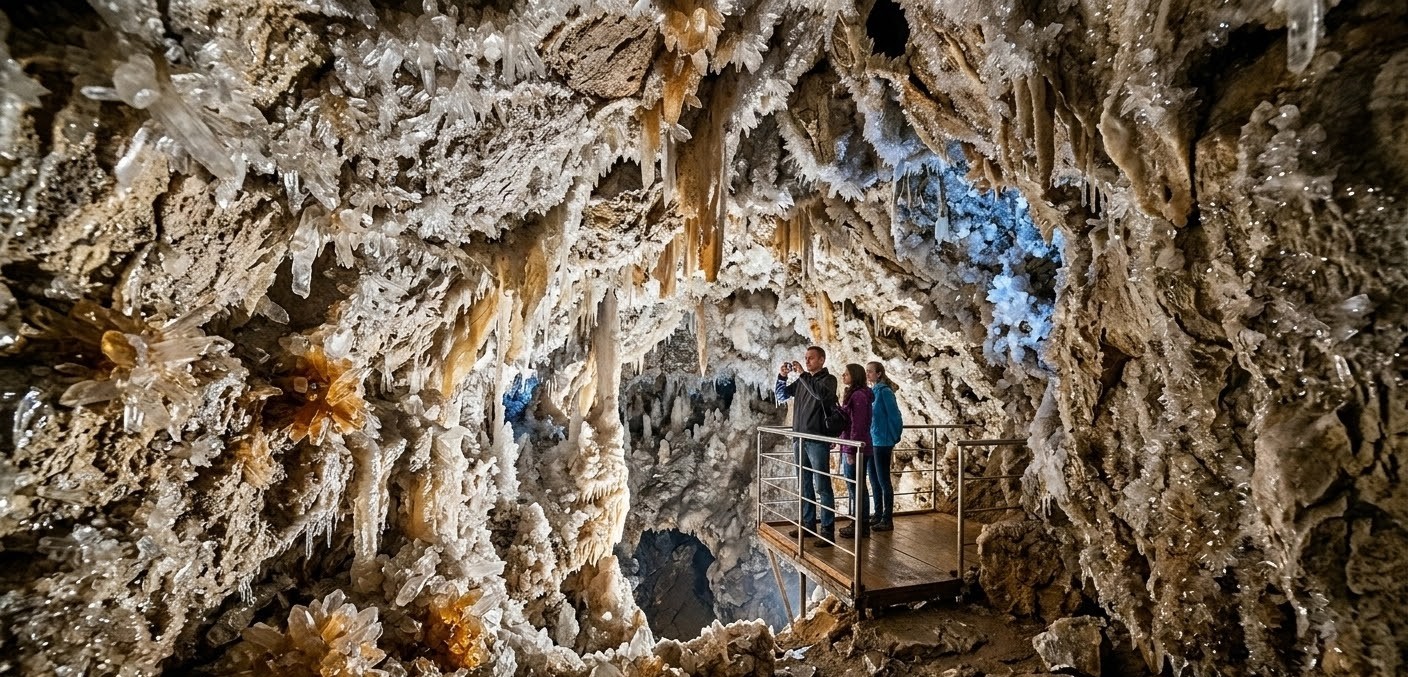
- The "Lace-wing" Crystals: While not biological, the "Crystal Dragonflies" (Libelulele de cristal) are delicate formations that look so lifelike they were named after the insects.
- Bat Sanctuary: The cave is home to several colonies of bats (see more). During the winter months, you can see them hanging from the ceiling in hibernation. They are highly sensitive to body heat, so visitors are asked to keep a respectful distance.
- Fragile Growth: Calcite crystals here grow at an incredibly slow rate: about 1 millimeter every 25 years. This means a 1-centimeter crystal took 250 years to form!
Legends and Modern History
Unlike ancient caves with millenia-old folklore, Farcu has a "modern legend" rooted in mystery and survival.
The Sealed Treasure: After its discovery in 1987, the cave was unfortunately vandalized by those seeking to sell the crystals. However, shortly after, the mine ceiling collapsed naturally, "sealing" the cave away from humans for nearly 25 years. Locals believe the mountain itself chose to protect its heart until people were ready to value it as a monument, not a commodity.
The Good Luck Charm: There is a popular local belief that a visit to the Farcu cave brings good luck for the upcoming year, as the crystals are said to "absorb" negative energy and leave the visitor feeling recharged.
Fun Facts & Curiosities for Foreigners
- One of Two: This is the only cave of its kind in Romania and one of only two in the entire world accessible to the general public (the other is in Asia).
- The Mining Museum: Before you reach the crystals, you walk through a section of the old Farcu mine, which has been turned into a museum. You can see authentic bauxite mining equipment and tools used by Romanian miners in the 20th century.
- The Glass Balcony: The tour ends at a suspended balcony where you can look down into a 70-meter deep abyss—a thrilling view of the cave's vertical scale.
- "Macaroni" Stalactites: You will see long, thin, hollow formations that look exactly like glass pasta. Some of these reach lengths of up to 1.5 to 2 meters.
It is a rare chance to see a "living geode." Because the access is through a former mine, it combines the industrial history of Romania with the fragile, shimmering beauty of nature. It’s an easy, 25-minute guided tour that leaves a lasting impression.
A nice video from Romanin tourist which present the interior of Farcu Crystal Cave (Peștera cu Cristale din Mina Farcu):
Frequently Asked Questions: Farcu Crystal Cave
1. How do I get to the cave?
The cave is located near Rosia village in Bihor County. From the center of the village, follow the road signs for about 3 kilometers. The road is asphalted and accessible by any standard car.
2. Is the cave suitable for children or seniors?
Yes! The cave is well-lit with modern LEDs and equipped with safe stairs and metal railings. The tour is relatively short (about 25-30 minutes) and not physically demanding, making it a favorite for families.
3. What is the temperature inside?
The temperature remains constant year-round, between 9 and 12 degrees Celsius. Even if you visit in the middle of summer, we highly recommend bringing a light jacket and wearing closed-toe shoes.
4. Can I touch the crystals?
No. Touching the crystals is strictly prohibited. The oils from human skin can stop the crystals from growing and cause them to turn black over time. We must keep them pristine for future generations.
5. Do I need a professional guide?
Entrance is only permitted with a local guide (included in the ticket price). They will lead you through the mining museum first and then into the natural crystal chamber, explaining the history and geology of the site.
6. Can I take photos?
Yes, photography is allowed and encouraged! However, please avoid using a powerful flash near the bat colonies, as it can disturb them during their rest.
7. Is there a souvenir shop?
Yes, there is a small shop near the entrance where you can buy local crafts from the Rosia region and small mineral samples (not from the cave itself, as those are protected!).
