
A Natural Masterpiece
What sets Șugău Cave apart from others in Romania is the delicacy of its interior.
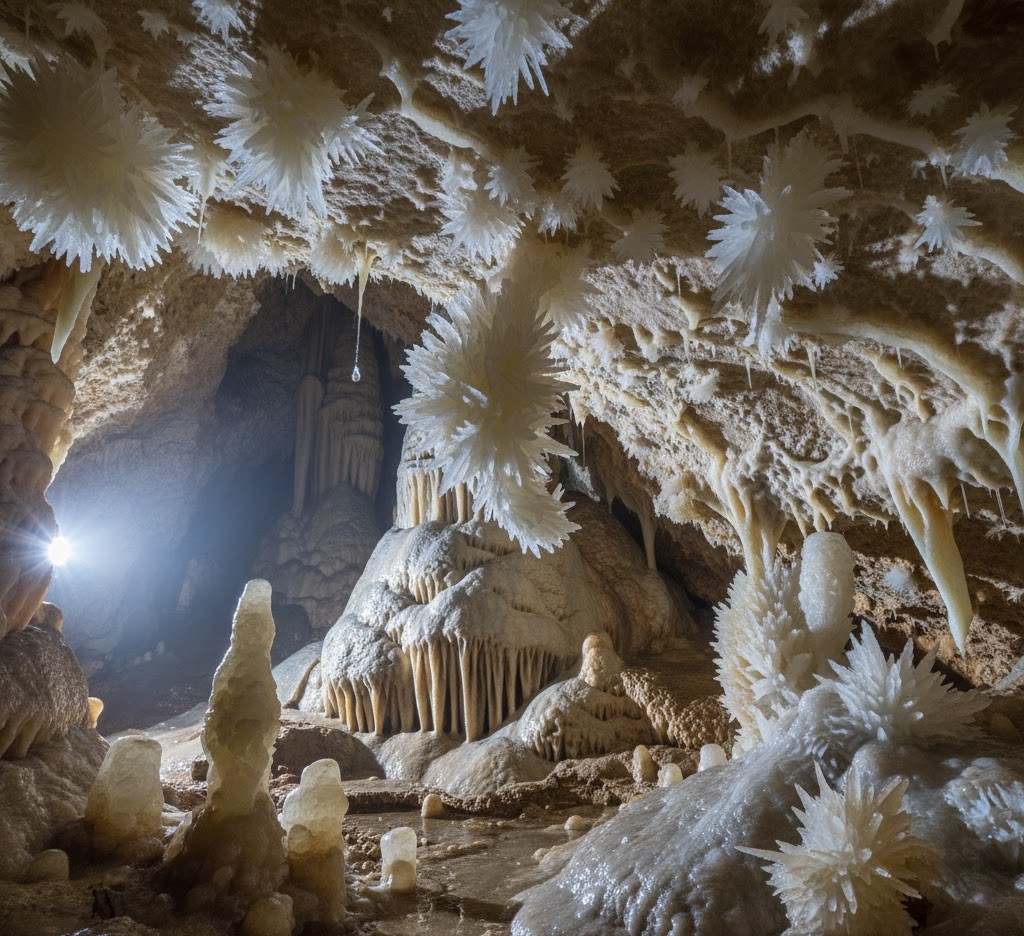
- The Calcite Flowers: The cave is renowned for its "anthodites"—formations that resemble delicate stone flowers or corals. These are extremely fragile and grow over thousands of years in the silent, humid darkness.
- The Gallery of Pillars: Travelers will be amazed by the towering stalactites and stalagmites that meet to form majestic columns, creating the atmosphere of an underground cathedral.
- The Sound of Silence: In the deeper galleries, the only sound you hear is the rhythmic "clink" of water droplets, a process that continues to shape this masterpiece of nature.
The Legend of the Whispering Mountain
The name Șugău isn't just a label; it carries an ancient echo. According to local folklore, the cave is a "living being" that speaks to those who dare to enter.
The Whispering Spirit: Local elders from Voșlăbeni tell stories of the "Whistling Cave." They believed that on windy nights, the mountain would sigh or sing. Scientific minds say it’s just air currents passing through narrow galleries, but legend says it is the Spirit of the Mountain guarding its stone flowers, whispering a warning to anyone who might try to break or steal a piece of the cave's crystal heart.
The Giant’s Jewels: Another legend claims that giants once ruled the Giurgeu peaks and hid their most precious diamonds and pearls in these deep galleries. When the giants vanished, the gods turned their treasures into the Calcite Flowers we see today—ensuring their beauty would remain forever anchored to the rock, where they could be admired but never taken away.
The Golden Spring: Deep within the cave, where the light reflects off the mineral walls, the water appears to turn golden. It was once believed that a traveler who drank from this "Golden Spring" would be granted a long life and the "strength of the stone."
Why It’s Unique for Travelers
- A Protected Sanctuary: To preserve its fragile ecosystem, the cave is not lit with permanent electric lights. Exploring it with a guide and a headlamp offers a true sense of adventure and discovery.
- The Climate: Inside, the temperature remains constant at about 7-9°C year-round, making it a perfect escape from the summer heat or a "warm" refuge during the harsh Giurgeu winters.
- Proximity to the Mureș Springs: Since it's located very close to the source of the Mureș River, travelers can visit both landmarks in a single day trip.
Speleologists consider Șugău a "living" cave because the formation process is still active. Every drop of water filtered through the limestone ceiling adds a microscopic layer of calcite, meaning the cave literally changes every single day, albeit at a pace invisible to the human eye.
A video which present the interior of Șugău Cave (Peștera Șugău):
FAQ: Exploring the Șugău Cave (Peștera Șugău)
1. Why is Șugău Cave considered a "monument of nature"?
It is protected due to its extraordinary mineral wealth. It houses rare formations called anthodites (calcite flowers) and helictites, which are much more delicate and complex than the usual stalactites. Because of this, it is one of the most strictly preserved caves in the Eastern Carpathians.
2. Is the cave illuminated for tourists?
No, and this is intentional. To prevent the growth of "lampenflora" (algae and moss that grow around artificial lights and damage the stone), there is no permanent lighting. Visitors use headlamps, which creates a more authentic and mysterious underground experience.
3. How long does a typical tour take?
A guided tour usually lasts between 45 and 60 minutes. This allows enough time to explore the main galleries, like the "Music Hall" or the "Palace Gallery," while hearing about the geological history of the mountain.
4. Can I take photos inside the cave?
Yes, photography is usually allowed, but flash photography may be restricted in certain areas to protect the environment. Also, you must be extremely careful not to touch any formations while trying to get the perfect shot; even a light touch can stop a stalactite's growth forever.
5. How do I get to the cave entrance?
The cave is located near the village of Voșlăbeni. There is a marked forest road that leads toward the mountain. While cars can get close, a short hike through a beautiful forest is required to reach the actual entrance, which sits at an altitude of about 1,000 meters.
6. What is the best season to visit?
The cave can be visited year-round. Since the interior temperature is always around 8°C, it feels cool in the summer and surprisingly warm in the winter when outside temperatures in the Giurgeu Depression can drop to -20°C.
