
Prejmer: The Fortress That Never Fell
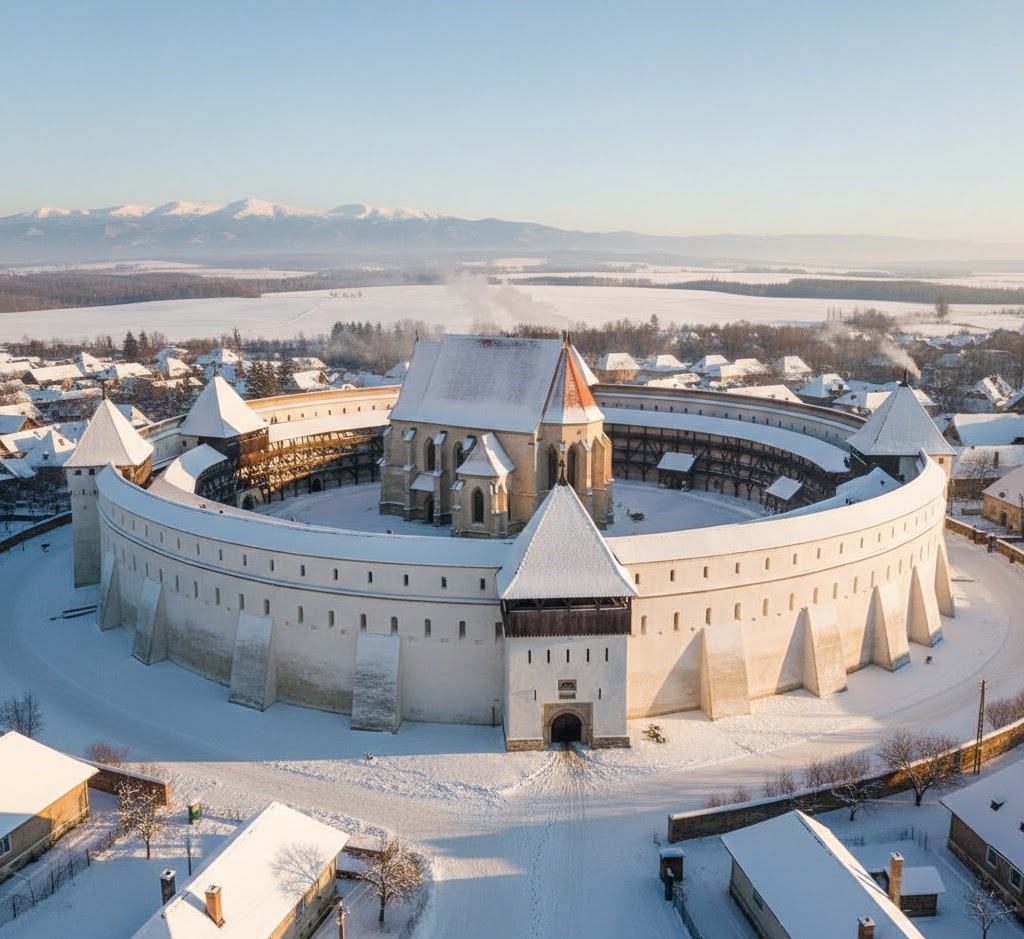
Prejmer (Tartlau) is home to the most powerful fortified church in Southeastern Europe, a UNESCO World Heritage site. Built by the Teutonic Knights and later fortified by the Saxon community, its walls are 5 meters thick and 12 meters high.
- The Hive of Rooms: One of the most unique features is the interior wall, which houses 272 small rooms—one for each family in the village. When the alarm sounded, the entire village moved inside. These rooms also served as classrooms, making it one of the earliest forms of mandatory education in the region.
- The "Organ of Death": Legend says the defenders used a terrifying weapon called the Death Organ. It was a series of muskets that could be fired all at once, creating a continuous wall of fire that made the fortress virtually impregnable. In fact, Prejmer was besieged 50 times and only fell once, but only because the defenders ran out of water!
Hărman: The Guardian of the Spirits
Just down the road is Hărman (Honigberg – "Mountain of Honey"). While smaller, it is equally mystical.
- The Weeping Tower: Hărman is famous for its massive towers. Legend tells of a secret room in the bell tower where those who were exiled or "lost their souls" were kept to pray for forgiveness. Local lore says that on quiet nights, you can still hear the whispers of the past echoing through the stone corridors.
- The Chapel of Hidden Murals: Inside the fortress, you can find a small chapel with 15th-century murals. It is said that the faces of the saints were painted to resemble the villagers themselves, so the community would always feel protected by their ancestors during times of war.

Why You Must Visit
Walking through these fortresses feels like stepping back 500 years. You can climb the narrow wooden stairs, explore the "beehive" rooms, and look through the arrow slits where archers once stood.
A Note on Wildlife & Nature
While these fortresses are located within villages, the surrounding areas of Brașov (Click HERE to see more) are prime wildlife territory. As you travel between these historic sites, remember that wild animals are unpredictable, especially bears which are common in the nearby forests. Always stay on marked paths if you decide to hike nearby.
A beautiful video wich present Prejmer and Harman (Bisericile fortificate Prejmer and Hărman):
Frequently Asked Questions: Prejmer & Hărman:
Q: How far are Prejmer and Hărman from Brașov? A: They are very close and easy to reach. Hărman is about 10 km (15 min drive) and Prejmer is about 15 km (20 min drive) from the center of Brașov. You can easily visit both in a single morning or afternoon.
Q: What is the best time of year to visit? A: These sites are open year-round, but late spring and autumn are the most scenic. During winter, the fortresses look magical under the snow, but keep in mind that the thick stone walls make the interiors very cold—dress warmly!
Q: Are there guided tours available? A: While there aren't always "official" guides waiting at the gate, the staff usually provides brochures in multiple languages (English, German, Romanian). Some rooms in Prejmer are set up as museum exhibits with detailed explanations about Saxon life.
Q: Can I take photos inside? A: Yes, photography for personal use is generally allowed and free of charge. However, if you are using professional equipment or filming for commercial purposes, you should ask for permission at the ticket office.
Q: Is it safe to drive between these villages at night? A: The roads are well-maintained, but please be cautious. As we always emphasize, wild animals are unpredictable; it is common for deer or even bears to cross rural roads in the Brașov area after dusk. Drive at a moderate speed and stay alert.
Q: Are there places to eat nearby? A: Yes, both villages have small local terraces and bakeries. For a traditional experience, try the local gingerbread or "colac secuiesc" (Kürtőskalács) often sold by vendors in the area.
