
The Long Journey to the Dobrogea Steppe
Every winter, these birds undertake an incredible journey of over 4,000 kilometers. They breed in the Arctic tundra of Siberia (Taymyr Peninsula) and fly south to spend the coldest months in the coastal lagoons and agricultural fields of Dobrogea, Romania, and Northern Bulgaria.
The Romanian Connection: Nearly 90% of the global population of this species can be found in the Romanian-Bulgarian border area during winter. Lakes like Techirghiol (see more), Sinoe, and Razim are essential resting and drinking spots for them.
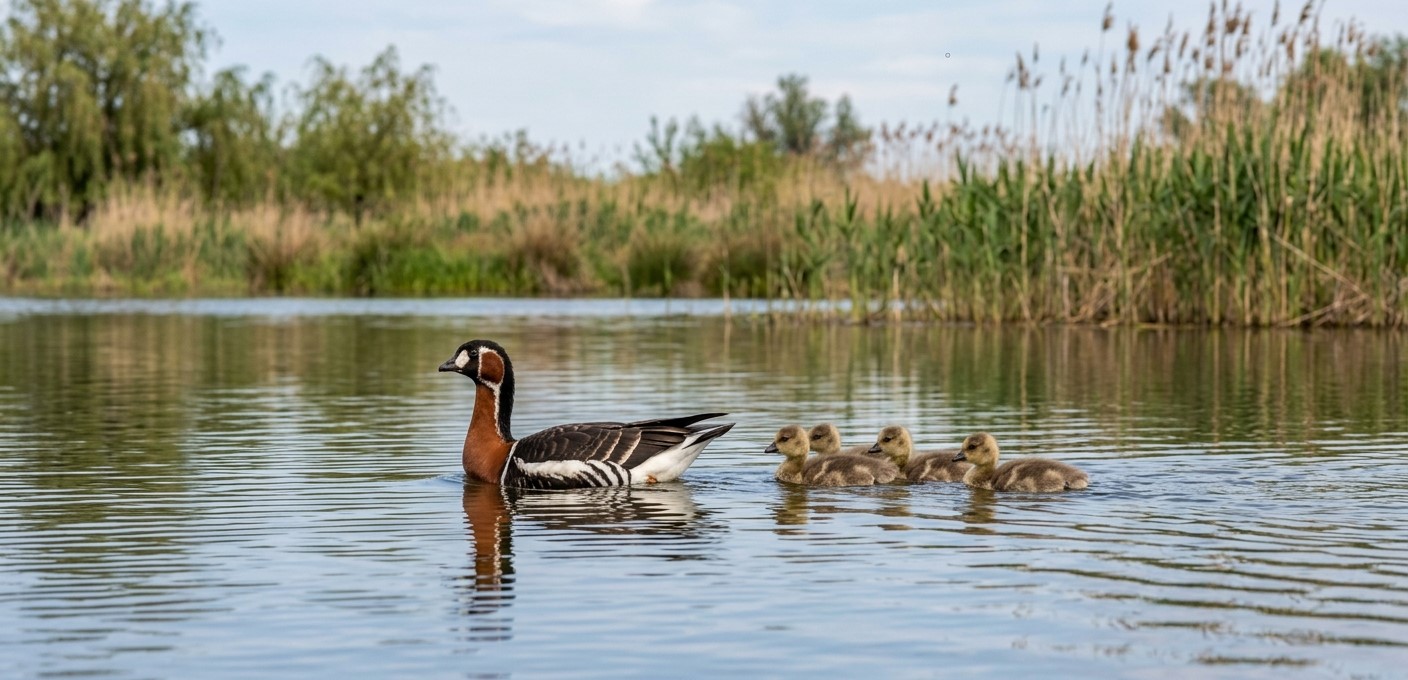
Appearance and "Fun Facts"
- Artistic Plumage: Unlike the common grey or brown geese, the Red-breasted Goose looks like it was painted by an artist. It features bold patterns of chestnut-red, black, and crisp white lines.
- Small but Mighty: It is one of the smallest goose species, barely larger than a mallard duck. Its small size makes it incredibly agile in flight.
- The "Bodyguard" Strategy: In their Arctic breeding grounds, these geese often nest near the nests of Peregrine Falcons (see more) or Snowy Owls. Why? Because these predators fiercely defend their own nests from foxes, unintentionally providing a "security service" for the geese.
The Red-breasted Goose is classified as Vulnerable on the IUCN Red List. Their survival is closely tied to the traditional agriculture of Romania.
- Feeding Habits: They feed almost exclusively on winter wheat and corn left over in the fields.
- Conservation Efforts: Romania has established several Special Protection Areas (SPAs) to ensure these birds can feed and rest without being disturbed by hunting or intensive industrial activities.
Wingspan: Between 110 and 125 cm.
Weight: Approximately 1 to 1.5 kg.
Social Behavior: They are highly social and are almost always seen in large, noisy flocks, often mixing with Greater White-fronted Geese.
The "Barking" Sound: Unlike the typical "honk" of a Canada goose, the Red-breasted Goose has a high-pitched, staccato call that sounds almost like a tiny dog barking.
Why a Visitor Should Care
Seeing a flock of thousands of Red-breasted Geese taking flight at sunrise over a Romanian lake is a breathtaking spectacle of nature. It reminds us that Romania is a vital link in the global chain of life, acting as a winter sanctuary for some of the planet's most fragile travelers.
A nice short video presenting Red-breasted Goose (Gâsca cu gât roșu)
Frequently Asked Questions: Red-breasted Goose (Gâsca cu gât roșu)
1. Where can I see the Red-breasted Goose in Romania?
The best place to spot them is in the Dobrogea region, specifically around Lake Techirghiol, Lake Sinoe, and the agricultural fields near the Danube Delta (see more). They prefer open plains where they can feed on winter winter wheat.
2. When is the best time to see them?
They are winter visitors. You can find them in Romania from late October until March. The peak numbers are usually seen in January when the Siberian winters are at their harshest, driving the entire population south.
3. Why is this bird so special to birdwatchers?
It is considered one of the "holy grails" of birdwatching because it is the rarest goose in the world. Almost the entire global population concentrates in just a few spots in Romania and Bulgaria during the winter, making it a spectacular and rare sight.
4. Is the Red-breasted Goose endangered?
Yes, it is listed as Vulnerable on the IUCN Red List. Their numbers have fluctuated significantly due to habitat loss, climate change in their Arctic breeding grounds, and illegal hunting or disturbance during their long migration.
5. How can I tell it apart from other geese?
While most geese are grey or brown, the Red-breasted Goose is highly colorful. It is much smaller than the common Greylag Goose and has a distinct reddish-chestnut patch on its neck and breast, framed by sharp white lines. From a distance, they appear much darker (almost black) than other species.
6. Do they stay in the water all day?
No. They usually spend the night on the safety of open water (like Lake Techirghiol) to avoid predators like foxes. At sunrise, they fly in large, noisy flocks to nearby agricultural fields to feed, returning to the water at dusk to drink and sleep.
7. Can I photograph them easily?
It is quite challenging. They are extremely shy birds and will fly away if humans get too close (usually within 300–400 meters). To photograph them, you need a long telephoto lens and a lot of patience, ideally using a specialized birdwatching blind or observing them from a car.
8. What does Romania do to protect them?
Romania has designated several Special Protection Areas (Natura 2000 sites). There are also "agri-environment" programs where farmers are compensated to leave part of their crops unharvested or to avoid using certain pesticides, ensuring the geese have enough food to survive the winter.
