
The Legend of the Old Man and the Donkey
The story of how the lake’s healing powers were discovered is as much a part of the local identity as the salt itself. According to folklore, a blind and crippled old Tatar man named Techir was traveling with his aging, ill donkey.
The donkey, exhausted and covered in sores, wandered into the thick, black mud at the edge of the lake and refused to budge. Techir spent hours trying to pull the animal out. When they finally emerged, a miracle had occurred: the donkey’s wounds were healing, and Techir realized his own aching joints were nimble and his vision had begun to clear. The lake was named "Techirghiol," which translates to "Techir’s Lake" (Ghiol meaning lake in Turkish).
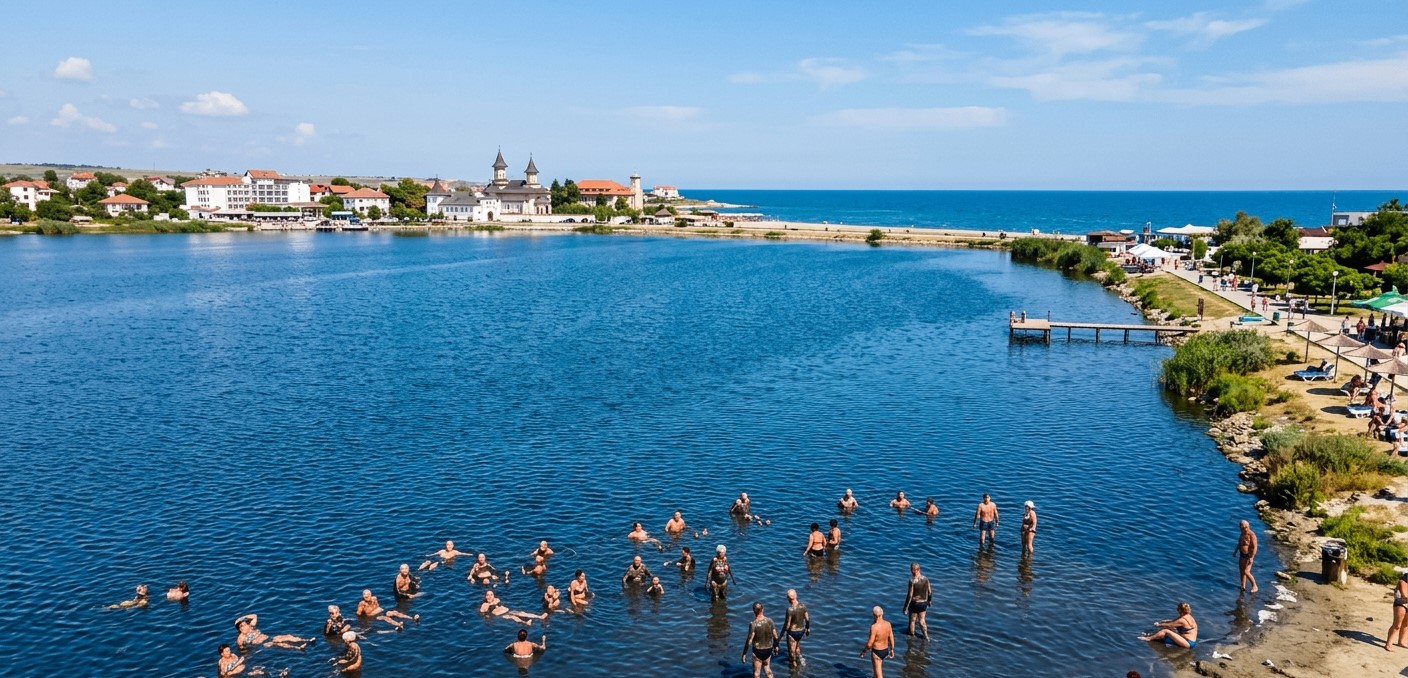
A Unique Ecosystem and Biodiversity
Despite its high salinity, Lake Techirghiol is a vibrant hub of life. It is a RAMSAR site and a protected area of international importance, especially for birdwatchers.
- The Red Brine Shrimp: The secret behind the lake's therapeutic mud is a tiny crustacean called Artemia salina. As these creatures live and die, their organic matter settles on the bottom, undergoing a multi-century fermentation process to create the famous "black gold."
- Avian Paradise: During migration seasons, you can spot over 150 species of birds. It is a crucial wintering ground for the Red-breasted Goose (Branta ruficollis) (see more), one of the rarest geese in the world. You might also see flamingos occasionally stopping by, attracted by the specific crustaceans in the water.
Understanding the lake requires a look at the "fine print" of its composition:
- Salinity: It is a fluvio-marine liman with a salt concentration that can reach up to 80-90 g/l, making it significantly saltier than the Black Sea.
- The Mud: The sapropelic mud is rich in mineral salts (colloidal silica, magnesium, iron) and organic substances. It feels like fine silk on the skin and acts as a natural anti-inflammatory.
- Depth and Surface: The lake covers about 11.6 square kilometers and has a maximum depth of approximately 9 meters.
- Float Like the Dead Sea: Because of the high density of the salt water, you don’t need to swim to stay afloat—you can simply bob on the surface and enjoy the sun.
- The "Pansy" of the Sea: The lake is home to specific algae that change the water's hue depending on the season and temperature, sometimes giving it a deep, mystical glow.
- A Royal Retreat: The therapeutic qualities of the lake were so renowned that the Romanian Royal Family and famous socialites of the early 20th century were frequent visitors to the local sanatoriums.
Techirghiol offers a different pace compared to the bustling resorts of Mamaia or Vama Veche. It is a place of quiet reflection, where you can cover yourself in sun-warmed mud, rinse off in the buoyant water, and watch rare birds fly toward the horizon. It is a testament to the idea that sometimes, the best medicine is simply what the earth provides.
A superb aerial video of Techirghiol Lake (Lacul Techirghiol)
Frequently Asked Questions: Lake Techirghiol
1. Why is Lake Techirghiol so famous?
The lake is world-renowned for its sapropelic mud and hypersaline water. This combination has been used for over a century to treat various musculoskeletal, skin, and gynecological conditions. It is often referred to as the "Dead Sea of Romania" due to its high salt content and therapeutic properties.
2. Can you swim in the lake?
Yes, you can swim, but it is a very different experience than swimming in the ocean. Because of the high salinity (salt concentration), your body becomes naturally buoyant. Instead of traditional swimming, most people enjoy floating effortlessly on the surface.
3. What exactly is the "Black Mud"?
The mud is a biological product formed over thousands of years from the decomposition of the Artemia salina (a tiny crustacean) and specific algae. It is rich in minerals, vitamins, and natural hormones. When applied to the skin and dried in the sun, it helps detoxify the body and improve circulation.
4. Are there any rules for using the mud?
To get the best results, locals and doctors usually recommend the Egyptian Method:
Stay in the saltwater for 10–15 minutes.
Apply a thin layer of mud over your body (or specific joints).
Wait in the sun for the mud to dry and crack (about 20–30 minutes).
Rinse off in the lake water.
5. Does the lake smell?
Because the mud is organic and contains sulfur, there can be a slight "egg-like" smell near the shore where the mud is most concentrated. However, most visitors get used to it quickly, as it is a sign of the mud's mineral richness.
6. When is the best time to visit?
The therapeutic season usually runs from late May to mid-September, when the water and air temperatures are high enough to allow for outdoor mud treatments. For birdwatching, the spring and autumn migration periods are ideal.
7. Is the lake connected to the Black Sea?
Technically, Lake Techirghiol is a fluvio-marine liman. It is separated from the Black Sea by a narrow strip of sand (a levee) about 300 meters wide. While they are geographically neighbors, the lake's water is significantly saltier than the sea.
8. Are there fish in Lake Techirghiol?
Due to the extremely high salt levels, you won't find common freshwater or marine fish here. The ecosystem is dominated by specialized organisms like the Brine Shrimp (Artemia salina) and various types of salt-loving micro-algae.
