
Biodiversity & Habitat
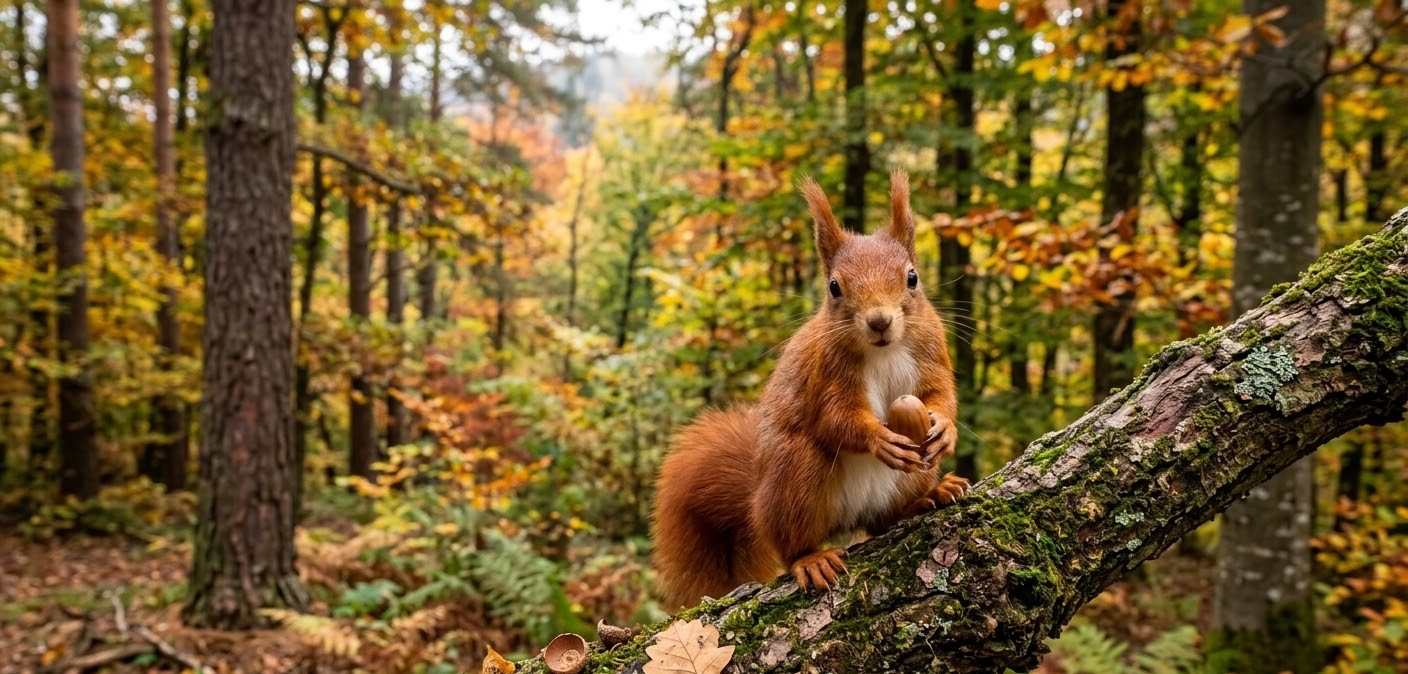
Romania offers one of the most diverse habitats for the Red Squirrel in Europe. While in Western Europe the Red Squirrel is often threatened by the invasive Grey Squirrel, in Romania, the Red Squirrel remains the king of its domain.
- Where to find them: They thrive in the coniferous forests of the Carpathian Mountains (see more), but they have adapted perfectly to mixed forests and urban green spaces.
- Dietary Architects: By burying walnuts, hazelnuts, and acorns—and inevitably forgetting where some are—squirrels are accidental foresters. Many of the oak and hazel trees in the Prahova Valley exist today because of a squirrel’s "bad memory."
The Folklore: A Messenger and a Hoarder
In Romanian village traditions, the squirrel is often seen as a symbol of diligence and foresight.
- The Legend of the Forest’s Secret: Some old stories suggest that squirrels were the "messengers" of the forest spirits (Spiritul Pădurii). Because they climb to the highest branches, it was believed they could hear the whispers of the wind and warn other animals of approaching danger or storms.
- The "Naughty" Companion: Unlike the wolf or the bear, which are feared, the squirrel appears in tales as a trickster. There’s a popular belief that if a squirrel crosses your path while you’re heading into the woods to pick mushrooms, it’s leading you away from the "good spots" just to keep them for itself!
Feature - Details
Scientific Name - Sciurus vulgaris
Average Lifespan - 3–7 years in the wild
Weight - 250g to 340g
Activity - Diurnal (most active in the morning and late afternoon)
Conservation Status - Least Concern (but protected in many Romanian natural parks)
A Note for Nature Lovers: While they might seem friendly, especially in tourist spots like Sinaia, remember that wild animals are unpredictable. It is always best to observe their acrobatic stunts from a distance and avoid feeding them processed human food!
A cute video with Eurasian Red Squirrel (Veverița Roșcată) in nature:
FAQ: The Eurasian Red Squirrel in Romania
1. Are squirrels in Romania friendly to humans?
In urban parks (like those in Sinaia, Brașov, or Bucharest), squirrels are quite accustomed to people and may come very close. However, in the wild Carpathian forests, they are much shyer and will likely vanish into the canopy the moment they sense you.
2. Can I feed the squirrels I encounter?
While it’s tempting, it is generally discouraged. If you must, stick to raw, unsalted walnuts or hazelnuts. Never give them processed snacks, chocolate, or salted peanuts, as these can be fatal to their delicate digestive systems. Remember: wild animals are unpredictable, so keep a respectful distance.
3. What is the best time of year to see them?
You can see them year-round! Unlike some mammals, squirrels do not hibernate. However, they are most active and visible in Autumn, when they are frantically gathering nuts for winter, and in Late Spring, when the new kits (baby squirrels) start exploring the branches.
4. Are there "Grey Squirrels" in Romania?
No. Unlike in the UK or parts of Italy, the invasive North American Grey Squirrel has not established itself in Romania. Our forests remain a stronghold for the native Eurasian Red Squirrel, which is a sign of a healthy, balanced ecosystem.
5. Why do some Romanian squirrels look almost black?
This is a common question! The Eurasian Red Squirrel has several color morphs. In the high-altitude coniferous forests of the Carpathian Mountains, you will often see squirrels with very dark, nearly black fur. This helps them absorb more heat from the sun in colder climates.
6. Do squirrels have any natural predators in Romania?
Yes, they are part of a complex food chain. Their main predators include the Pine Marten (Jderul de copac), which is just as agile in the trees as they are, as well as birds of prey like the Goshawk or the Common Buzzard.
