
A Muse for Literature, Music, and Folklore
In Romania, the Black Locust has long been a profound muse for artistic inspiration. For centuries, its white blossoms and bittersweet scent have haunted the verses of our greatest writers and poets, most notably Mihai Eminescu (see more), who often used the tree as a backdrop for romantic longing and the passage of time. Beyond literature, the "salcâm" is a cornerstone of Romanian folklore and traditional music. Countless doine and folk songs mention its shade as a place of rest for the weary traveler or a secret meeting spot for lovers. Its presence in our culture represents the bridge between the wild nature of the Balkans and the gentle soul of the Romanian peasant.
Technical Details & Appearance
- Scientific Name: Robinia pseudoacacia.
- Origins: Although native to North America, it was introduced to Romania in the 18th century and has since become perfectly integrated into our landscape.
- Height: It can reach up to 25-30 meters.
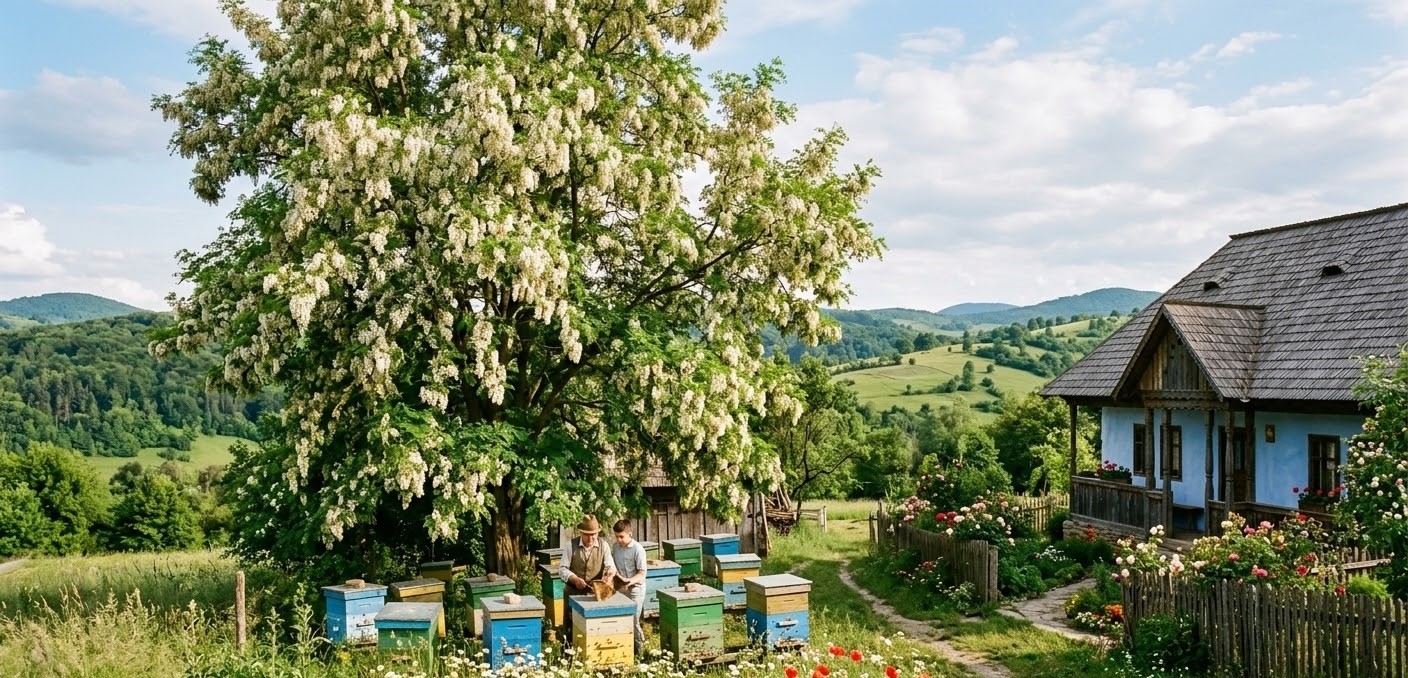
- Key Features: It has deeply furrowed bark, sharp thorns, and drooping clusters of delicate, white, and highly fragrant flowers.
Fun Facts for Travelers
- The "Acacia" Misnomer: While everyone in Romania calls it "Acacia" (Acația), it is botanically a Black Locust.
- Edible Flowers: In traditional Romanian cuisine, the flowers are often dipped in batter and fried to make a sweet, floral dessert similar to pancakes.
- Incredible Durability: The wood is famous for being extremely hard and resistant to rot, often used by locals for fence posts and vineyard stakes that last for decades.
Beyond its beauty and fragrance, the Black Locust is the backbone of Romanian beekeeping. Every spring, a spectacular nomadic phenomenon occurs: thousands of Romanian beekeepers transport their beehives deep into the locust forests of the Danube plains and the hills of Prahova and Oltenia. They "chase" the bloom to produce the famous Natural Acacia Honey (Miere de Salcâm), renowned worldwide for its exceptional purity. This honey is prized not only for its delicate, floral taste but also for its health benefits—it is rich in antioxidants, aids digestion, and is the only honey that remains in a liquid state for a very long time, making it a "liquid gold" staple in every Romanian household.
Biodiversity: A Guardian of the Soil
- Soil Protection: In Romania, the Black Locust is vital for stabilizing sandy soils, especially in the southern regions like Oltenia and parts of Prahova.
- Beekeeping: It is the primary source for Salcâm Honey (Acacia Honey), one of Romania's most prized exports—noted for remaining liquid for long periods and its clear, delicate flavor.
- Wildlife: Its dense canopy provides nesting sites for various bird species, while the flowers are a major food source for pollinators.
Frequently Asked Questions: The Black Locust (Salcâmul)
1. When is the best time to see the Black Locust in bloom?
The flowering season usually starts in mid-May and lasts until early June, depending on the altitude and temperature. This is when the Romanian countryside is filled with its unmistakable, sweet fragrance.
2. Is Romanian Acacia Honey (Miere de Salcâm) different from other types?
Yes. Due to the vast, wild forests of Black Locust in Romania, our honey is exceptionally pure. It has a very light, almost transparent color and a delicate floral taste. A unique characteristic is that it remains liquid for a very long time (up to two years) without crystallizing.
3. Can I eat the flowers of the Black Locust?
Yes, the white flowers are edible! In Romania, many families still make a traditional dessert by dipping the flower clusters in pancake batter and frying them. However, be careful: the bark, leaves, and seeds are toxic and should never be consumed.
4. Why do I see beehives being moved near these forests?
This is a traditional practice called "nomadic beekeeping." Romanian beekeepers transport their hives to the heart of the locust forests during the two-week blooming window to ensure the bees collect nectar almost exclusively from these flowers, resulting in the highest quality honey.
5. Is the Black Locust a native tree to Romania?
No, it was introduced from North America in the 1700s. However, it adapted so perfectly to our climate and soil that it is now considered a naturalized symbol of the Romanian village and landscape.
6. Is the wood used for anything special?
Locals highly prize the wood because it is extremely hard and rot-resistant. It is the preferred material for vineyard stakes, fence posts, and traditional tool handles, often lasting for decades even when buried in the ground.
7. Is it a good tree for the environment?
While it can be invasive in some areas, in Romania it plays a crucial role in preventing soil erosion, especially in the sandy regions of the south, where it helps stabilize the land.
