
Details & Appearance
- Scientific Name: Cygnus olor.
- Size: One of the heaviest flying birds, with a wingspan that can reach up to 2.4 meters.
- Identification: Unlike the Whooper Swan, the Mute Swan has a distinctive orange bill with a black knob at the base and a classic "S" curve to its neck.
- Weight: An adult male can weigh between 10 to 12 kg.
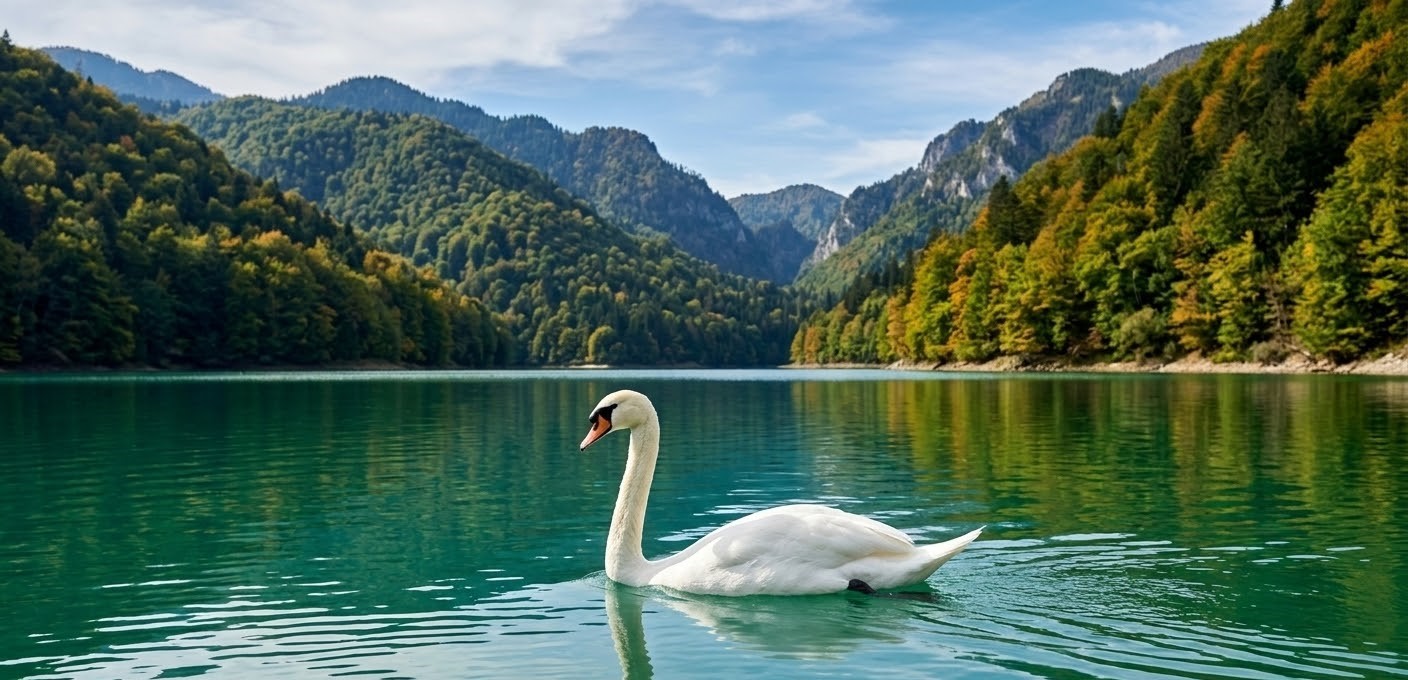
Biodiversity: A Romanian Sanctuary
- Romania is a critical habitat for these birds, offering diverse ecosystems for nesting and wintering.
- Habitat: They thrive in the Danube Delta (UNESCO World Heritage site) (see more), but are increasingly common on inland reservoirs and even urban lakes.
- Diet: Primarily herbivorous, feeding on submerged aquatic vegetation.
- Conservation: In Romania, the swan is a protected species. It is illegal to disturb their nesting sites, especially during the spring.
The Song of the Swan (Cântecul Lebedei)
A widespread legend in Romanian folklore (and across Europe) suggests that a swan remains silent its entire life, only to sing one incredibly beautiful, haunting song just before it dies. While scientifically a myth, it remains a powerful metaphor in Romanian literature and art for a final, supreme effort.
Lifelong Fidelity
In local traditions, swans are the ultimate symbol of love. It is believed that if a swan loses its mate, it will never choose another, spending the rest of its life in solitude. This is why they are often featured in Romanian wedding symbolism and folk embroidery.
Fun Facts for Travelers
- The "Mute" Misnomer: They aren't actually mute! They communicate through grunts, snorts, and a very loud hiss if they feel their nest is threatened.
- Territorial Warriors: Don't let the grace fool you. An adult swan is fiercely protective of its "cygnets" (baby swans) and can chase away predators much larger than itself.
- Winter Guests: While many migrate, some populations stay in Romania throughout the winter if the waters don't freeze completely, often being fed by locals in city parks.
Frequently Asked Questions: The Mute Swan (Lebăda de Vară)
1. Where is the best place to see wild swans in Romania?
The Danube Delta is the primary breeding ground, home to thousands of pairs. However, you can also find them on the Olt River reservoirs, Lake Snagov (see more) , and even on the Paltinu Reservoir in Prahova (see more) during their migration.
2. Can I feed the swans if I see them on a lake?
While it is common to see people feeding them, do not give them bread or crackers. These processed foods cause "Angel Wing" deformity and digestive issues. If you want to feed them, use cracked corn, peas, or chopped lettuce.
3. Are swans in Romania migratory?
Most are. They usually arrive in early spring to nest and leave for warmer climates (like the Nile Delta or the Caspian Sea) in late autumn. However, due to milder winters, some populations now stay year-round on non-freezing rivers.
4. Why is it called the "Mute" swan?
It is a bit of a misnomer. While they are much quieter than other species, they are not silent. They communicate through hisses, snorts, and soft grunts, especially when defending their territory or communicating with their cygnets.
5. How many eggs does a swan lay?
A female typically lays between 4 and 8 pale green eggs once a year. Both parents are extremely protective of the nest, which is usually a large mound of aquatic vegetation.
6. Are swans aggressive towards humans?
Swans are generally peaceful but become highly territorial during nesting season (March–June). A male (cob) will hiss and flap its wings powerfully if you get too close to its mate or young. Always maintain a respectful distance.
7. Is the swan a protected species in Romania?
Yes. The Mute Swan is protected by law. Hunting them or disturbing their nesting sites is strictly prohibited and carries heavy fines.
8. Why are the baby swans grey?
The young, known as cygnets, are born with thick grey down feathers for camouflage and insulation. They only develop their iconic pure white plumage after their first year of life.
