
A Blue and Gold Sentinel
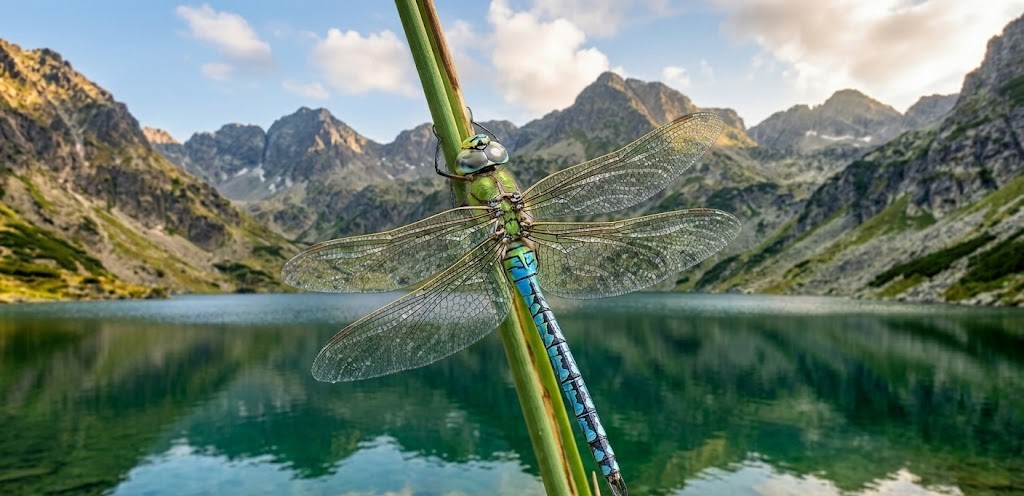
Measuring up to 8 centimeters in length, the male is easily recognized by its striking pattern of bright blue and yellow spots on a dark body. The female, slightly more camouflaged in shades of yellow and brown, is often seen hovering near the water's edge. Unlike other dragonflies that perch frequently, the Common Hawker is a tireless flyer, patrolling its territory for hours.
Life in the Clouds: Habitat and Survival
This species is a specialist of the High Carpathians. It prefers:
- Peat Bogs (Turbării): Acidic environments where few other insects can survive.
- Glacial Lakes: It can be found at altitudes where most dragonflies would freeze, thanks to its ability to fly even in cooler, overcast mountain weather.
- The Underwater Hunter: Before it takes to the skies, the larva (nymph) lives underwater for 2 to 3 years, being a fierce predator of tadpoles and even small fish.
Fun Facts & Curiosities
-Hovering Mastery: It can fly at speeds of up to 30-40 km/h and has the unique ability to fly backward or hover perfectly still in mid-air while scanning for prey.
-360-Degree Vision: Its massive compound eyes allow it to see in almost every direction at once, making it nearly impossible to surprise.
-A Bio-Indicator: Its presence in a mountain lake is a sign of excellent water quality and a healthy, unpolluted ecosystem.
The Legend of the Mountain's Diamond
In the remote shepherd communities of the Carpathians, there is an old story about why these dragonflies look like flying jewels:
The Shepherd's Gift: Legend says that once, a young shepherd playing his flute near a glacial lake (Tău) saw the "Spirit of the Mountain" weeping because the waters were too dark and lonely. To cheer the spirit up, the shepherd offered his most precious possession: a small, blue diamond found in a hidden cave.
The Transformation: The Spirit was so moved by the boy's kindness that instead of keeping the diamond, she shattered it into thousands of tiny, living pieces. These pieces became the Common Hawkers.
The Guardian of Purity: It is said that their wings were made from the mountain mist and their bodies from the blue of the sky and the gold of the sun. Their mission? To fly forever over the high lakes to guard the purity of the water.
The Good Omen: For hikers and shepherds, seeing a Common Hawker is considered a sign of protection. It is believed that as long as the "blue aviators" are dancing above the water, the mountain springs will remain clean and the weather will hold fair for the journey.
Why It Matters
Seeing a Common Hawker in the Retezat or Rodna Mountains is a reminder of the fragile beauty of our alpine wetlands. These "jewels of the air" are essential for controlling the mosquito population and serve as a vital link in the mountain food chain.
Frequently Asked Questions: Common Hawker (Libelula Mare de Munte)
1. Is the Common Hawker different from lowland dragonflies?
Yes. Unlike the species found in warmer, lower altitudes, the Common Hawker is a cold-hardy specialist. It can fly in lower temperatures and even under overcast skies, which is essential for survival in the unpredictable weather of the Romanian Carpathians.
2. Where is the best place in Romania to photograph them?
The most iconic spots are the glacial lakes of the Retezat National Park (like Bucura (see more) or Zănoaga (see more) ) and the peat bogs of the Rodna Mountains. They are usually found at altitudes between 1,200 and 2,000 meters.
3. Does the "Hawker" name mean it is a predator?
Exactly. They are called "Hawkers" because of their hunting style—they fly back and forth over a specific territory, "hawking" for prey in mid-air. They are the apex predators of the insect world in the mountains, feeding on flies, mosquitoes, and even smaller dragonflies.
4. How can I tell the difference between a male and a female?
The male is the "showstopper" with bright blue spots and narrow yellow bands on a dark abdomen. The female is more discreet, with mostly yellow or brownish markings, which helps her stay camouflaged while she lays eggs in the moss near the water's edge.
5. Are they active all year round?
No. You will only see them in their adult, winged form during the short mountain summer, typically from late July to late September. They spend the rest of their lives (up to 3 years!) as larvae at the bottom of frozen mountain lakes.
6. Do they have any natural enemies in the mountains?
While they are fast, they are often hunted by mountain birds like the Hobby (Șoimul rândunelelor) or caught by frogs near the shoreline. However, their 360-degree vision makes them one of the hardest insects to catch.
7. Is it true that they indicate a clean environment?
Yes. The Common Hawker is an ecological indicator. They cannot survive in polluted waters or environments with heavy pesticides. Seeing them is a guarantee that the mountain air and water you are enjoying are of the highest purity.
