
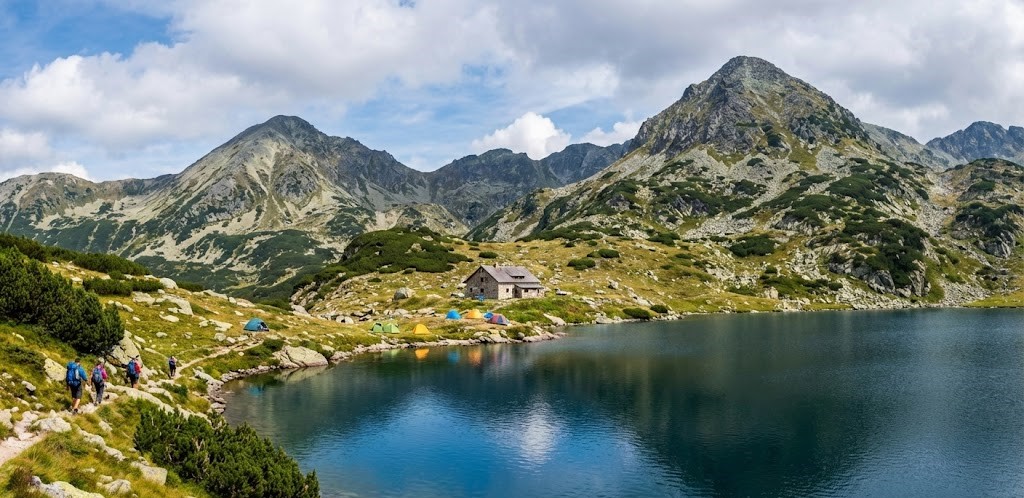
Situated at an altitude of 2,040 meters, it is the largest glacial lake in Romania. But Bucura is more than just a geographical statistic; it is a place where geology meets mythology, surrounded by the rugged, rocky crests of the Retezat National Park.
The Legend: The Tears of the Giants
While geologists will tell you that the Retezat landscapes were carved by massive glaciers during the Ice Age, local folklore tells a different, more dramatic story.
Legend has it that long ago, the Retezat Mountains (Click HERE to see more) were the domain of Giants (Uriași). These titans were not always peaceful. The story goes that a great battle ensued between a giant inhabiting the Retezat peaks and another from the nearby Rusca Mountains.
In their fury, the giants tore massive boulders from the earth and hurled them at one another.
- The rocks that fell short or piled up formed the jagged peaks we see today (like Peleaga and Păpușa).
- The craters left behind by their devastating footsteps—or, in some versions, the spots where the defeated giant’s heavy tears fell—filled with water, creating the 80+ glacial lakes scattered across the massif.
Why Visit Lake Bucura?
Beyond the stories, the reality of Bucura is breathtaking. Covering nearly 9 hectares, it serves as the main hub for hikers exploring the National Park.
- The "Eyes of the Sea": The Retezat lakes are often poetically called the "Eyes of the Sea" (Ochii de Mare) because of their intense blue color and crystal-clear water.
- The Peaks: From the lake, you have direct access to the highest peaks in the range, including Peleaga (2,509 m) and Păpușa (2,508 m).
- The Camping Experience: Camping is permitted in designated areas near the Mountain Rescue (Salvamont) refuge. Waking up to the sunrise reflecting off the glacial water is an experience unmatched anywhere else in the Carpathians.
The most accessible route for most hikers starts from Poiana Pelegii.
- Drive: You can drive on the forest road from Gura Apei Dam up to Poiana Pelegii (an SUV or car with high ground clearance is recommended).
- Hike: From Poiana Pelegii, it is a moderate hike of about 1.5 to 2 hours to reach the lake. The trail is well-marked (Blue Band) and passes through lush juniper bushes before opening up to the alpine bowl.
The Retezat National Park is a protected area and a true wilderness. While the landscape is beautiful, it is also home to a thriving population of wildlife, including vipers, chamois (black goats), and brown bears.
 Respect the Wildlife: Please remember that wild animals are unpredictable. Never approach them for photos, do not feed them, and always keep your food sealed and stored away from your tent if you are camping. We are guests in their home; keeping a safe distance is essential for your safety and theirs.
 Respect the Wildlife: Please remember that wild animals are unpredictable. Never approach them for photos, do not feed them, and always keep your food sealed and stored away from your tent if you are camping. We are guests in their home; keeping a safe distance is essential for your safety and theirs.
Whether you are chasing the legends of ancient giants or simply looking for silence above the clouds, Lake Bucura offers a connection to nature that feels almost prehistoric. It is a place where the mountains hold the sky, and for a moment, time stands still.
A 4K video of a tourist group hiking to Bucura Lake (Lacul Bucura):
Frequently Asked Questions about Lake Bucura:
1. Can I drive all the way to Lake Bucura?
No, you cannot drive directly to the lake. The furthest point you can reach by car is Poiana Pelegii. From there, you must hike approximately 1.5 to 2 hours (following the Blue Band marking) to reach the lake. The road to Poiana Pelegii is an unpaved forest road; while reachable by regular cars with care, a car with higher ground clearance is highly recommended.
2. Can I swim in the lake?
No. Swimming is strictly prohibited in Lake Bucura and all other glacial lakes within the Retezat National Park. This rule is in place to protect the delicate alpine ecosystem. Additionally, the water temperature rarely rises above 5–7°C (41–44°F), even in summer, posing a risk of hypothermia.
3. Is there a hotel or chalet (cabana) at the lake?
No, there is no commercial accommodation (hotel or chalet with food service) at Lake Bucura.
- Camping: There is a designated camping area where you can pitch your own tent for a small fee.
- Refuge: There is a Mountain Rescue (Salvamont) refuge, but this is primarily for the rescue team and emergency situations/extreme weather. It is not a hotel. You must bring your own tent, sleeping bag, and food.
The route from Poiana Pelegii to Lake Bucura is considered medium difficulty. It is consistently uphill but not technical. Active children and beginners with reasonable fitness can complete it, provided they have proper hiking boots and weather-appropriate clothing.
5. When is the best time to visit?
The best time to visit is July, August, and early September. During these months, the snow has usually melted, and the weather is most stable. However, weather in the Retezat Mountains changes rapidly; always check the forecast before heading out.
6. Are there bears or snakes in the area?
Yes. Retezat is home to brown bears and vipers (Vipera berus).
- Vipers: Usually found on sunny rocks at lower altitudes, but can be seen on trails. Watch your step and use trekking poles.
- Bears (Click HERE to see more): While they generally avoid busy trails, they are present. As noted in the safety section, wild animals are unpredictable. Keep food sealed in airtight containers and never keep food inside your tent overnight. If you spot an animal, keep a considerable distance.
It is not recommended to drink directly from the lake due to sediment and potential camping runoff. However, there is a captured spring (izvor) near the Salvamont refuge which provides fresh, potable water. It is always a good practice to carry a small water filter just in case.
