
The Historic Flight: Bacău to Blaj
On November 23, 1918, Romania was divided by the Carpathian Mountains and the lines of the First World War. To coordinate the Great National Assembly at Alba Iulia, the leaders in Moldavia needed to send secret documents to the National Council in Transylvania.
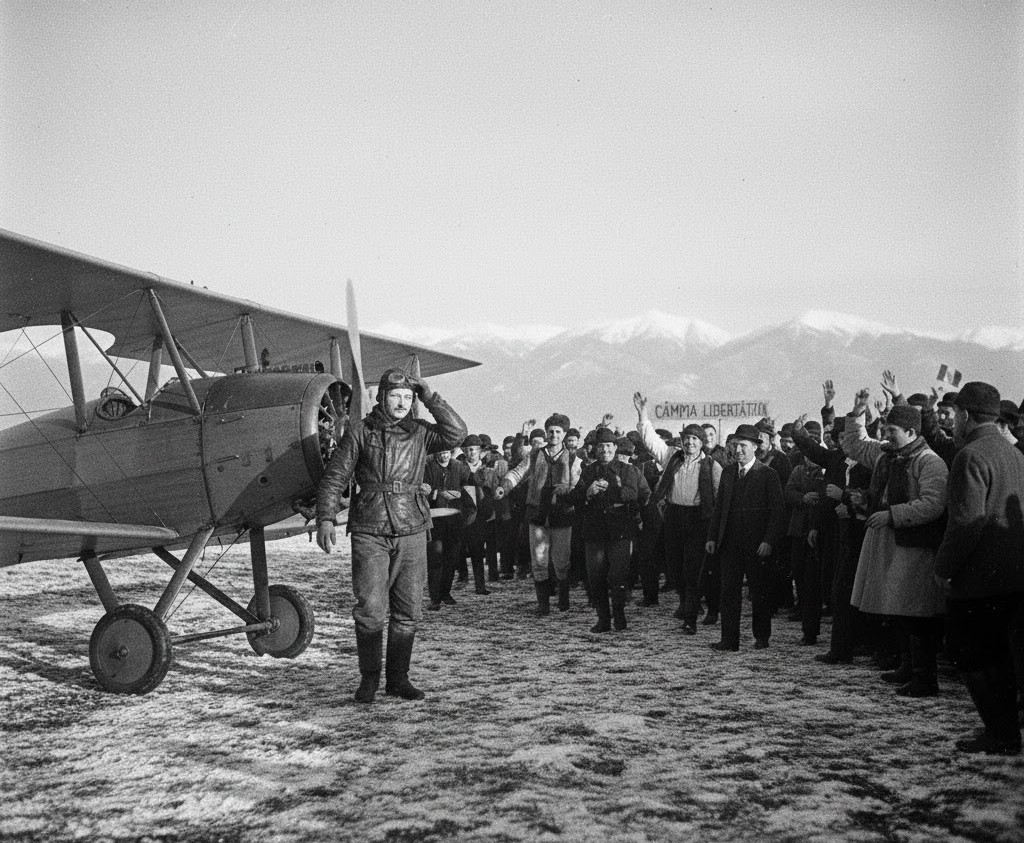
- The Mission: Vasile Niculescu was chosen to fly a fragile Farman F.40 biplane from Bacău to Blaj.
- Extreme Conditions: He flew at an altitude of 2,600 meters in an open cockpit, with temperatures dropping to -40°C. To survive the freezing wind, his face was covered in a thick layer of protective grease.
- The Landing: He landed on the "Câmpia Libertății" (Field of Liberty) in Blaj, where he was greeted by thousands of cheering people. He carried the letters that would finalize the plan for the unification of all Romanians.
The Legacy of a Hero
Vasile Niculescu was not just a pilot; he was a messenger of destiny. His flight proved that the mountains were no longer a barrier between brothers.
- National Recognition: After the war, he continued to serve in the Romanian Air Force, being recognized as one of the pioneers of Romanian aviation.
- A Symbol of Bravery: His story is a testament to the fact that the Great Union was achieved not only through diplomacy and sacrifice in the trenches but also through incredible feats of individual courage.
- The Plane: The Farman F.40 he flew was a reconnaissance aircraft made of wood and fabric—extremely vulnerable to the harsh winter winds of the Carpathians.
- The Message: The documents he delivered contained the specific instructions for the delegates who were to travel to Alba Iulia on December 1st.
- Commemoration: Every year, Romanian aviation enthusiasts and historians honor his flight as a key technical and patriotic milestone.
Q: Why was the flight so dangerous?
A: Beyond the freezing temperatures, Niculescu had to fly over the Carpathian Mountains without modern navigation systems, during a time when anti-aircraft fire from retreating enemy troops was still a real threat.
Q: Where can I see a plane like the one he flew?
A: Replicas and similar models from that era can be found at the National Military Museum in Bucharest and the National Aviation Museum.
Q: What happened to him after 1918?
A: Vasile Niculescu lived a long life, passing away in 1981. He remained a modest hero, often saying that he simply "did his duty for his country."
