
A Masterpiece of Nature
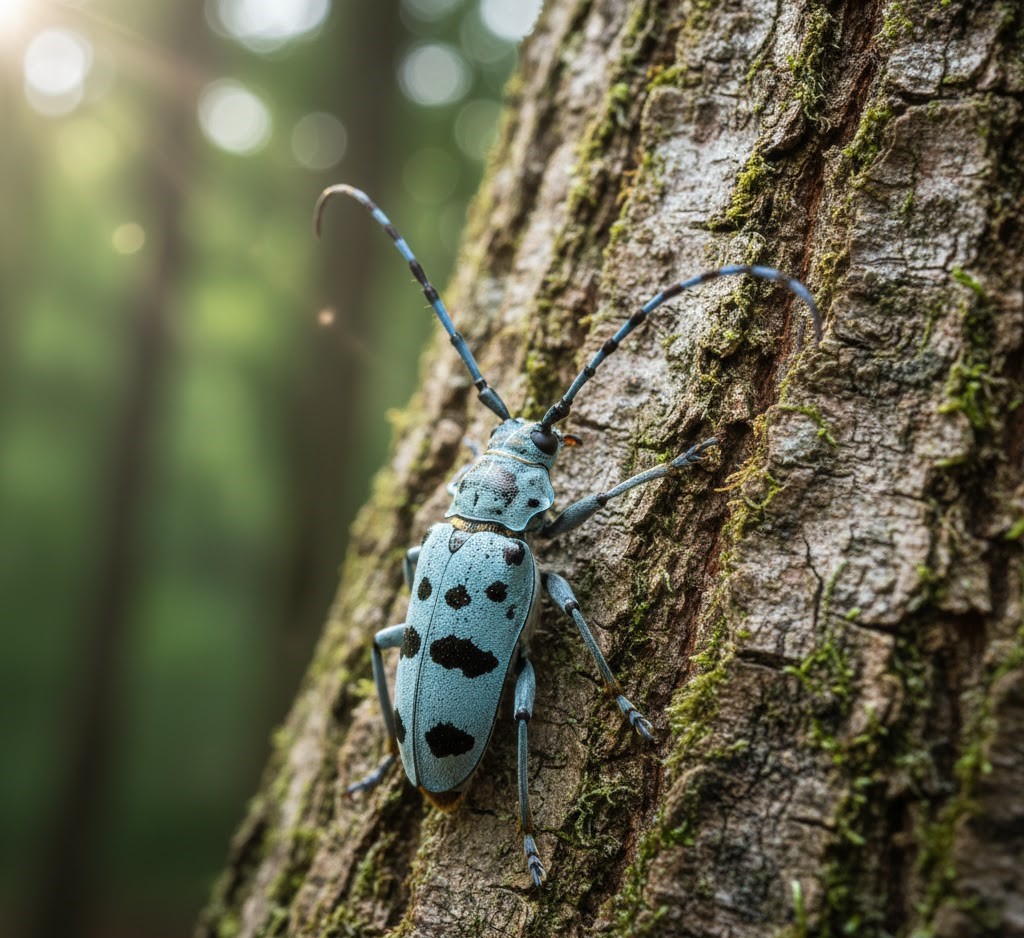
The beetle is instantly recognizable due to its striking appearance:
- Color: A soft, pastel blue or greyish-blue body covered in fine, velvet-like hairs.
- Markings: It features characteristic black spots of various shapes on its wing cases (elytra).
- Antennae: True to its name "Longhorn," its antennae are incredibly long—often longer than its body—and are banded in alternating blue and black segments.
Habitat & Biodiversity
The Alpine Longhorn Beetle is a "relic" of ancient forests. It depends on old, sun-exposed beech trees (Fagus sylvatica).
- The Cycle of Life: Its larvae develop in the wood of old or fallen trees for several years. This makes the beetle an indicator species; its presence tells us that the forest is healthy, old, and has a high degree of natural integrity.
- Conservation: Because it relies on old-growth forests, it is a protected species in Romania and across Europe (listed under the Natura 2000 network).
While not as famous in myths as the bear or the wolf, the Alpine Longhorn Beetle holds a special place in the hearts of naturalists:
- The Forest Guardian: In some mountain communities, seeing one is considered a sign of a "living forest." It is a symbol of the delicate balance of nature.
- The Silent Carpenter: Its Romanian name, Croitorul (The Tailor), comes from the precise way the larvae "cut" or "tailor" galleries through the wood.
- Best Time to Spot: Look for them on sunny days in July and August, usually on the trunks of old beech trees.
- Behavior: Despite their long antennae, they are quite peaceful and move with a slow, aristocratic grace.
- Unpredictable Nature: Like all residents of the wild, wild animals are unpredictable. Even a small beetle should be observed without being disturbed or picked up, as they are fragile and play a vital role in the ecosystem.
FAQ: Alpine Longhorn Beetle (Rosalia alpina)
Q: Is the Alpine Longhorn Beetle dangerous?
A: Not at all. It does not bite or sting humans. It is a peaceful herbivore that spends its short adult life looking for a mate and feeding on tree sap.
Q: Where can I see one in Romania?
A: They are common in the Carpathian Mountains (see more), particularly in the Apuseni Natural Park, the Bucegi Mountains, and the Piatra Craiului National Park.
Q: Why is it blue?
A: The blue color serves as a form of camouflage against the grey bark of beech trees in the dappled sunlight of the forest, helping them hide from birds.
