
A Living Fossil
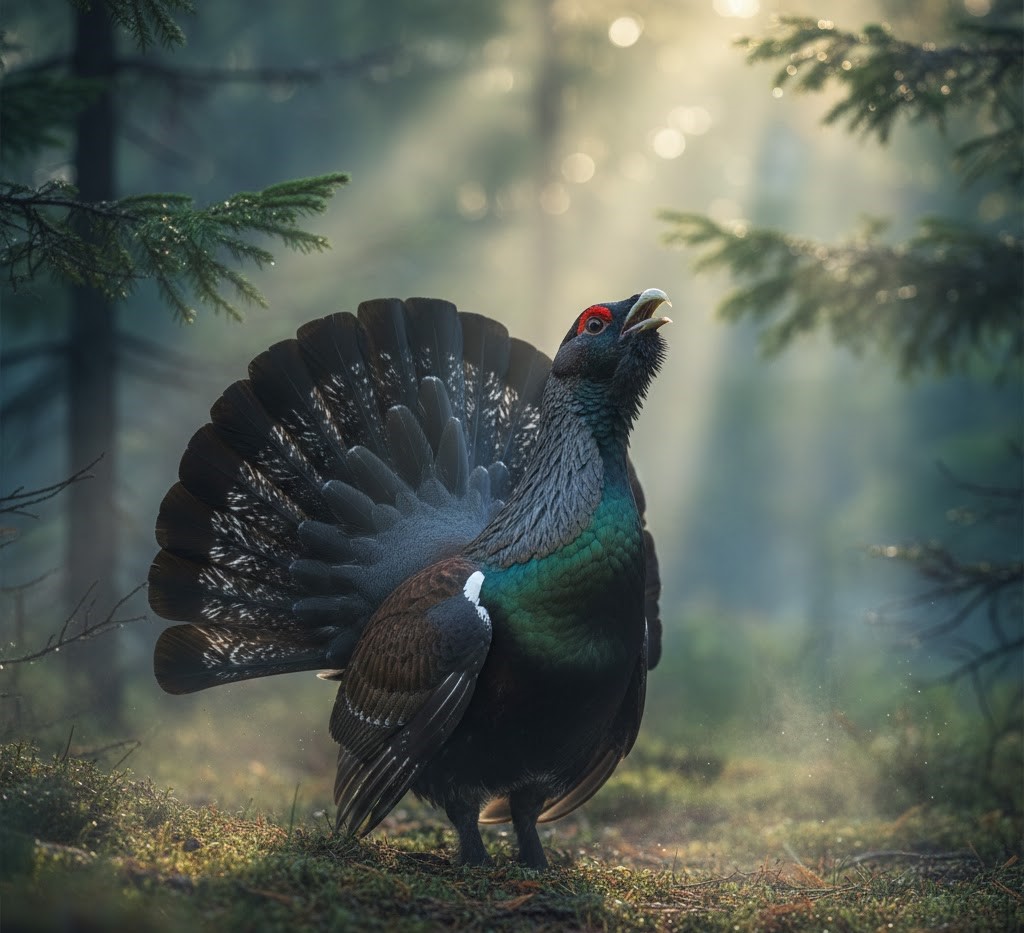
The Capercaillie is the largest member of the grouse family, and looking at one feels like looking back in time. With its fan-like tail, metallic green chest, and fierce red "eyebrows," the male is a true masterpiece of evolution.
The "Deaf" Singer (Legend & Mystery)
In Romanian, he is known as the "Mountain Rooster," but he’s famous for a strange biological quirk. During his elaborate mating song (the rotit), for a few brief seconds, the bird becomes completely deaf to the world.
- The Song of Love: He clicks, pops, and scrapes with his beak. In those final moments of the song, his ear canal is physically blocked by his own jaw.
- The Ninja Approach: For centuries, hunters and now photographers have used these 3-4 seconds of silence to sneak closer, step by step, through the snow and pine needles.
Where the Silence Dwells
This bird doesn't just live anywhere. He demands the purest environment:
- Old-Growth Forests: They need ancient pine and spruce forests (over 60-80 years old) with plenty of berries and ants.
- The High Altitudes: You’ll find them in the Retezat (see more), Rodna (see more), or Apuseni Mountains, usually above 1,200 meters, where the air is crisp and human footsteps are rare.
 A Word of Warning to Explorers
As we always say at Beautiful Romania, wild animals are unpredictable.
- Don't Underestimate the "Rooster": During the mating season, male Capercaillies are pumped with hormones and become incredibly territorial. There are famous stories of these birds chasing hikers or even attacking vehicles that stray too close to their "dance floor."
- Do Not Disturb: They are extremely sensitive to noise. If they are scared away from their lek (mating ground) too often, they may stop breeding altogether. Always use a professional guide and keep a respectful distance.
FAQ: The Mystery of the Capercaillie
1. Is it a common bird in Romania?
No. It is a rare and protected species. Romania has one of the most stable populations in Europe precisely because our mountain forests are still wild and vast.
2. Can I hear them singing?
Only in the very early hours of dawn (usually between 4:00 and 6:00 AM) during late April and May. It's a sound you will never forget—a mix of wood clicking and a "cork popping" sound.
3. Why is it a symbol of "Beautiful Romania"?
Because it represents purity. The Capercaillie cannot survive in polluted or fragmented forests. Its presence is a "certificate of health" for our mountains.
