
Myths and Mystery
In local folklore, the Wildcat is often seen as a solitary and mysterious guardian of the deep woods. Unlike the lynx, which is the "big cat" of the mountains, the wildcat is the "silent shadow." Ancient tales often speak of their cunning and their ability to vanish into thin air, making them symbols of independence and sharp instincts.
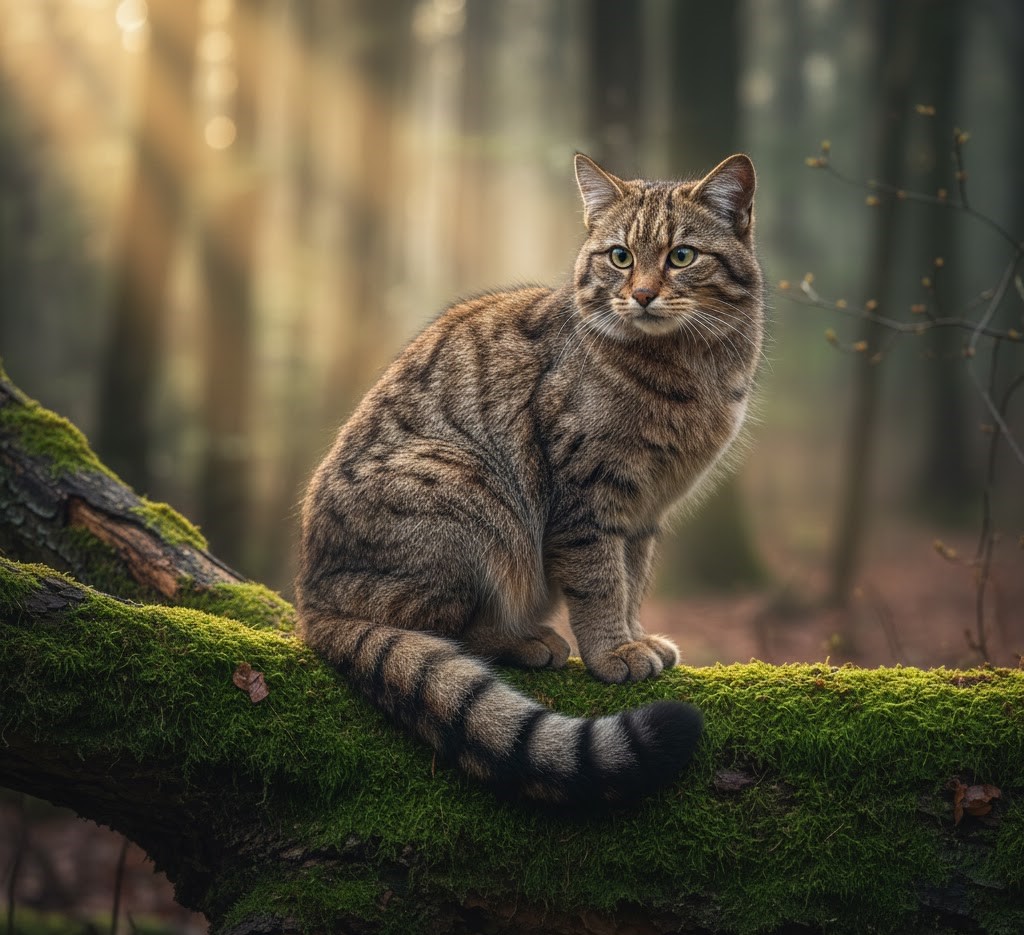
Wild vs. Domestic: How to Tell the Difference
At first glance, you might think you’ve spotted a common tabby cat, but the Wildcat is a true predator of the wilderness.
- The Tail: This is the best giveaway. The Wildcat has a thick, bushy tail with a blunt, black tip and 3–5 distinct black rings.
- The Build: They are larger and more muscular than domestic cats, with longer legs and a wider head.
- The Temperament: As we always remind our readers, wild animals are unpredictable. Even a wildcat kitten, as cute as it may look, is fiercely territorial and cannot be domesticated.
Spotting a Wildcat is a badge of honor for any wildlife enthusiast in Romania.
- Piatra Craiului National Park: The limestone ridges and dense forests provide the perfect rocky crevices for dens.
- The Măcin Mountains (see more): In the oldest mountains of Romania, these cats can sometimes be seen sunning themselves on rocks at dawn.
- The Hills of Transylvania: The mosaic of old oak forests and wild meadows is their favorite hunting ground for rodents.
 A Word on Conservation and Safety
Because they look so much like domestic pets, they face a unique threat: hybridization. It is vital to keep domestic cats away from the edges of wild forests.
- Keep your distance: If you are lucky enough to see one, stay perfectly still. They are extremely sensitive to movement and will disappear in an instant.
- Do not approach: They are not "stray cats." A cornered Wildcat is incredibly fierce and will defend itself with lightning speed.
1. Is it just a domestic cat that ran away?
No. The European Wildcat is a distinct species that has lived in Europe's forests for millennia. While they can interbreed with domestic cats, the pure wildcat has a different bone structure, a larger brain, and a much more aggressive temperament.
2. What do they eat?
They are strict carnivores. Their diet consists mainly of small rodents (voles and mice), but they are capable of taking down birds or even young roe deer fawns if the opportunity arises.
3. Are they active during the day?
They are primarily crepuscular, meaning they are most active during dawn and dusk. However, in remote areas of the Carpathians where human presence is low, they may occasionally hunt during the day.
4. Why are they so hard to see?
The Wildcat is perhaps the most timid animal in the Romanian forest. Their fur blends perfectly with the leaf litter and grey rocks, and their footsteps are completely silent.
