
In Romania, the plum is far more than just a fruit, it is a national institution. From the endless orchards of the Carpathian foothills to the traditional copper stills found in village courtyards, this humble fruit defines the rhythm of rural life and the spirit of Romanian hospitality. Even unnoficial, most Romanians (Including me) consider the plum the national fruit of Romania.
Legends and Folkloric Roots
In Romanian folklore, trees are often seen as sentient beings with souls. The plum tree, in particular, is celebrated for its resilience and generosity.
The Tree of Life’s Little Brother: Old legends suggest that when God created the world, the plum tree was tasked with providing "the essence of the earth" to the people. While other trees offered shade or wood, the plum tree offered a fruit that could be eaten fresh, dried for winter, or transformed into a spirit that "warms the soul."
A Symbol of Prosperity: It is a long-standing tradition in many Romanian villages for a young man to plant fruit trees—often plums—before building a house or getting married. A blooming plum tree in a courtyard is seen as a sign that the household is blessed and will never go hungry.
Biodiversity and Varieties
Romania is one of the most biodiverse regions in Europe, and its plum varieties reflect this rich natural heritage. While the Stanley and Anna Späth are common, Romania is home to several local biotypes adapted to specific microclimates:
- Tuleu Gras: A local variety prized for its high sugar content and thin skin, making it the "king" of Romanian dessert plums.
- Grase de Beclean: Famous in the Transylvania region for their size and juiciness.
- Vinete de Italia: While the name suggests otherwise, these have been naturalized for centuries in the Prahova and Argeș regions, perfect for both jam and distillation.
- The National Spirit: Approximately 70-80% of Romania’s annual plum harvest is used to produce Țuică or Pălincă (see more). This potent plum brandy is the traditional welcome drink for any guest.
- Magiun de Topoloveni: Romania boasts a protected geographical indication (PGI) for this unique plum spread. It is made without any added sugar, cooked in double-walled cauldrons for hours until it reaches a thick, dark consistency rich in antioxidants.
- The "Blue" Fingerprint: The dusty, waxy coating on a fresh plum is called "bloom." It’s a natural barrier that protects the fruit from moisture loss and bacteria—a sign of a truly fresh, untouched plum.
Romania consistently ranks among the top plum producers globally, often vying for the #1 spot in Europe.
2025 (Estimated): ~820,000 Tonnes
A stable year with high quality due to a dry autumn.
2026 (Forecast): ~910,000 - 950,000 Tonnes
An exceptionally rich year. Optimal winter chilling followed by a mild spring has led to record-breaking blossoms.
The 2026 season is expected to see a surplus in production, which will likely lead to an increase in exports of dried plums and a particularly vintage year for artisanal țuică production.
Why Foreigners Love It
For those visiting Romania, the plum represents the authentic "farm-to-table" experience. Whether you are tasting a handmade gomboți (plum dumplings coated in cinnamon breadcrumbs) in Transylvania or sipping a glass of clear brandy in a mountain village, you are participating in a tradition that has remained unchanged for centuries.
The plum isn't just agriculture, it's the taste of the Romanian landscape.
The Versatility of the Romanian Plum
The plum is a true staple of the Romanian pantry, utilized with a resourcefulness that spans from breakfast to late-night celebrations. Here is how locals transform this purple treasure:
- The Spirits: The most famous use is, of course, the production of Țuică and Pălincă. These traditional fruit brandies are the heartbeat of social gatherings, often served as an appetizer to "open the appetite."
- Sweet Preserves: Romanians are masters of Gem (thick fruit spread) and Dulceață (whole fruit or large pieces preserved in heavy syrup). These preserves capture the essence of summer to be enjoyed during the cold winter months.
- Local "Raisins": When smoked (Prune afumate) or simply dried (Prune uscate), they become a natural, healthy snack—a local alternative to raisins. These are often used in traditional stews or meat dishes, adding a unique smoky-sweet depth.
- Fresh and Pure: Beyond processing, nothing beats a plum eaten fresh straight from the branch, bursting with juice and natural sugars.
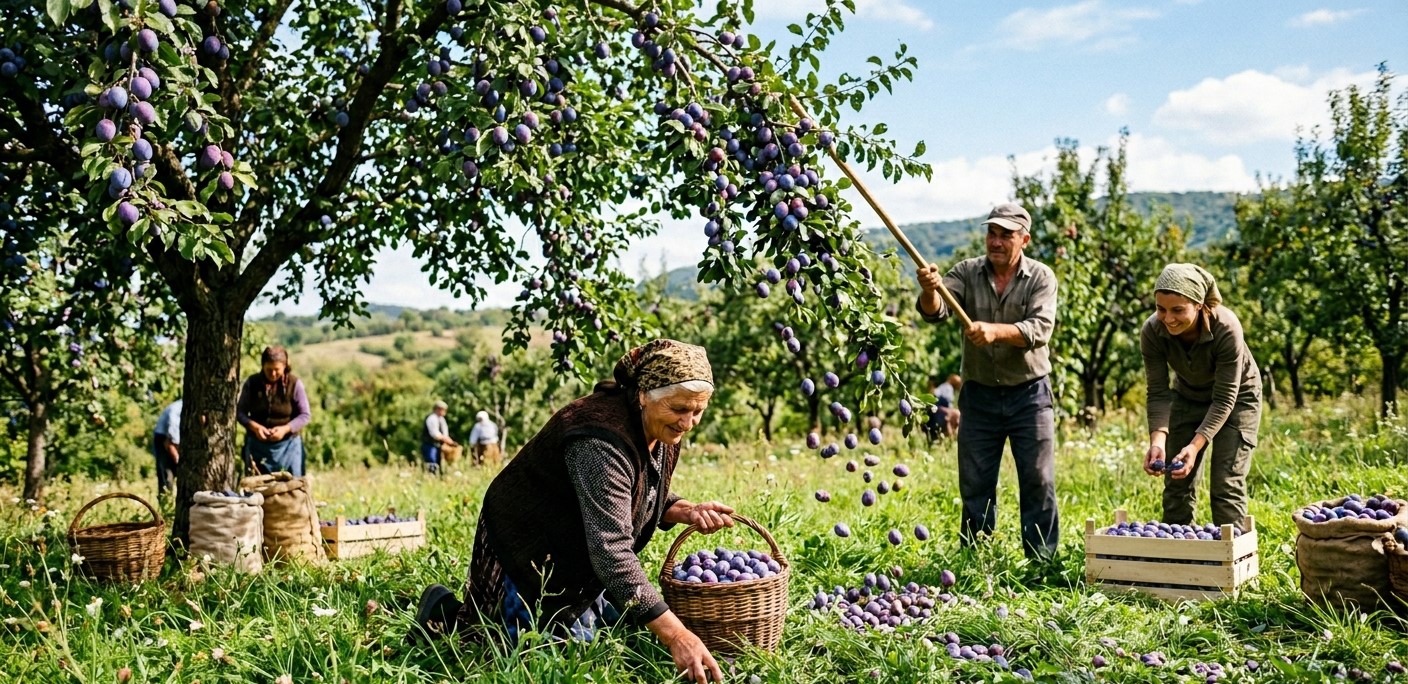
In many parts of the country, the harvest remains a beautiful, communal ritual that has changed very little over generations. It is a sensory experience that defines the Romanian autumn.
Instead of heavy industrial machinery, the process is tactile and rhythmic:
- The Shaking: Strong arms shake the trunks and branches of the trees.
- The "Bătut" (Beating): For the higher branches, locals use long wooden poles (prăjini) to gently beat the limbs, encouraging the ripe fruit to let go.
- The Collection: The plums fall into the lush, fragrant green grass beneath the trees. From there, they are hand-picked one by one. This ensures that only the best fruit is selected, all while the orchard is filled with the sweet, heavy scent of ripe plums and crushed grass.
A beautiful video which presenting plum picking in Romania:
Frequently Asked Questions about the Romanian Plum
Is Romanian Țuică the same as Plum Brandy found in other countries?
While similar to Slivovitz or Rakia, Romanian Țuică is unique because, by traditional standards, it must be made only from plums. It is often double-distilled to achieve a high alcohol content, but it retains a very specific, fruity aroma that is unmistakable once you've tasted the authentic village-made version.
What is the best time of year to visit a Romanian plum orchard?
There are two magic windows:
- 1. Late April: When the hills are covered in a "white sea" of plum blossoms.
- 2. Late August to September: During the traditional harvest, when the air in the villages smells of ripe fruit and wood-fired copper stills.
Yes! It is widely available in Romanian supermarkets and specialty shops. Look for the PGI (Protected Geographical Indication) seal on the jar to ensure you are getting the authentic, sugar-free version made according to the century-old recipe.
Why are some plums covered in a white, dusty powder?
Don't worry—it’s not dust or chemicals! That thin, waxy layer is called "bloom." It is produced naturally by the fruit to protect itself from bees and moisture. In Romania, seeing a thick bloom on a plum is a sign that it was hand-picked and handled with care.
What are "Gomboți"? I see them on many menus.
Gomboți (or plum dumplings) are a beloved dessert, especially in Transylvania. They consist of a whole plum encased in a delicate potato-based dough, boiled, and then rolled in toasted breadcrumbs with sugar and cinnamon. It’s a "must-try" comfort food!
Is it true that Romania is a top global producer?
Absolutely. Romania consistently ranks in the top 5 plum producers worldwide. For 2026, we are expecting a record-breaking harvest, making it one of the best years in recent history for plum-based products.
