
The Legend and the Ritual of the "Țest"
The making of the țest is a ritual steeped in folklore, traditionally performed by women.
- The Sacred Earth: According to tradition, the clay for the țest should be gathered on a specific day—usually a Thursday after Easter (known as Joia Moartă or Joia Iertării). It is said that only clay mixed with water, straw, and horsehair by the bare feet of women can create a dome that won't crack under the fire's heat.
- The Breath of the Earth: Villagers believe that the țest "breathes" with the bread. Because it is made of natural earth, it regulates moisture perfectly, ensuring the bread inside stays fluffy while the outside becomes a thick, golden armor.
- Blessing the Dough: Before the dome is lowered over the dough, the woman of the house often makes the sign of the cross over the loaf, a silent prayer for the prosperity of the household.
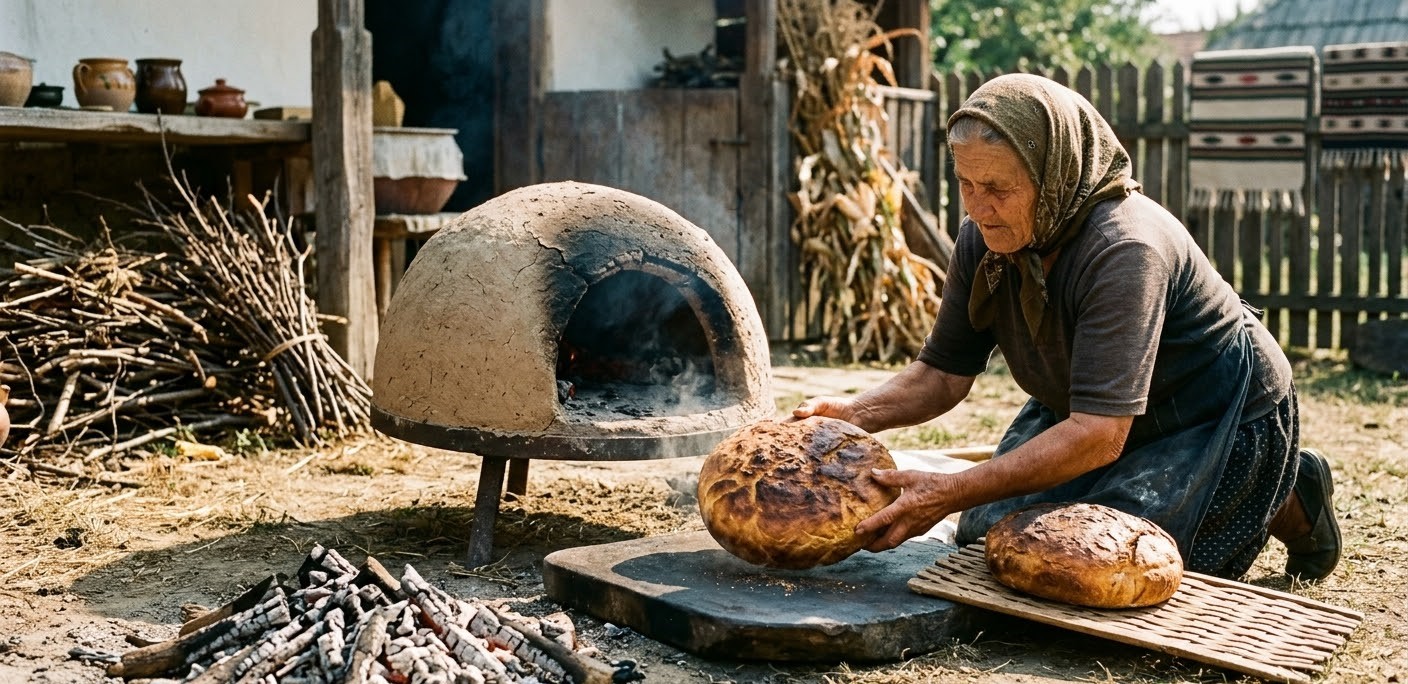
The Art of Baking with Fire
The process of baking pâine la țest is an exercise in timing and sensory skill:
- The Heating: A fire of dry twigs and corn husks is lit directly on the hearth where the bread will sit. The țest dome is placed over the fire to soak up the heat until the clay glows with a dull red warmth.
- The Hearth: Once the fire burns down, the ashes are swept away, and the flat dough (often flavored with a bit of lard or topped with pumpkin seeds) is placed on the hot stone or ceramic base.
- The Seal: The heated dome is lowered over the dough, and sometimes the edges are sealed with fresh mud to keep every bit of steam inside.
- The Result: After about 45 minutes, the dome is lifted to reveal a loaf with a charred, smoky crust and an interior that smells like the very essence of the Romanian harvest.
- The Material: A traditional țest is made from a specific mixture of yellow clay, chopped straw, and horsehair (which acts as a binding agent to prevent cracking).
- The Science: The clay dome acts as a thermal mass. It radiates infrared heat from all sides, much like a modern professional deck oven, but with the added benefit of natural humidity from the clay.
- Regionality: While once found all over the Balkans, the specific Romanian țest is most famously preserved in the villages of the Danube Valley and the Olt River region.
- More than just Bread: While bread is the star, the țest is also used to cook "Pui la țest" (chicken) or "Sarmale," giving the meat a unique smoky flavor.
- The "Hobbit" Kitchen: A collection of țesturi in a backyard looks like a series of tiny clay huts, often covered with a small wooden roof to protect them from the rain.
- The Sound of Quality: You know the bread is ready when you tap the bottom of the hot loaf and it sounds hollow—a "knock" that every Romanian grandmother knows by heart.
FAQ: Pâinea la Țest - The Ancient Clay Oven Bread
Q: What exactly is a "țest"?
A: A țest is a portable, bell-shaped dome made from a specific mixture of clay, straw, and horsehair. It acts as a miniature clay oven that is heated by a fire and then lowered over the dough to bake it using intense, radiant heat.
Q: Is "Pâinea la Țest" different from regular oven bread?
A: Yes, significantly. Because the clay dome is porous, it manages moisture differently than a metal or brick oven. The result is a much thicker, crunchier crust with a distinct smoky aroma, while the inside remains remarkably soft and airy.
Q: Why is horsehair used in making the dome?
A: Horsehair acts as a natural reinforcement (similar to rebar in concrete). It binds the clay together as it dries and prevents the dome from cracking when it is repeatedly exposed to high temperatures from the fire.
Q: Is this tradition still alive in Romania?
A: While it has become rarer in modern cities, it is still very much a living tradition in the villages of southern Romania, particularly in Oltenia and Muntenia. In recent years, it has seen a revival in "slow food" restaurants and traditional festivals.
Q: How long does it take to bake a loaf?
A: Once the țest is properly heated (which takes about 20–30 minutes), the bread itself bakes in about 45 to 60 minutes. The dome retains heat so well that several loaves can sometimes be baked in succession.
Q: Can you cook other things under a "țest"?
A: Absolutely! It is quite common to cook chicken, potatoes, or even small pots of sarmale (cabbage rolls) under the dome. The slow-roasting effect and the light infusion of wood smoke make the food incredibly tender.
Q: Why was it traditionally made only by women?
A: In Romanian folklore, the creation of the țest was seen as a domestic ritual linked to the hearth and fertility. It was often a communal activity where women from the village would gather to knead the clay with their bare feet, turning a chore into a social and spiritual event.
