Legend & Folklore: The Feathered Baby Deliverer
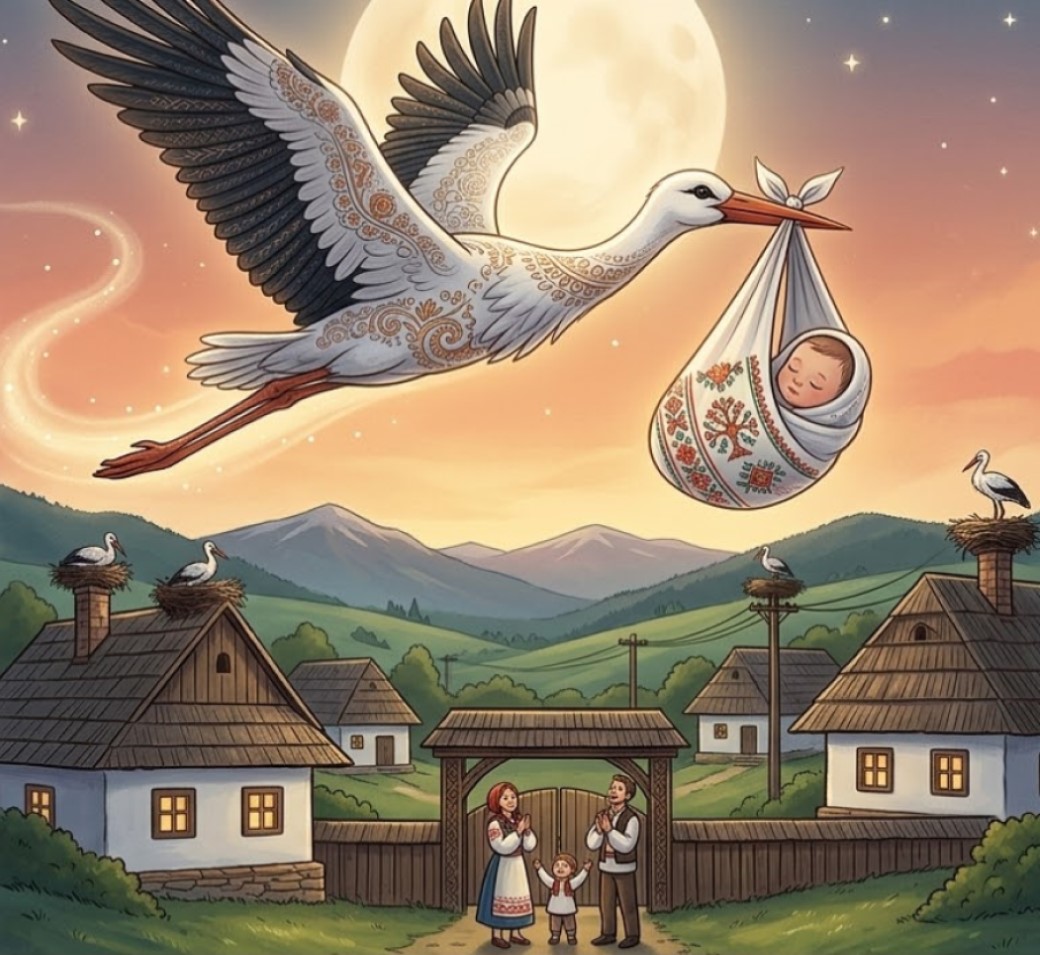
Perhaps the most universally recognized myth involving the White Stork is its role as a bringer of new life. In Romania, this legend is deeply ingrained in family folklore and is often used by parents as a gentle explanation for very young children curious about where babies come from.
The story told to children goes like this: When a family is ready for a child, they must wait for the stork. These magical birds fly over the villages, carrying the perfect baby for each specific family in a white cloth held tightly in their strong beaks. They fly down the chimney or through an open window to deliver the precious cargo.
This charming legend beautifully mirrors the stork’s actual behavior: they always return to the same nest, they are known for their devotion as parents, and their arrival coincides with spring—a universal time of rebirth and new beginnings.
Biodiversity: Storks and the Romanian Village Ecosystem
The White Stork is deeply connected to traditional, extensive agriculture. Their presence is an indicator of a healthy, biodiverse environment:
- Habitat: Storks thrive in wet meadows, pastures, and shallow wetlands near villages. These areas provide their diverse diet of frogs, insects (especially grasshoppers), rodents, and small snakes.
- The Nest Effect: Stork nests are massive structures, often weighing hundreds of kilograms. They are not just homes for storks; their tangled branches provide shelter for many smaller birds, like tree sparrows, creating a mini-ecosystem high above the ground.
- Conservation Status: While widespread in Romania, the intensification of agriculture and the drainage of wetlands are ongoing threats. Romania’s network of traditional pastures is crucial for their long-term survival.
- The Stork Capital: The village of Vlădeni in Brașov County is often cited as a "Stork Village" due to the high density of nests. The region of Transylvania, in general, has many villages where every second pole has a nest.
- Bill-Clattering (Toca-Toca): Storks don't sing. Instead, they communicate by rapidly clattering their beaks together (called tocat in Romanian), creating a distinctive, rhythmic sound that echoes through the villages during mating season.
- Long-Distance Travelers: Storks are amazing migrators. Romanian storks travel thousands of kilometers every autumn, crossing the Bosphorus strait to spend the winter in sub-Saharan Africa.
Frequently Asked Questions: The White Stork
1. Why is the stork considered a symbol of family in Romania?
Beyond the legend of delivering babies, storks are seen as symbols of family because of their behavior. They are monogamous during the breeding season and show incredible devotion to their chicks. The fact that they return to the exact same nest year after year makes them a symbol of loyalty and the "home hearth."
2. Is the story about storks bringing babies unique to Romania?
While the legend exists in many European cultures, it is particularly beloved in Romania. Parents use it as a poetic way to explain the "miracle of life" to children who are too young to understand biological processes, telling them that the stork chooses the right baby for the right family and carries it safely in its beak.
3. Where is the best place in Romania to see stork nests?
While they are common across the country, the villages in Transylvania and the Danube Delta (see more) regions have the highest density. Villages like Christian (near Sibiu) or Vlădeni (near Brașov) are famous for having dozens of active nests that visitors can observe from the street.
4. How many babies do storks usually have?
A stork pair typically lays between 2 and 5 eggs per year. Both parents take turns incubating the eggs and feeding the chicks. By the time August comes, the "babies" are almost as large as their parents and ready for the long flight to Africa.
5. What should I do if I find an injured stork?
Romanians are very protective of these birds. If you find one in distress, there are dedicated organizations like "Prietenii Berzelor" (Friends of Storks) in Cristian that provide medical care and shelter for injured birds until they can fly again.
6. Do storks only eat frogs?
That is a common myth! While they do enjoy frogs, storks are "sanitizers" of the fields. They eat a wide variety of prey, including large insects (like locusts), mice, voles, and even small snakes, helping farmers keep pests under control naturally.
