
The Lungs of Europe: Climate & Air Quality
The importance of these forests goes far beyond their beauty. They are sophisticated biological machines that sustain life:
- Carbon Champions: A single mature beech tree can produce enough oxygen for 10 people every day and absorbs massive amounts of CO2 locking it away in its dense wood for centuries.
- Natural Air Purifiers: Their broad leaves filter dust and pollutants, making the air in regions like the Carpathian mountains some of the purest in the world.
- Water Guardians: The deep leaf litter (the "carpet" of the forest) acts as a giant sponge, preventing soil erosion and ensuring that mountain springs—like the ones in our villages—stay clean and flow year-round.
Legends and Heritage
The "Codru" Spirit
In Romanian folklore, the beech forest is often referred to as the "Codru" – a place that is alive and protective. It was said that the forest was "the brother of the Romanian" (Codrul e frate cu Românul), providing refuge and sustenance during difficult times in history.
UNESCO World Heritage
Since 2017, many of Romania's ancient and primeval beech forests (such as those in Semenic (see more), Nera Gorges (see more), and Maramureș (see more)) have been protected by UNESCO. They are considered "evolutionary laboratories" where nature has been allowed to follow its own rules without human interference for thousands of years.
Seasonal Magic for Photographers
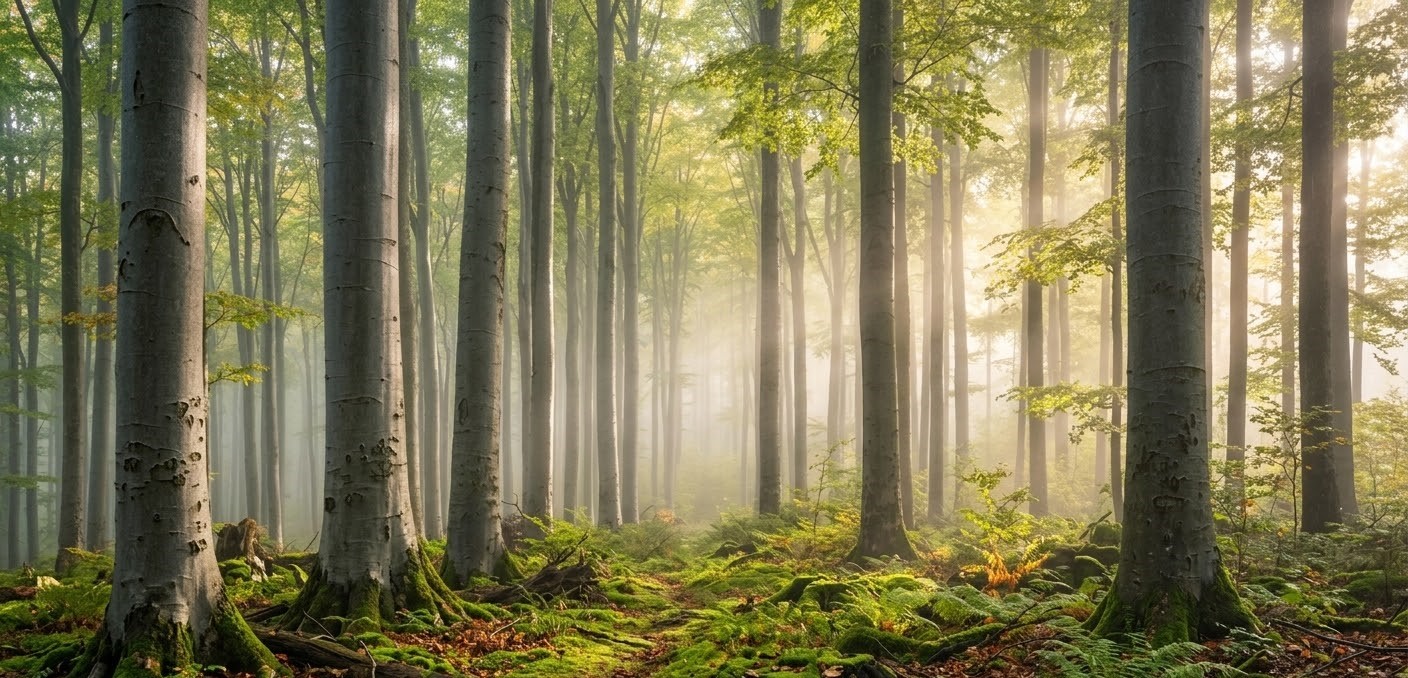
- The Copper Autumn: In late October, the beech forests transform into a sea of fire. The leaves turn a deep copper-orange, creating a breathtaking contrast against the silver-gray bark of the trunks.
- The Cathedral Effect: Because beeches grow very tall with a high canopy, walking through an old-growth forest feels like being in a natural cathedral, with sunbeams filtering down like golden spotlights.
- Scientific Name: Fagus sylvatica
- Average Height: 25–35 meters (some reach 45m in virgin areas)
- Lifespan: 150–300 years (up to 500 years in protected zones)
- Status: Large areas are under UNESCO and National Park protection.
- Key Locations: Semenic-Cheile Carașului, Izvoarele Nerei, Domogled-Valea Cernei, and the Făgăraș Mountains (see more).
The ancient beech forests of Romania are more than just a beautiful landscape; they are our planet's living defense system. When you visit these "Gray Giants," you are stepping into a sacred space that has balanced our climate for thousands of years.
How you can help:
- Leave No Trace: Ensure that the only thing you leave behind are footprints and the only things you take are photographs.
- Spread the Word: By sharing the story of Romania’s UNESCO beech forests, you help the world understand why their preservation is vital for our global climate.
- Support Local: Choose eco-friendly tours and stay in local guest houses in villages like Cuib (see more) or those in the heart of Bukovina, which respect and protect the surrounding woods.
FAQ: The Vital Role of Beech Forests
How does a beech forest improve air quality?
Beech trees act as massive biological filters. Their dense canopy and hairy leaf surfaces trap fine dust particles and pollutants from the atmosphere. Furthermore, through photosynthesis, a single hectare of mature beech forest can produce up to 30 tons of oxygen per year, making the Carpathian air exceptionally crisp and healthy.
Can these forests really help fight climate change?
Yes, significantly. Fagus sylvatica is a "carbon sink." It captures CO2 from the air and stores it in its biomass (trunk, branches, and roots) and in the soil. Because these trees live for centuries, they keep that carbon locked away, preventing it from heating the planet. Protecting our old-growth forests is one of the most effective ways to stabilize the climate.
Is it true that beech forests regulate the water cycle?
Absolutely. The thick layer of fallen leaves (litter) on the forest floor acts as a natural sponge. It slows down rainwater, allowing it to seep into the ground and recharge underground aquifers instead of causing flash floods. This is why mountain villages near healthy forests, like Cuib, often have reliable and clean water sources.
Why are Romania's beech forests part of the UNESCO World Heritage?
UNESCO protects them because they represent the most complete and best-preserved examples of post-glacial forest expansion in Europe. In countries like Germany or France, most forests were managed or replanted, but in Romania, we still have "primary" forests where nature has evolved undisturbed for millennia.
What wildlife depends on the beech (Fagus sylvatica)?
The beech forest is an entire ecosystem. The "beechnuts" (fructul fagului) are a crucial, high-fat food source for bears, wild boars, and squirrels before winter. Additionally, the hollows in old beech trees provide essential nesting sites for rare woodpeckers, owls, and the elusive lynx.
How can tourists help preserve these forests?
The best way is to practice "Leave No Trace" tourism. Stay on marked paths to avoid soil compaction, never carve into the silver bark (which can introduce diseases to the tree), and support local communities that prioritize eco-tourism over industrial logging.
