
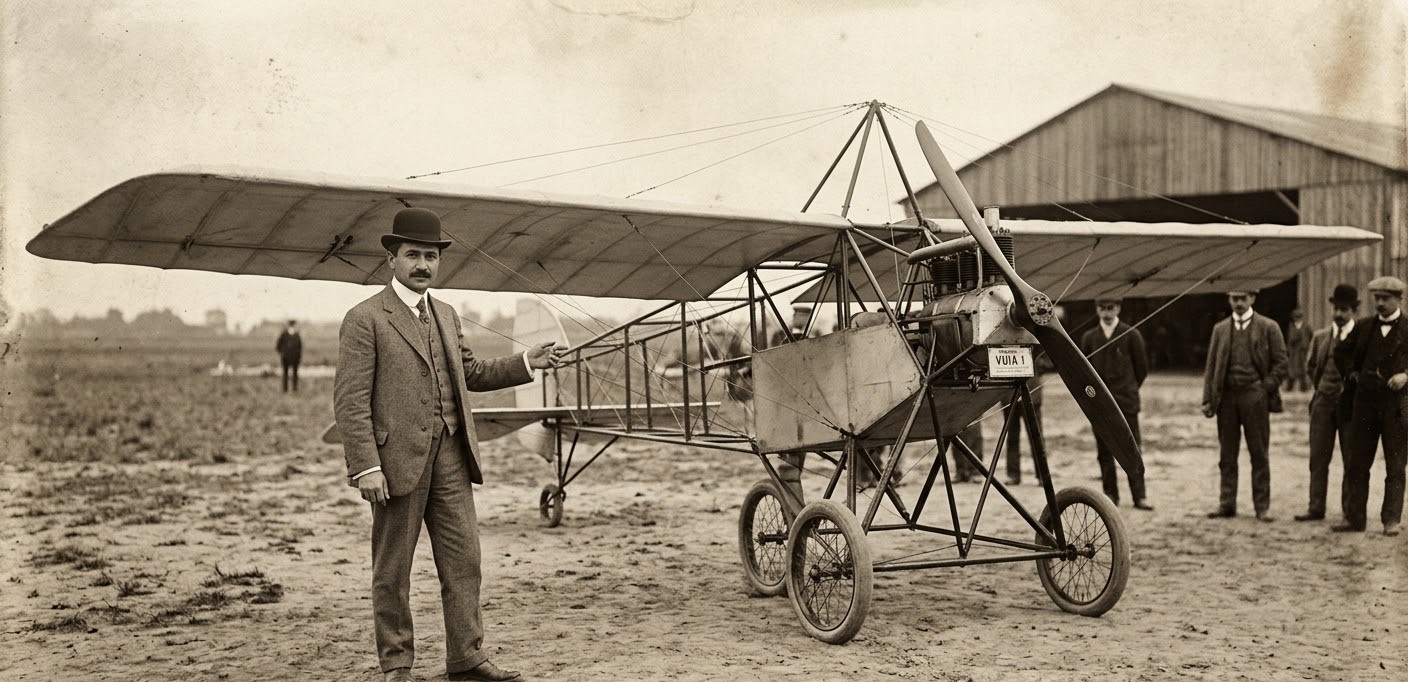
The Vuia No. 1: "The Bat"
Vuia’s aircraft, nicknamed "The Bat" (Liliacul), was a masterpiece of independent engineering for its time. Unlike other early pioneers who used external help to launch, Vuia's machine took off from a flat surface using only its own engine power. He was also the first to use rubber tires on his landing gear, a feature that eventually became standard for all modern aircraft.
A Legacy Beyond the Skies
Traian Vuia was not just a dreamer; he was a brilliant mechanical engineer. Beyond his famous 1906 flight, he continued to innovate throughout his life. Between 1918 and 1922, he designed several experimental helicopters, contributing significantly to vertical flight theory. Later, he invented a highly efficient steam generator that is still studied in industrial engineering today.
The Golden Triangle of Romanian Aviation
Traian Vuia does not stand alone in history. He is one part of what we call the "Golden Triangle" of Romanian Aviation Pioneers, alongside Aurel Vlaicu (see more) and Henri Coandă (see more).
While Vuia was the first to achieve an autonomous takeoff with a self-propelled aircraft in 1906, his work inspired a generation of Romanian geniuses. Shortly after, Aurel Vlaicu revolutionized aircraft stability and maneuverability, and Henri Coandă changed the world forever by inventing the first jet-powered aircraft in 1910.
Together, these three icons represent the "birth certificate" of global aviation. When you visit Romania today, you are walking in the footsteps of the men who gave wings to the 20th century.
Why He is a Global Icon
For any international visitor interested in history or science, Traian Vuia represents the spirit of perseverance. Coming from a small village in Banat, he reached the heights of global science through sheer intellect. Today, the Timișoara International Airport and his home village proudly bear his name as a tribute to his genius.
FAQ: Traian Vuia and the Invention of Flight
Did Traian Vuia fly before the Wright Brothers?
The Wright Brothers flew in 1903, but they used a catapult system and rails for take-off. Traian Vuia's historic flight in 1906 was the first time a heavier-than-air aircraft took off entirely on its own power from a normal road, without any external assistance.
What happened during his first flight?
On March 18, 1906, at Montesson, Vuia’s aircraft accelerated for about 50 meters and then lifted into the air. He flew at an altitude of about 1 meter for a distance of 12 meters before landing safely. While it seems short today, it proved to the world that self-propulsion was possible.
Where can I see his inventions today?
A famous replica of the Vuia No. 1 is kept at the National Military Museum in Bucharest. There is also a memorial museum dedicated to him in his birth village, Traian Vuia, in Timiș County.
Was he only interested in airplanes?
No. Vuia was a versatile inventor. He designed steam engines and worked on early helicopter designs, proving that his understanding of propulsion was decades ahead of his time.
