
Technical Details & Architecture
- Location: Sucevița, Suceava County, Bukovina region.
- Built: Between 1583 and 1586 by the Movilă family of boyars.
- Fortifications: Unlike other painted churches, Sucevița is enclosed by massive walls (6 meters high and 3 meters thick) and defensive towers, giving it the appearance of a medieval fortress.
- Style: A perfect blend of Byzantine and Gothic elements, with a specific Moldavian touch.
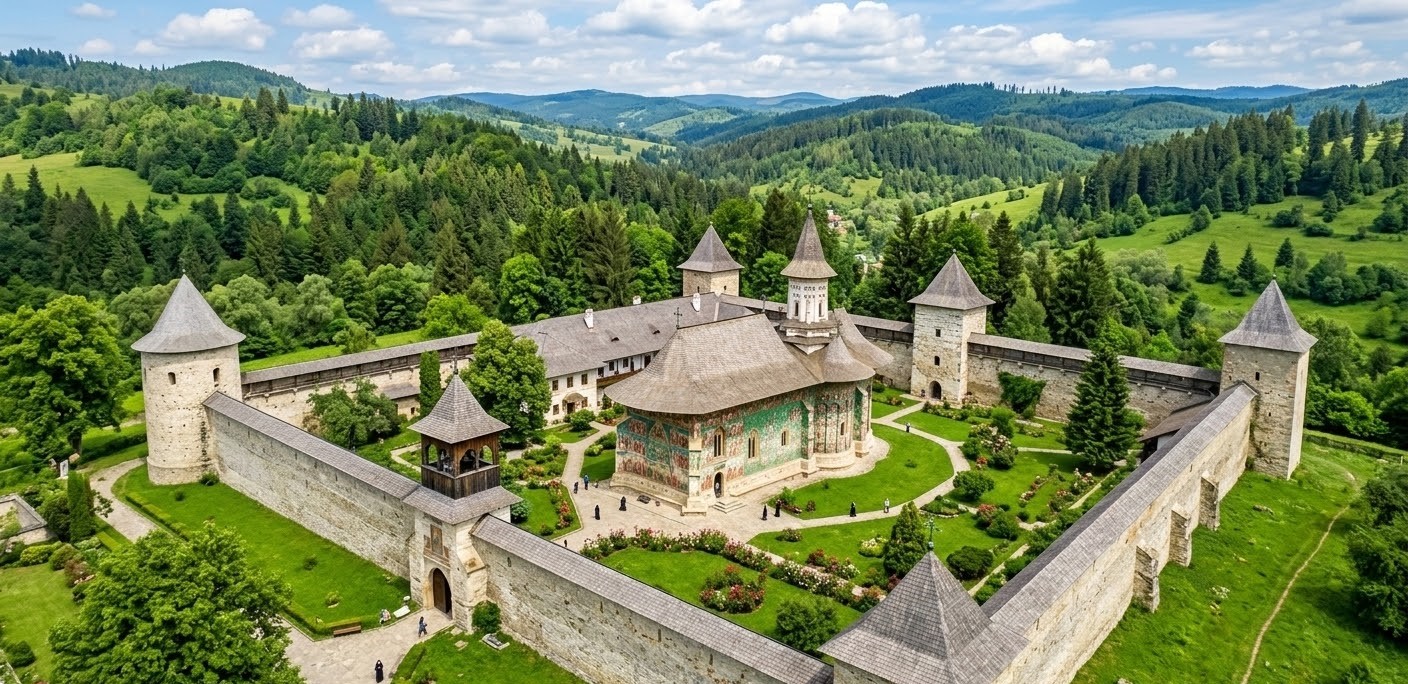
Biodiversity: The Green Valley
The monastery is situated in the picturesque valley of the Sucevița river, surrounded by rolling hills and dense forests.
- Flora: The courtyard is famous for its meticulously kept rose gardens.
- Surroundings: The nearby forests are dominated by spruce and fir trees, part of the extensive Bukovina woodland where wild deer and rare forest birds are frequently spotted.
The Sacrifice of the Old Woman
Legend has it that an old woman, to atone for her sins, hauled the stones used to build the monastery with her ox-drawn cart for 30 years. As a tribute to her devotion, her head is said to be carved in stone somewhere on the monastery's bell tower.
The "Incomplete" Painting
One of the most famous frescoes is the "Ladder of Divine Ascent." Legend says that while the artists were painting this masterpiece, one of them fell from the scaffolding and died. Out of respect and fear, the remaining artists left a small portion of the wall unfinished, which can still be seen today.
Fun Facts for Travelers
- The "Sucevița Green": Just as Voroneț (see more) has its blue, Sucevița is defined by a deep, vibrant emerald green background in its frescoes, made from secret natural pigments.
- UNESCO World Heritage: It was added to the UNESCO list in 2010, completing the "Painted Churches of Moldavia" group.
- The Living Museum: It remains a working nunnery. The nuns here are famous for their skill in traditional embroidery and painting icons.
While Sucevița was not directly built by Stephen the Great (Ștefan cel Mare) (see more), it is considered the most loyal continuation of the "Moldavian Style" he established.
The Movilă brothers were not just rulers; they were great admirers of Stephen's era. By strictly following his architectural blueprints—the trefoil plan, the Gothic windows, and the high-pitched shingle roofs—they sought to prove their legitimacy on the throne. For the Movilă family, building Sucevița in this specific style was a way to tell the world: "We are the true successors of Stephen the Great." It is, in essence, the final, grand tribute to the golden age of Moldavian history.
The Sacred Connection: Moldovița and Sucevița
When exploring the painted wonders of Bukovina, it is impossible to separate the stories of Moldovița (see more) and Sucevița. Linked by both geography and history, these two fortified treasures represent the pinnacle of Moldavian medieval art.
A stunning aerial video presenting Sucevița Monastery (Mănăstirea Sucevița):
Frequently Asked Questions: Sucevița Monastery (Mănăstirea Sucevița)
1. Where is Sucevița Monastery located?
It is located in the commune of Sucevița, in the historical region of Bukovina (Suceava County), Northeastern Romania. It sits in a beautiful valley between the Obcina Mare and Obcina Feredeului mountains.
2. What makes Sucevița different from other painted churches?
Sucevița is the only painted church that features a massive fortress-like enclosure with thick walls and defensive towers. It also has the largest number of individual images (frescoes) of all the Moldavian churches.
3. Is there a specific dress code for visitors?
Yes. As a functioning nunnery and sacred site, visitors are asked to dress modestly. Shoulders and knees should be covered. If you are wearing shorts or a sleeveless shirt, the monastery usually provides traditional wrap-around skirts or capes at the entrance.
4. Am I allowed to take photos?
You are welcome to take photos of the exterior frescoes and the stunning courtyard. However, photography and filming are strictly forbidden inside the church to protect the centuries-old pigments from flash damage and to maintain a prayerful atmosphere.
5. What is the "Ladder of Virtues" fresco?
It is the most famous painting on the northern exterior wall. it depicts the struggle between good and evil, showing monks ascending a ladder to heaven while being pulled down by demons. It is considered a masterpiece of Eastern Orthodox iconography.
6. How much time should I plan for a visit?
To truly appreciate the exterior details and the small museum inside the monastery, we recommend planning for at least 1 to 1.5 hours.
7. Can I find accommodation nearby?
Absolutely. The village of Sucevița is famous for its traditional agritourism. You can find many guesthouses that serve organic, local Bukovina cuisine right within walking distance of the monastery.
8. Why is one side of the church unpainted?
The western wall of the church is blank. Legend says the painter fell from the scaffolding and died before finishing it, and out of superstition, no other artist ever dared to complete the work.
