

Movile Cave: The Alien World Under Romania Legends
1. The Sealed Ecosystem (The Cave from Another Planet)
The Story: Discovered in 1986 during some geological tests for a power plant, Movile Cave is one of the most isolated places on Earth. It was completely cut off from the atmosphere and sunlight for millions of years. Inside, the air is toxic for humans (high in hydrogen sulfide and carbon dioxide), but it’s a paradise for creatures that don't exist anywhere else on the planet. For a tourist, this is like finding a real-life "Area 51" under the Dobrogean soil.
2. The Creatures of the Dark (Life without Light)
The Legend: Science meets science-fiction. The Story: There are over 50 species of insects, scorpions, and leeches inside that are unique to this one cave. Because they lived in total darkness, they have no eyes and no pigment—they are completely white or translucent. Legend among explorers says that these creatures didn't just survive; they evolved into a perfectly closed "alien" society that doesn't need the Sun to exist. They live off bacteria that eat sulfur. It’s the only place on Earth where life is based on chemosynthesis, not photosynthesis!
3. The Legend of the "Underground Sea"
The Legend: A hidden lake beneath the dry fields of Dobrogea. The Story: Inside the cave, there is a thermal lake with sulphurous water. Local folklore in the Mangalia area often spoke of "bottomless wells" and warm currents coming from deep underground. When Movile was found, the legends were confirmed. Some say the cave is just the "entrance hall" to a massive, unexplored network of flooded tunnels that stretch all the way to the Black Sea.
A sciencific video of the Movile Cave (Peștera Movile):
Location & Geography
Discovered in 1986 near the city of Mangalia, in Constanța County, Movile Cave is located just a few kilometers from the Black Sea coast.
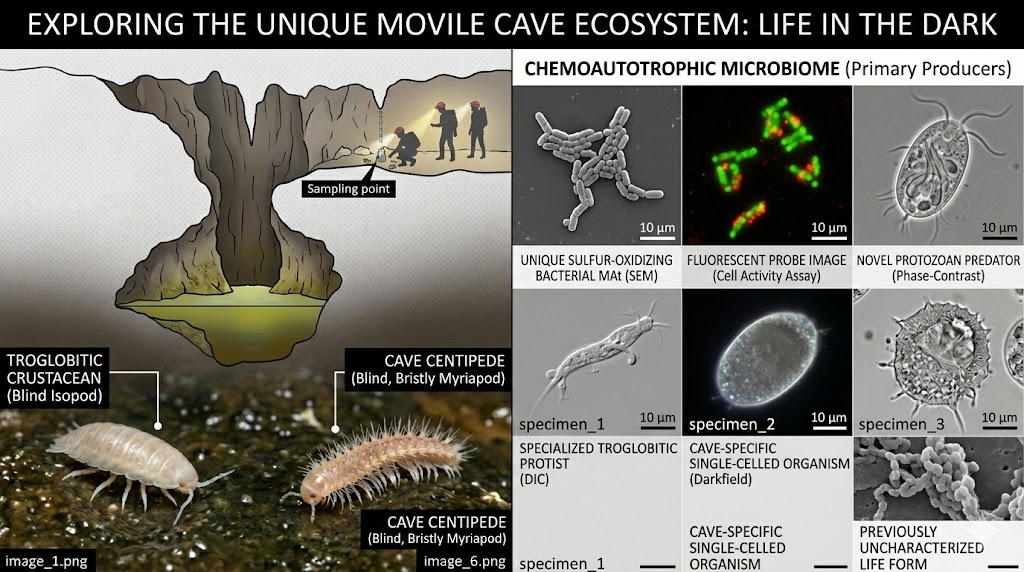
Geologically, it is a unique "time capsule":
Total Isolation: The cave was sealed by thick layers of clay and limestone during the late Miocene, cutting it off from the Earth's atmosphere and surface waters.
Atmosphere: The air is low in oxygen (about 7-10%) but rich in carbon dioxide and methane. It also contains high levels of hydrogen sulfide (H2S).
The Lake: The cave features an underground lake with thermal sulfuric waters (21°C).
A video from inside the Movile Cave (Pestera Movile) Constanța county:
Why is Movile Cave World-Famous?
Life Without Photosynthesis: Unlike almost everywhere else on Earth, life here doesn't depend on the sun. Instead, it relies on chemosynthesis—bacteria that extract energy from chemical reactions (oxidizing sulfur and methane).
Unique Species: Out of the 50+ species discovered inside, 35 are found nowhere else on the planet. These include blind leeches, translucent spiders, and "water scorpions."
The NASA Connection: Scientists from NASA and research centers worldwide study Movile to understand how life might exist on Mars or the moons of Jupiter, where conditions are similarly extreme.
Evolutionary Mystery: Because the creatures have lived in total darkness for millions of years, they have completely lost their eyes and skin pigment, developing extra-long antennae to navigate.
Tourist Access: Can You Visit?
Important Notice: Due to its extreme fragility and the toxic atmosphere, Movile Cave is closed to the public. * Only certified divers and scientists with special equipment are allowed inside.
Even researchers must spend limited time inside to avoid contaminating the ecosystem with human breath (CO2).
For Tourists: You can visit the Marine Biological Station in Agigea or museums in Mangalia like : Click HERE to view Callatis Museum Mangalia, where you can find detailed information and high-quality footage of this extraordinary "closed world."
Frequently Asked Questions (FAQ) - Movile Cave
1. Can tourists visit Movile Cave? No, Movile Cave is strictly closed to the general public. It is a high-security scientific reserve. Access is granted only to specialized researchers and divers to protect the fragile, closed ecosystem from human contamination.
2. Why is Movile Cave famous? It is world-famous for being the first known terrestrial ecosystem based on chemosynthesis rather than photosynthesis. It was sealed off from the Earth's atmosphere for over 5.5 million years, creating an "alien" environment.
3. What kind of animals live in Movile Cave? Scientists have discovered over 50 species inside, including spiders, scorpions, centipedes, and leeches. Of these, 35 species are endemic, meaning they are found nowhere else on Earth. These creatures are blind and translucent due to millions of years spent in total darkness.
4. Is the air inside Movile Cave toxic to humans? Yes, the atmosphere inside is very harsh. It contains only about 7-10% oxygen (compared to 21% on the surface) and is rich in carbon dioxide, methane, and hydrogen sulfide (H2$). Researchers must use special breathing equipment to survive inside.
5. How was Movile Cave discovered? The cave was discovered by accident in 1986 by Romanian geologist Cristian Lascu while he was testing the ground for the construction of a power plant near Mangalia.
