
Biodiversity: A Botanical Fortress
The Trascău range is a biodiversity hotspot, largely thanks to its massive limestone composition. The alkaline soil created by the rocks supports rare flora that you won't find elsewhere.
- The Szekler’s Rock Pink (Dianthus callizonus): While the Piatra Craiului version is famous, Trascău has its own unique floral gems tucked into the crevices of the Râmeț Gorges.
- The Edelweiss (see more): Surprisingly, you can find this "Queen of the Mountains" at relatively low altitudes here (around 1,000 meters) because of the specific microclimate of the limestone walls.
- Wildlife: The area is a sanctuary for large carnivores, but it is also famous for its vulture populations and the Carpathian chamois (see more) that roam the steep cliffs of Piatra Secuiului.
The Sleeping Giant of Rimetea
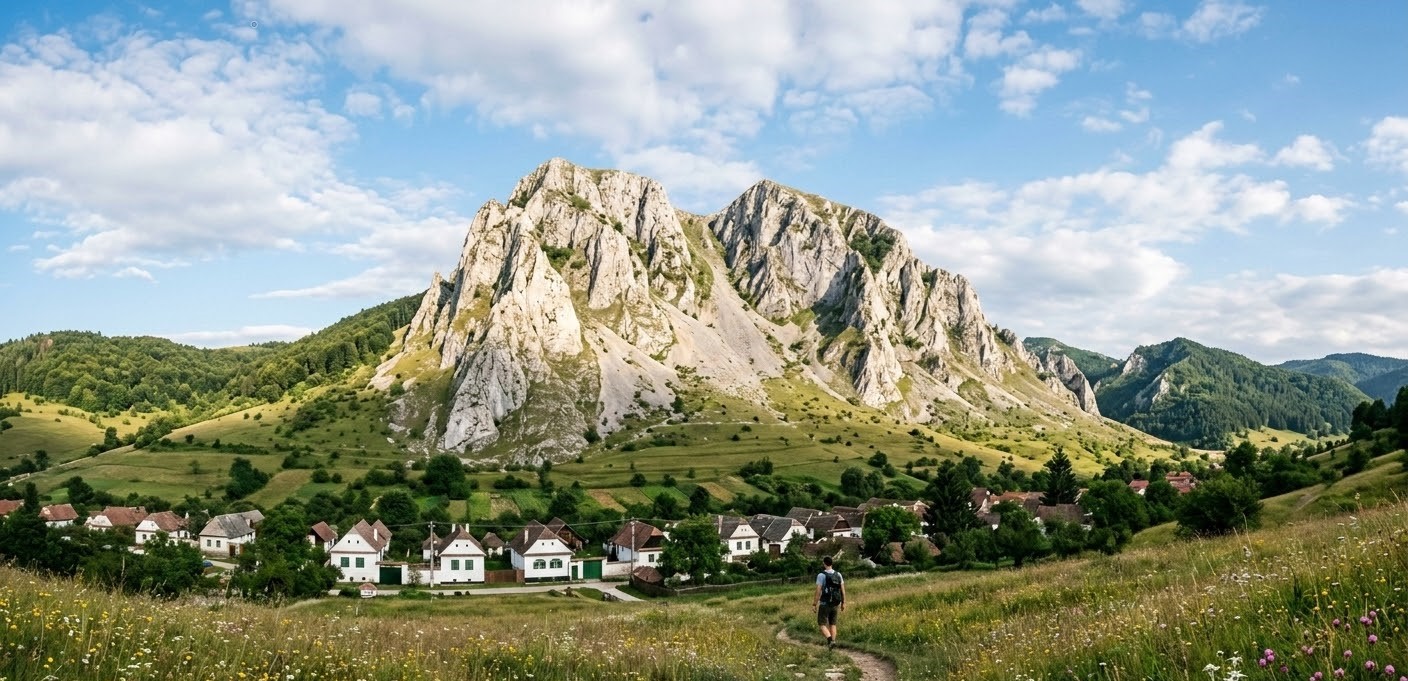
If you look at the mountain known as Piatra Secuiului (The Szekler’s Rock) from the village of Rimetea, it looks like a giant lying on his back. Legend says that the giant was once a protector of the valley who was turned to stone by a wizard’s curse. Locals claim that on certain nights, you can still hear the mountain "sighing" as the wind passes through its caves.
The Devil’s Bridge (Podul Coșovei)
In the heart of the Râmeț Gorges, there is a massive rock formation forming a natural bridge. Legend tells of a villager who tried to outsmart the Devil to save his soul; the Devil, in a fit of rage, threw a massive boulder to block the path, but it got stuck between the canyon walls, creating the bridge we see today.
Fun Facts for the Curious
- The Village Where the Sun Rises Twice: In Rimetea (see more), because of the massive Piatra Secuiului cliff towering over the village, the sun rises in the morning, disappears behind the mountain, and then "rises" again later in the day as it clears the peak.
- A Fortress of Ice: The Scărișoara Ice Cave (see more) is nearby, but the Trascău range itself is riddled with over 600 caves, some of which still contain the bones of the extinct Cave Bear (Ursus spelaeus).
- UNESCO Heritage: The village of Rimetea, at the foot of these mountains, was the first in Romania to be awarded the Europa Nostra prize for its impeccably preserved 19th-century white houses with green shutters.
For those planning a trek, here are the essential stats:
- Highest Peak: Vârful Dâmbău (1347 Meters).
- Main Rock Type: Jurassic Limestone (which explains the spectacular caves and gorges).
- Key Gorges: Cheile Râmețului, Cheile Turzii, and Cheile Vălișoarei.
- Accessibility: Best reached from the cities of Alba Iulia or Cluj-Napoca.
Frequently Asked Questions: Trascău Mountains
Where are the Trascău Mountains located?
The Trascău Mountains are situated in the southern part of the Apuseni Range (Western Carpathians) in central Romania. They are primarily located in Alba County, making them easily accessible from cities like Cluj-Napoca (about a 1-hour drive) and Alba Iulia (about 45 minutes).
What is the best time of year to visit?
Late spring (May to June) is ideal for witnessing the mountain flora and waterfalls at full flow. Autumn (September to October) offers excellent hiking conditions with crisp air and spectacular foliage colors contrasting against the white limestone. Winter is beautiful for photography, but many trails—especially through the gorges—can become dangerous due to ice and high water levels.
Are the hiking trails difficult?
The Trascău Mountains offer a variety of difficulty levels. The ascent from Rimetea to Piatra Secuiului is steep but manageable for anyone with average physical fitness. In contrast, trails through the Râmeț Gorges (Cheile Râmețului) can be challenging, involving sections with metal cables and rungs fixed into the rock, or even wading through water during rainy periods.
Where should I stay?
The village of Rimetea is the most popular hub, famous for its uniform white architecture and traditional guesthouses. Other excellent options include the village of Colțești, home to the ruins of a medieval fortress, or the Râmeț area for those seeking the quiet atmosphere near the monastery.
Is it true the sun rises twice in Rimetea?
Yes. Due to the vertical shape of the Piatra Secuiului massif, the sun appears in the morning, then is "hidden" by the massive shoulder of the rock as it climbs, only to reappear a short while later once it clears the ridge. This phenomenon creates the illusion of a double sunrise.
What are the main tourist attractions?
Piatra Secuiului (Szekler's Rock) is the most iconic viewpoint. The Trascău Fortress (Colțești Fortress) offers a glimpse into 13th-century history. Other must-see spots include the Huda lui Papară Cave and the Vânătările Ponorului waterfall, where water spectacularly disappears into the earth.
Is there a risk of encountering bears?
While the Carpathians are home to brown bears, they are less frequently encountered on the open limestone plateaus of Trascău compared to the dense forests of the Southern Carpathians. However, their presence is confirmed in the area. Caution is advised, including making noise while hiking and properly storing food.
Can the area be visited without a car?
It is difficult but possible. There are buses from Aiud to Rimetea or Râmeț, but they run infrequently. For the best experience, renting a car or booking a private tour from nearby major cities is recommended.
