
The Master of "Amintiri din copilărie" (Childhood Memories)
His masterpiece, "Amintiri din copilărie", is more than just a collection of stories. It is a nostalgic journey into the heart of a traditional Romanian village.
- Nică a lui Ștefan a Petrei: This is the alter-ego of Creangă, a mischievous boy whose adventures—from stealing cherries to "kidnapping" the famous hoopoe (pupăza din tei)—have been read by every single Romanian child for over a century.
- The Universal Child: Although the setting is a specific Moldavian village (Humulești), the themes of curiosity, fear of punishment, and the joy of simple games make Nică a character that anyone, anywhere, can relate to.
- Born: March 1, 1837 (though some records suggest 1839).
- Passed Away: December 31, 1889.
- Age: He died at only 52 years old on New Year's Eve, following a struggle with epilepsy—a condition he inherited from his mother.
- The Rebellious Deacon: Before becoming the writer we know today, he was a deacon in various churches in Iași. However, his non-conformist nature led to his expulsion from the clergy. Legend says he was sanctioned for shooting at crows that dirtied the church courtyard and for attending the theater, which was forbidden for clerics at the time.
- A Pioneer of Education: Few know that Creangă co-authored the first modern Romanian literacy textbook, "Metodă nouă de scriere și cetire" (1868). He revolutionized how Romanian children learned to read and write.
- The Bohemian of "Bojdeuca": After leaving the church, he retired to the Bojdeuca in Țicău, a simple cottage overlooking the Ciric hills. He lived modestly, surrounded by many cats (which he loved dearly), and frequently hosted his best friend, the national poet Mihai Eminescu (see more).
- A Tragic End: In his final years, his health declined significantly. The death of Mihai Eminescu in June 1889 devastated him, likely accelerating his own passing just six months later on the very last night of the year.
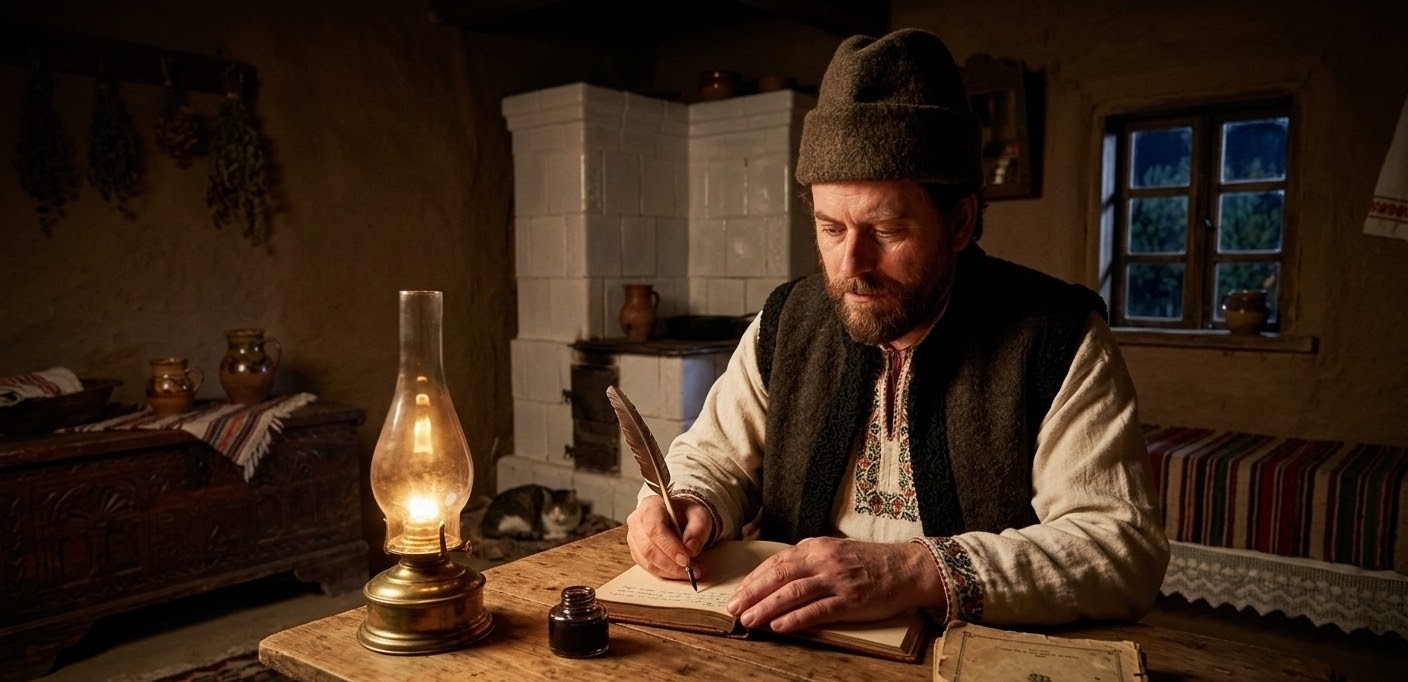
Tales and Fables: Wisdom Wrapped in Humor
Creangă was also a master of the folk tale. His stories are famous for their "common sense" wisdom and their sharp, peasant wit:
- "The Goat and Her Three Kids" (Capra cu trei iezi): A dark but moralistic tale of a mother's revenge against a treacherous wolf.
- "The Tale of Harap-Alb" (Povestea lui Harap-Alb): One of the most complex and beautiful fantasy stories in Romanian literature, depicting a prince's initiation journey filled with mythical creatures and profound lessons.
- The Language: Creangă’s genius lies in his use of regionalisms and proverbs. He didn't just tell a story; he spoke it onto the page, making the reader feel like they were sitting by a fireplace listening to a wise old grandfather.
No biography of Creangă is complete without mentioning his soulmate and best friend, the national poet Mihai Eminescu.
- It was Eminescu who recognized Creangă’s raw talent and encouraged him to write down the stories he used to tell verbally in the literary circles of Iași.
- Their friendship is legendary in Romanian culture—the intellectual, melancholic poet and the boisterous, humorous storyteller, two pillars of Romanian spirit supporting each other.
By Ion Creangă
Once upon a time, in a certain village, there lived a man so incredibly lazy that he wouldn't even chew his own food. Seeing that there was no way to change him and that he was becoming a burden to the entire community, the villagers decided to take him to the gallows to rid the world of such a useless fellow.
As they were carting him away in a horse-drawn wagon, they met a kind-hearted lady on the road. Seeing the man in the wagon, she asked:
"Good people, where are you taking this poor soul?"
"To the gallows, lady," the villagers replied, "for he is too lazy to live and is eating the village's bread for nothing."
"Oh, what a shame!" the lady said. "Don't hang him yet! I have a large granary filled with dried rusks (hard bread). Take him to my estate; he can live there and eat my rusks, and he won't be a burden to anyone."
The villagers stopped the wagon. "Do you hear that, lazybones? You've had a stroke of luck! This lady is offering you a place to stay and plenty of rusks to eat. Will you go?"
The lazy man, without even lifting his head or moving a finger, slowly opened one eye and asked the lady in a bored voice:
"But tell me, lady... are the rusks soaked in water?"
"What? Soaked?" the lady asked, surprised. "No, they are dry, but you can soak them yourself!"
The lazy man sighed deeply, closed his eye, and said to the villagers:
"Drive on, boys... the gallows is better."
FAQ: Ion Creangă – The Voice of the Romanian Village
1. Where can I visit Ion Creangă’s home?
There are two iconic locations:
- The Memorial House (see more) in Humulești (Neamț): This is the house where he was born and raised. It is a stunning example of 19th-century peasant architecture with a thatched roof and a "prispa" (traditional porch).
- The "Bojdeuca" in Țicău (Iași): This is the tiny, humble cottage where he lived as an adult and wrote his most famous works. It was the first literary memorial museum in Romania (opened in 1918).
Their friendship is considered the most beautiful in Romanian history. Eminescu (the "National Poet") was the one who discovered Creangă's storytelling talent and practically forced him to write down the stories he used to tell at the Junimea literary club. Without Eminescu’s encouragement, the "Childhood Memories" might have stayed only as spoken words.
3. What does "Povestitorul de la Humulești" mean?
It translates to "The Storyteller from Humulești." Humulești was his home village, and he remained so deeply attached to it that his writing never lost the authentic, witty, and sometimes "salty" dialect of the Moldavian peasants.
4. Is his work difficult for foreigners to read?
The plots (stealing cherries, the hoopoe (see more), the goat and her kids) are universal and easy to enjoy. However, Creangă used many archaisms and proverbs that are a delight for linguists but a challenge for translators. Most modern English editions do a great job of capturing his "peasant wisdom" and humor.
5. What happened to the famous "Pupăza din Tei"?
In the story, after Nică (the young Creangă) stole the bird and tried to sell it at the market, he eventually had to release it due to the village scandal. The bird returned to its hollow linden tree (see more), and for generations of Romanians, it has remained a symbol of the "early morning alarm" and the innocence of rural childhood.
