
The Story of the Golden Bread
- Historical Roots: Corn was introduced to Romania in the 17th century and quickly became the staple food of the peasantry because it was easy to grow and prepare.
- Versatility: It can be served in many forms: soft and creamy like a porridge, or firm enough to be sliced with a piece of sewing thread (the traditional way).
- The Shepherd’s Companion: In the mountains, shepherds prepare "Bulz" (see more)- mămăliga filled with salty sheep cheese and grilled over open flames.
- Mămăligă cu Brânză și Smântână (MBS): The classic comfort food, served with fresh cow or sheep cheese and a generous dollop of sour cream.
- The Perfect Side: It is the mandatory companion for Sarmale (cabbage rolls) (see more) or fried fish with Mujdei (strong garlic sauce).
- Rural Tradition: In villages mămăliga is still the soul of any family gathering around the wooden table.
In Romanian folklore, mămăliga is more than just a meal; it is a sacred symbol of the earth's generosity. Legend has it that in ancient times, when our villages were often raided and wheat (see more) for bread was scarce, the land offered a gift to the people: corn.
- The Hidden Gold: It is said that corn kernels are actually tiny rays of sunshine that the earth captured and transformed into food to save the Romanian people from hunger during harsh winters.
- The Ritual of Unity: A round mămăliga placed in the center of a wooden table represents the sun from the sky brought into the home. Traditionally, the head of the family would cut it with a thread while making the sign of the cross, a gesture of gratitude for the abundance of the land.
- The Shepherd’s Strength: Another mountain legend says that a shepherd who eats mămăliga with salty sheep cheese gains the strength of the bear and the agility of the wolf, receiving protection from the spirits of the mountains as long as he respects the wild.
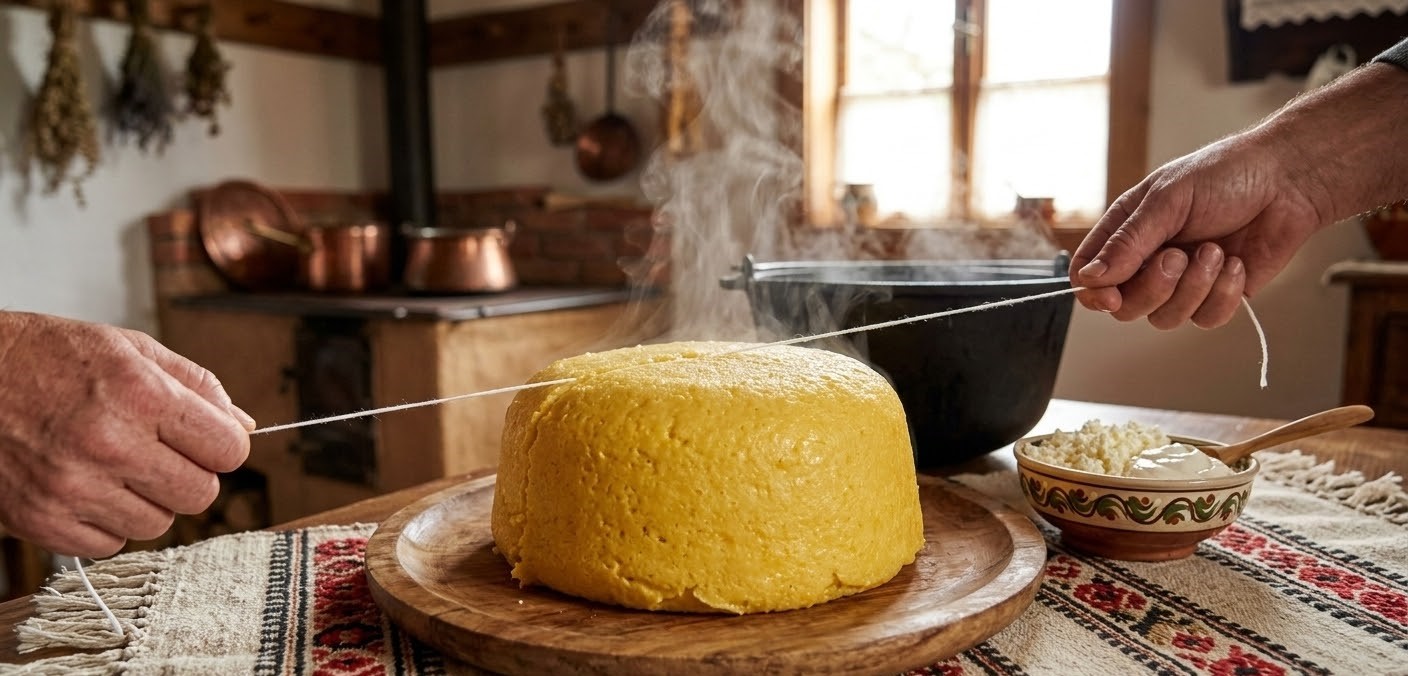
The Classic Recipe: Traditional Romanian Mămăliga
Making the perfect mămăliga is an art of patience and simple ingredients. In the villages of Romania, this is how it has been done for generations.
Ingredients
1-Water: 1 liter.
2-Cornmeal (Mălai): Approximately 250-300 grams (the ratio is usually 1:3 or 1:4 depending on how firm you want it).
3-Salt: 1 teaspoon (to taste).
4-Optional: A small knob of butter for extra creaminess.
Instructions
1-The Boil: Pour the water into a cast-iron cauldron (ceaun) or a heavy-bottomed pot and add the salt. Bring it to a boil.
2-The First Dusting: When the water starts to bubble, throw in a small handful of cornmeal. This helps prevent clumps later.
3-The Pour: Gradually pour the rest of the cornmeal in a steady stream into the center of the boiling water.
4-The Mixing: Use a traditional wooden whisk or a thick wooden spoon (făcăleț) to stir vigorously. Make sure to break up any lumps against the sides of the pot.
5-The Simmer: Reduce the heat to low and let it simmer for about 15-20 minutes. Stir frequently to prevent sticking. The mămăliga is ready when it starts to pull away from the edges of the pot.
6-The Flip: Shake the pot slightly to detach the mămăliga, then quickly flip it onto a round wooden platter. It should stand tall and golden, like a sun.
Pro Tip for the Perfect Slice
Do not use a metal knife! Use a clean piece of sewing thread. Hold it tight with both hands and pull it through the mămăliga to get those iconic, smooth slices.
A good video recipe for Mămăliga (Polenta):
Frequently Asked Questions: Mămăliga (Romanian Polenta)
1. Is mămăliga the same as Italian Polenta?
While both are made from cornmeal, Romanian mămăliga is typically cooked to a much firmer consistency. It was historically used as a direct substitute for bread in rural communities.
2. Why is it called "The Golden Sun on the Table"?
This nickname comes from its bright yellow color and the round shape it takes when flipped out of the cast-iron cauldron (ceaun) onto a wooden platter, resembling a sun.
3. Is mămăliga healthy?
Yes, it is naturally gluten-free and low in calories compared to traditional bread. It’s a great source of complex carbohydrates and fiber.
4. How do you eat it like a local?
The most traditional way is Mămăligă cu Brânză și Smântână (with fresh cheese and sour cream). It is also the mandatory side dish for Sarmale (cabbage rolls) or fish with garlic sauce (mujdei).
5. Why is it cut with a thread instead of a knife?
Because mămăliga is very dense and sticky when hot, a knife would tear it. A simple piece of clean sewing thread provides a perfect, smooth slice every time—a tradition passed down through generations.
6. Can I find mămăliga in restaurants?
Absolutely. You will find it in almost every traditional restaurant in Romania, ranging from the simplest mountain huts to high-end dining in the cities.
