
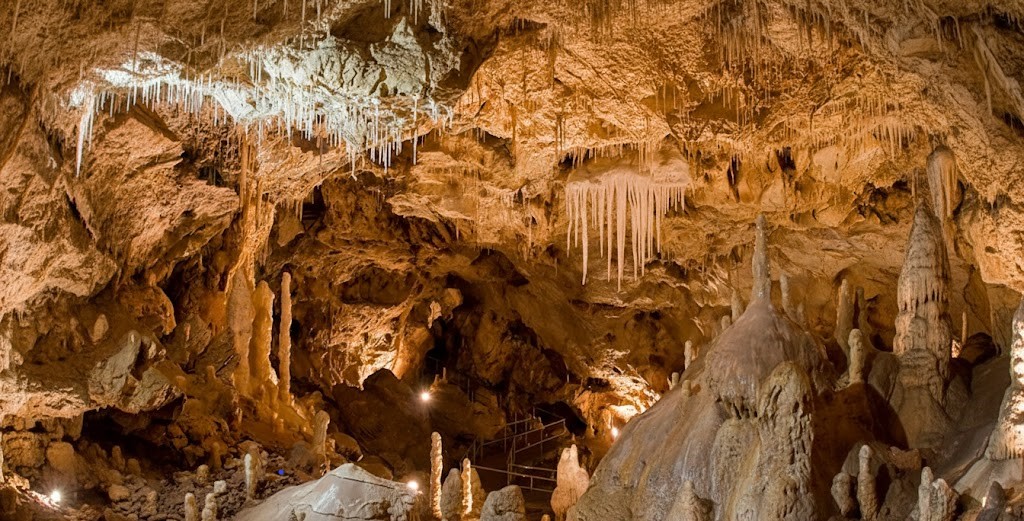
The Bears' Cave: A Prehistoric Drama Frozen in Time
1. The Great Trap (The Tragedy of 140 Bears)
The Legend & Science: This is one of the few places where legend and science tell the exact same terrifying story.The Story: About 15,000 to 17,000 years ago, a massive rockfall sealed the only exit of the cave while a huge colony of Cave Bears (Ursus spelaeus) was inside. Trapped in total darkness and driven by hunger, the bears fought each other for survival. When the cave was accidentally discovered in 1975 (after a marble quarry blast), explorers found over $140$ complete skeletons. For a visitor, walking among the bones of these "trapped giants" is a bone-chilling experience.
2. The "Embrace of the Rocks"
The Legend: The stalagmites that tell stories. The Story: In the Gallery of Wonders, the formations have taken shapes that seem almost intentional. There is one formation called "The Enchanted Castle" and another known as "The Grandmother's Chair." Legend says that these aren't just rocks, but the memories of the mountain itself, capturing the shapes of those who lived in the valley before the great ice ages. The most famous is the "Bear at the Door," a stalagmite that looks exactly like a bear trying to push its way out of the cave.
3. The Discovery of "Traian Curta"
The Legend: The man who looked into the abyss. The Story: Every great place has a hero. For this cave, it’s Traian Curta, the miner who first entered the dark void after the blast. Local stories say he felt a mysterious "cold breath" that called to him. When he stepped inside, his lantern revealed thousands of sparkling crystals and the white bones of the bears. He refused to let the quarry destroy it, saving one of the world's most important paleontological sites for us to see today.
Location & Geography
The cave is situated at the foot of the Bihor Mountains (see more), at an altitude of 482 meters. It was discovered purely by accident in 1975 during quarrying works.
Geologically, the cave spans over 1,500 meters in length, organized on two levels:
-The Upper Level: 488 meters long, fully illuminated and open to tourists.
-The Lower Level: 1,000 meters long, reserved exclusively for scientific research.
The cave’s name is derived from the Cave Bear (Ursus spelaeus), a massive predator that vanished during the last Ice Age. Over 140 bear skeletons were found here, trapped inside after a rockfall sealed the entrance thousands of years ago.
A video with rapid story of Bears' Cave of Bihor (Pestera Ursilor din Bihor):
Highlights for Travelers
The Gallery of Bones: Witness the actual remains of the prehistoric giants. The cave floor holds remarkably preserved skeletons, including a massive bear skull that has become the icon of the site.
The Gallery of Wonders: True to its name, this section is packed with breathtaking speleothems. You’ll see stalactites and stalagmites shaped like "The Pagodas," "The Dwarfs’ House," and "The Water Lily."
The Candle Gallery: A breathtaking corridor where thin, white limestone formations hang from the ceiling like thousands of wax candles.
Perfect Preservation: Because the cave was sealed for millennia, the colors and textures of the limestone are incredibly vivid, ranging from milky white to deep ochre.
A video from inside Bears' Cave of Bihor (Peștera Urșilor din Bihor):
Traveler Tips
Constant Climate: The temperature inside is a steady 10°C year-round. A light jacket is recommended even during the summer months.
Guided Tours: Access is granted only through guided tours (approx. 45 minutes). The paths are paved and safe, making it accessible for families.
Nearby Attractions: Combine your visit with a trip to the Ethnographic Museum of Chișcău, located just a few minutes away.
Discovery Year: 1975
Duration of Tour: 45 - 50 minutes
Key Species: Ursus spelaeus (extinct)
Total Galleries: 3 (Bones, Emils Racoviță, and Wonders)
This one is in top 5 Romania's caves to visit, one of the Apuseni Mountains attractions.
 Frequently Asked Questions: The Bears' Cave (Peștera Urșilor)
1. Why is it called "The Bears' Cave"?
The cave was named after the hundreds of Cave Bear (Ursus spelaeus) skeletons found inside. These animals became extinct about 24,000 years ago. Legend and science suggest that a rockfall blocked the exit, trapping about 140 bears inside, whose remains were perfectly preserved by the cave's constant environment.
2. Where exactly is the cave located?
Peștera Urșilor is located in the village of Chișcău, in Bihor County, Western Romania. It is situated at the foothills of the Bihor Mountains (part of the Apuseni range), about 85 km from the city of Oradea.
3. How was the cave discovered?
Unlike other historical caves, this one was discovered by accident in 1975 during a routine marble quarrying operation. A miner named Traian Curta was the first to enter through a small opening created by a dynamite blast, revealing the untouched treasure inside.
4. What are the main galleries I can visit?
The tourist circuit is divided into three main galleries:
-The "Bears" Gallery: Where you can see numerous fossils and skeletons.
-The "Emil Racoviță" Gallery: Named after the founder of biospeleology, showcasing spectacular stalactites and stalagmites.
-The "Candles" Gallery: Famous for its tall, thin, white formations that resemble wax candles.
5. What are the visiting hours and entrance fees?
Hours: Generally open Tuesday to Sunday, from 10:00 to 17:00. It is closed on Mondays.
Guided Tours: Entrance is allowed only in groups with a guide (included in the price). Tours depart approximately every 30–45 minutes.
Fees: Expect to pay around 30–40 RON (6-8 EUROs) for adults and 20RON (4EUROs) for children. Note that there is an extra fee for professional photography or filming.
6. Is it cold inside the cave?
Yes. The temperature is constant throughout the year at about 10°C. Even if it is 35°C outside in summer, you will feel the chill immediately. We highly recommend wearing a jacket and long pants, along with comfortable, non-slip shoes.
7. How long does the visit take?
The guided tour of the 488-meter-long tourist section takes approximately 45 minutes. The entire cave is about 1.5 km long, but the deeper sections are reserved for scientific research.
