
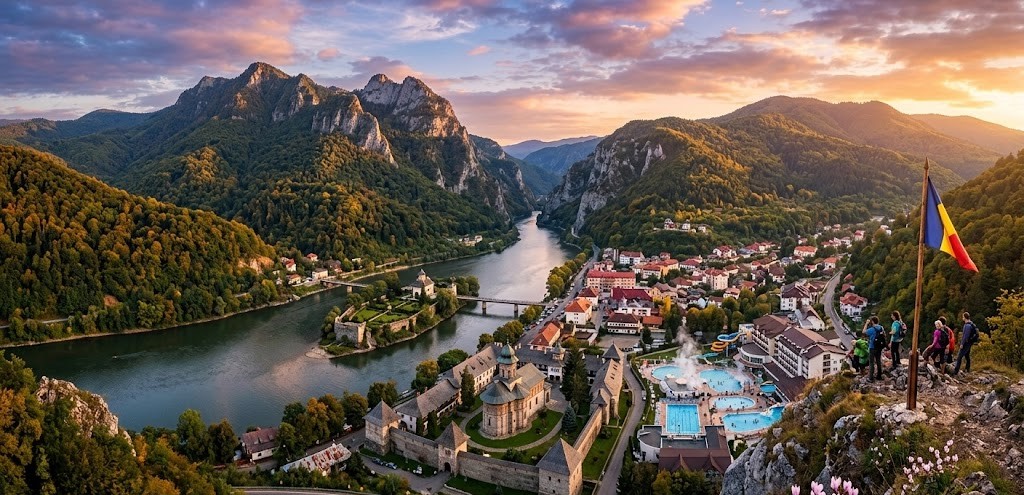
Nestled in the picturesque Olt Valley, Călimănești-Căciulata is not just a spa resort; it is a gateway to the past. Known for its healing thermal waters and breathtaking scenery, this twin-town destination has been a sanctuary for health and relaxation since Roman times. It is a place where the grandeur of the Cozia Mountains reflects in the serene flow of the Olt River.
The Legend of the Healing Shepherd
Local folklore tells the story of a shepherd named Căliman. Legend has it that he noticed his aging sheep and limping horses regained their strength and vitality after bathing in the "miraculous" marshes of the Olt Valley. He shared this secret with the monks of the nearby Cozia Monastery (see more), who eventually built the first primitive treatment baths, giving the town its name and its destiny.
Royal Recognition and History
- The Napoleon Connection: The mineral waters here are world-class. In the 19th century, Emperor Napoleon III of France was a regular consumer of the Călimănești bottled waters, which were transported all the way to Paris by mail coach for his treatments.
- Roman Heritage: Near the resort, you can visit the ruins of Arutela, a Roman castrum built in 138 AD (see more). It was part of a strategic defense line and proves that the Romans were the first to appreciate the strategic and thermal value of this gorge.
Biodiversity and Nature: The Cozia National Park
Călimănești-Căciulata is the starting point for exploring Cozia National Park, a hotspot for biodiversity:
- The "Cozia Rose": A unique species of wild rose (Rosa coziae) grows only in this specific microclimate.
- Flora and Fauna: The area is famous for its thermophilic (heat-loving) plants that survived the ice ages. In the dense forests above the resort, you might spot the elusive wildcat or the golden eagle soaring over the Olt Defile (see more).
- The Island of Longevity: In the middle of the Olt River lies the Ostrov Island, home to a 16th-century monastery and a beautiful park. It is the only inhabited river island in Romania that houses a monastic community.
- A Bridge to the Past: The Cozia Monastery, built by Mircea the Elder in 1388, is one of the most important monuments of medieval art in Romania, housing original frescoes that have survived for over 600 years.
- Modern Wellness: Today, the resort boasts "Căciulata Aqua Park," where visitors can enjoy geothermal pools outdoors even in the middle of winter, surrounded by snow-capped peaks.
Frequently Asked Questions: Călimănești-Căciulata
1. Is Călimănești-Căciulata only for medical treatments?
Not at all! While it is famous for its therapeutic mineral waters, it has evolved into a modern wellness and adventure destination. Many visitors come for the outdoor geothermal aqua parks, hiking in Cozia National Park, or visiting medieval monasteries.
2. Can I use the thermal pools in winter?
Yes, and it is one of the best experiences in Romania! The geothermal waters remain hot (around 35-38°C) year-round, allowing you to swim outdoors in steaming water while surrounded by snow-capped mountains.
3. What is the "Napoleon III" connection?
The mineral water from Spring No. 1 (Izvorul 1) was so highly regarded in the 19th century that it was bottled and sent by mail coach to the Tuileries Palace in Paris for Emperor Napoleon III, upon the recommendation of his personal physician.
4. Are there easy hiking trails for beginners?
Yes. You can take a gentle walk to the Ostrov Monastery, located on an island in the middle of the Olt River, or hike the "Calea lui Traian" path. For those seeking a challenge, the trail to Cozia Peak (1668m) offers some of the most dramatic views in the Southern Carpathians.
5. What is the Cozia Monastery?
Built in 1388 by Prince Mircea the Elder, it is one of the most valuable monuments of medieval architecture in Romania. It is famous for its 14th-century frescoes and for being the burial place of its founder. It is located right on the bank of the Olt River.
6. Can I visit the Roman ruins?
Absolutely. You can visit the Arutela Roman Castrum, located near the Cozia Monastery. It is a partially reconstructed stone fortress built by Roman soldiers in 138 AD to guard the strategic passage through the mountains.
7. How long should I stay there?
A weekend is perfect for a quick escape to the thermal pools and a visit to the monasteries. However, if you plan to explore the hiking trails of the Cozia Massif or follow a mineral water treatment, a 5 to 7-day stay is recommended.
