
Biodiversity: A Botanical Wonder
Discovered in the 19th century by botanists Schott and Kotschy, this flower has become the legal symbol of the Piatra Craiului National Park (see more).
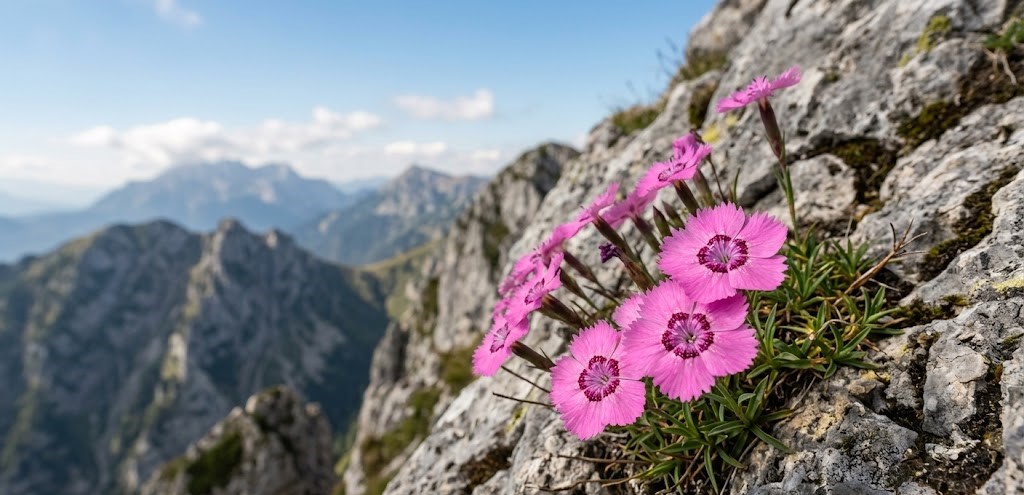
- Unique Features: It is easily recognized by its large, bright pink or carmine petals, which feature a distinct purple ring with white spots and fine hairs at the center (the "beautiful zone" mentioned in its Latin name, callizonus).
- Fragile Habitat: It thrives at high altitudes, usually between 1,600 and 2,200 meters, clinging to limestone scree and rocky ledges where few other plants can survive.
The flower is not just a plant; it is a survivor of the ice ages that found a perfect refuge on these jagged peaks.
- The Name's Meaning: Dianthus comes from the Greek words "Dios" (God) and "anthos" (flower) — literally, the "Flower of God." Combined with callizonus ("beautiful belt"), it translates to the "God's flower with a beautiful belt."
- A Protected Treasure: Being so rare, it is strictly protected by law. Picking even a single flower is illegal and carries heavy fines, as it threatens the survival of the entire species.
Fun Facts for Hikers
- A Short Window: You can only see it in bloom for a short period, typically from late June to mid-August, depending on the snowmelt.
- The High-Altitude Resident: It loves the sun but needs the constant humidity of the mountain mists to survive the harsh alpine environment.
- Small but Mighty: Despite its delicate appearance, it has a very strong root system that anchors it firmly into the limestone cracks against the fierce mountain winds.
FAQ: Garofița Pietrei Craiului (The Beauty of the Ridge)
1. Can I find this flower in other mountains in Romania or Europe?
No. This is a strict endemic species. It only grows on the limestone ridges of the Piatra Craiului Massif. If you see a similar-looking pink flower in the Bucegi (see more) or Făgăraș mountains (see more), it is likely a different species of Dianthus, but not the callizonus.
2. Why is its Latin name "Dianthus callizonus"?
The name is very descriptive. Dianthus means "God's Flower," and callizonus comes from the Greek kallos (beautiful) and zone (belt/ring). It literally means "The God's Flower with a Beautiful Belt," referring to the purple, hairy ring at the base of its petals.
3. Is it dangerous to reach the areas where it grows?
Yes, it can be. The flower grows at high altitudes (above 1,600m) on steep limestone slopes and scree. To see it, you usually need to hike on medium-to-difficult trails. Always check the weather and wear proper hiking boots before heading to the crest.
4. What should I do if I find one?
- Admire it: It’s a rare sight!
- Photograph it: But be careful not to step on other small plants around it.
- Do NOT touch or pick it: It is strictly protected by law. The survival of the species depends on the seeds falling back into the rocky soil.
While some species of Dianthus have been used in traditional medicine, Garofița Pietrei Craiului is NOT used for anything other than conservation. Its rarity makes it far too precious for any other use than being a symbol of wild nature.
6. Who discovered this flower?
It was first described in the mid-19th century by two famous botanists, Schott and Kotschy, who were fascinated by the unique flora of the Transylvanian Alps.
