
The Legend of Hercules and the Hydra
Local folklore tells a thrilling tale: the legendary hero Hercules (Heracles) fought the terrifying multi-headed Hydra right here in the Cerna Valley. According to legend, after a fierce battle, Hercules bathed in the valley's thermal springs to regain his strength.
- The "Corcoaia" Gorge: Some say the narrow, twisted limestone shapes of the Corcoaia Gorge were carved by the Hydra's body as it tried to escape the hero.
- The Statue: To honor him, a massive bronze statue of Hercules, cast in Vienna in 1847, stands proudly in the town center, symbolizing the eternal strength of these waters.
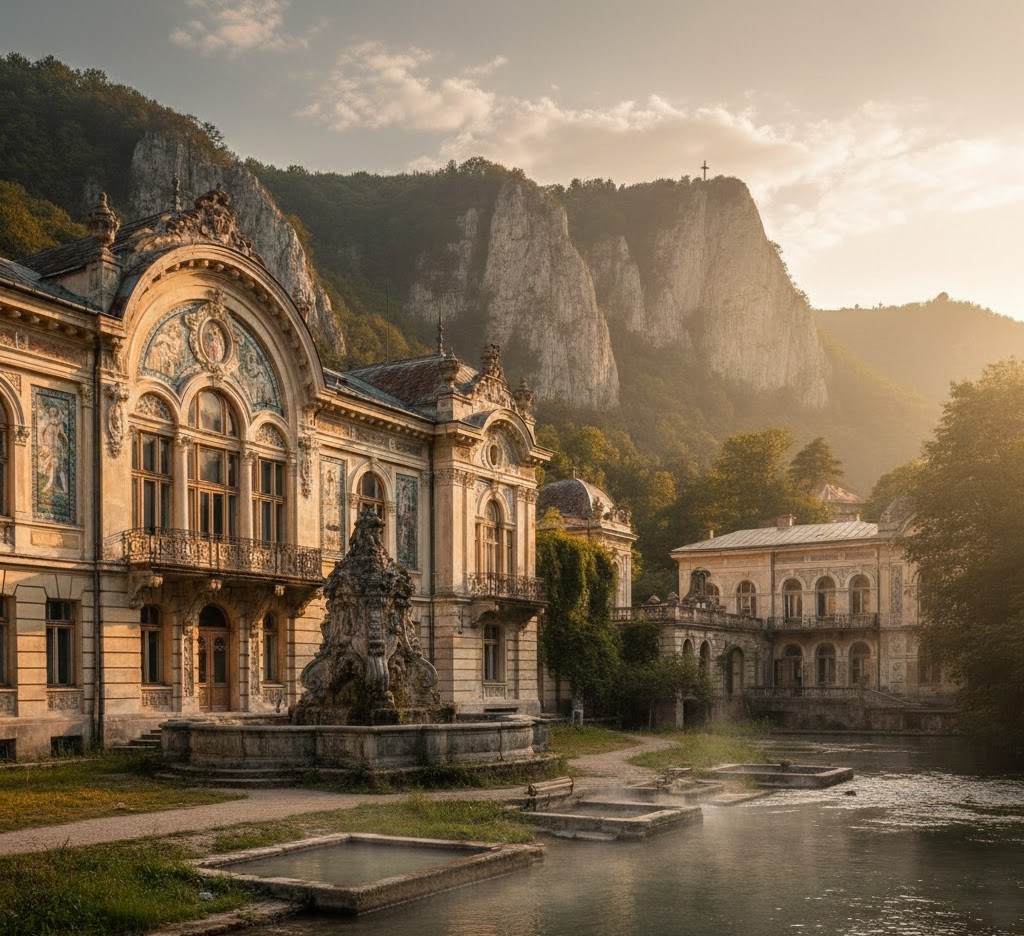
Imperial Elegance: The "Pearl of Europe"
In the 19th century, during the Austro-Hungarian Empire, Emperor Franz Joseph I called Băile Herculane "the most beautiful resort on the continent."
- Empress Elisabeth (Sisi): The famous Empress Sisi was a frequent visitor. She loved the solitude of the mountains and often hiked to the White Cross (Crucea Albă), a viewpoint that still offers the best panoramic vista over the town.
- Architecture: The "Neptune" Imperial Baths, with its stunning ceramic decorations and fountain, remains a masterpiece of Austrian Baroque and Eclectic style, even as it awaits restoration.
Băile Herculane is the gateway to the Domogled-Valea Cernei National Park, a hotspot for biodiversity:
- The Black Pine of Banat (see more): You can see these unique, umbrella-shaped pines clinging to the steep limestone cliffs.
- Butterflies: This region is world-famous among entomologists, home to over 1,500 species of butterflies.
- Thermal Flora: Because of the warm microclimate, you can find sub-mediterranean plants and even scorpions (the harmless Carpathian scorpion) (see more), which are rare in other parts of Romania.
The waters here are rich in sulfur and minerals, with temperatures reaching up to 60°C. For a truly local experience, many visitors still use the "Cădițe"—small, natural thermal pools right by the Cerna River, where you can soak for free under the open sky, just as the Roman legionnaires did centuries ago.
A video which present Herculane Baths (Băile Herculane):
FAQ: Visiting the Ancient Spa of Băile Herculane
1. What makes the thermal waters of Băile Herculane special?
These waters are among the most mineralized and potent in Europe. They are rich in sulfur, chlorine, sodium, and calcium. For over 2,000 years, they have been used to treat bone, joint, and muscle issues, as well as skin conditions and respiratory problems.
2. Can I visit the historic Imperial buildings?
Yes, but with caution. Many of the iconic buildings, like the Neptune Baths (Băile Neptun), are currently in various stages of conservation or restoration. You can admire their stunning Austrian Baroque architecture from the outside, which is incredibly "Instagrammable," but access inside might be restricted for safety reasons.
3. Is there a "best" way to experience the hot springs?
There are two ways:
- Modern Comfort: Most hotels have their own modern spa facilities and indoor thermal pools.
- The Authentic Way: Join the locals at the "Cădițe" – natural stone pools along the Cerna River where thermal water flows directly from the mountain. It’s free and offers a unique "wild spa" atmosphere.
Absolutely. The hike to the White Cross (Crucea Albă) is the most popular; it takes about 45 minutes and offers a breathtaking view. For something even easier, you can walk along the Cerna riverbed towards the "7 Springs" (7 Izvoare) area.
5. Is the resort safe for international travelers?
Yes, it is a very safe and peaceful town. While some parts of the historic center look weathered or "ruined," this is part of its melancholic charm. The locals are used to tourists, though learning a few basic Romanian phrases or having a translation app is helpful, as English is not spoken by everyone.
6. What else can I visit nearby?
Băile Herculane is a great base for exploring:
- The Danube Gorges (Cazanele Dunării) (see more): Only a 45-minute drive away, where you can see the massive rock sculpture of Decebalus.
- The Bigăr Waterfall (see more): Once voted the most unique waterfall in the world, located about 1.5 hours away.
