
The Legend of the "Holy Bird"
In many local fishing communities, the pelican is regarded with a mix of awe and respect. There are old tales suggesting the pelican is a "self-sacrificing" bird; it was once believed that in times of famine, a mother pelican would pierce her own breast to feed her chicks with her blood. While this is a biological myth, it has made the pelican a powerful symbol of devotion and protection in Romanian spiritual heritage.
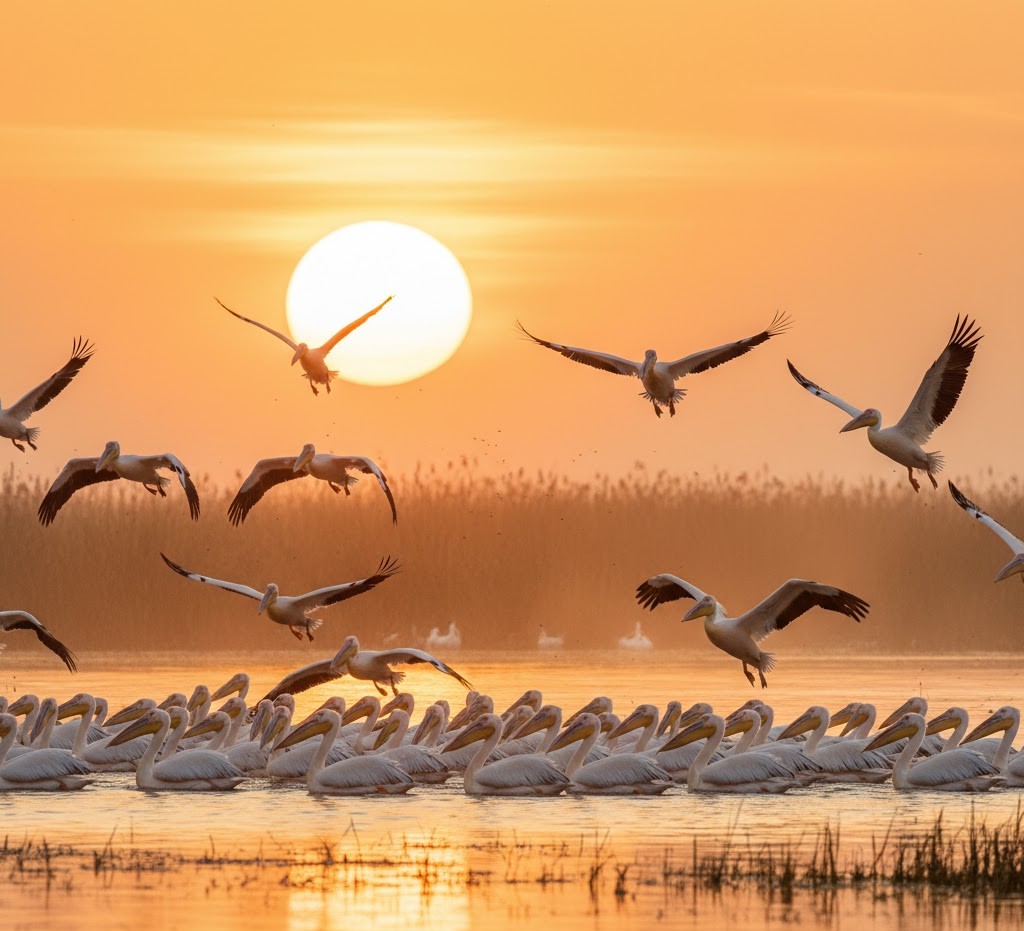
Two Kings of the Water: Common vs. Dalmatian
Romania hosts two distinct species, each with its own charm:
- The Great White Pelican (Pelicanul Comun): These are the social stars. They live in huge colonies (like the famous Roșca-Buhaiova) and are known for their spectacular collective fishing—forming a semi-circle to drive fish into shallow waters.
- The Dalmatian Pelican (Pelicanul Creț): Rarer, larger, and more solitary. You can recognize them by their "curly" feathers on the back of the head and their silvery-grey plumage. They are the giants of the Delta skies.
The Danube Delta is vast, but certain areas are pelican hotspots:
- Roșca-Buhaiova Reserve: A strictly protected area that hosts the largest colony of Great White Pelicans in Europe. Entry is forbidden, but you can see thousands of birds flying to and from the area.
- Lake Fortuna & Lake Baclanesti: Excellent for boat tours where you can watch them fishing.
- The Musura Bay: Near Sulina (see more), where the Danube meets the Black Sea, it's a great place to see them resting on sandbars.
 Respect the Colony: Safety and Ethics
As always, wild animals are unpredictable, and pelicans are extremely sensitive to human presence.
- Keep your distance: Approaching a nesting colony too closely can cause the adults to fly away in panic, leaving eggs or chicks exposed to predators like gulls.
- Use a zoom lens: A good pair of binoculars or a 400mm+ lens is your best friend here.
- Slow the engine: If you are in a boat, ask your guide to slow down or stop the engine from a distance to avoid startling them.
FAQ: Pelicans in Romania
1. When is the best time to see them?
They are migratory birds. They arrive in the Delta in late March or April and stay until late September or October, when they head back to Africa or the Middle East for the winter.
2. Do they really carry fish in their pouches?
The pouch is used like a scoop or a net to catch fish, not to store it for long periods. After catching a fish, the pelican drains the water and swallows the prey immediately.
3. How big are they?
They are among the heaviest flying birds. A Dalmatian Pelican can have a wingspan of up to 3 meters and weigh over 10kg!
