
Welcome to Jgheabul lui Zalion-widely considered the most difficult and demanding cave in Romania. The Deepest Vertical Abyss.
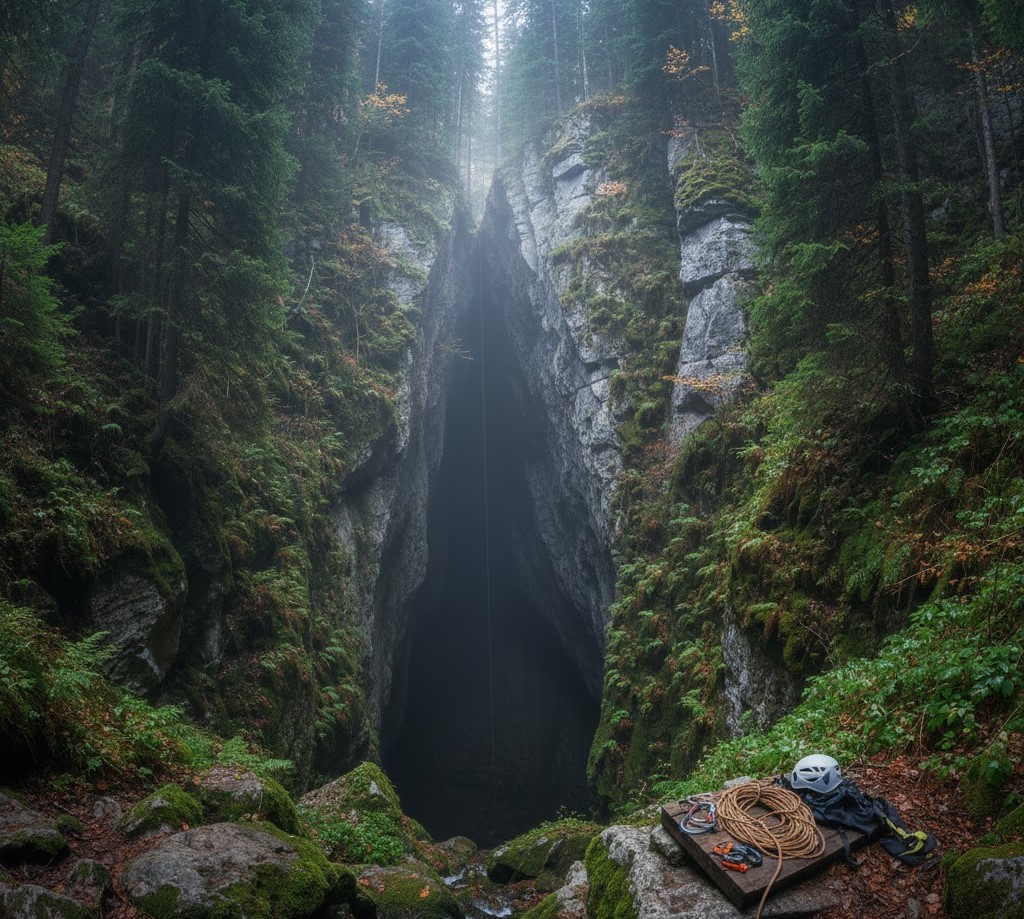
 Jgheabul lui Zalion: The Vertical Abyss
1. The Name of the Outlaw (Zalion)
The Legend: Who was Zalion? The Story: Local folklore says that Zalion was a famous outlaw (haiduc) or a shepherd-hero who used the steep and hidden "jgheab" (a narrow, trough-like ravine) to escape the authorities. Legend has it that he was the only one who knew how to navigate the slippery limestone cliffs to reach the cave's mouth, where he hid his earnings. To this day, the cave preserves his name as a symbol of defiance and the untamable spirit of the Rodna Mountains.
2. The Whispering Cascades
The Legend: The voices from the deep. The Story: Because the cave is a active system with many vertical drops and waterfalls, the sound of rushing water echoes through the narrow shafts. Miners and shepherds of old believed that the mountain was "talking" or "crying." They avoided the area at night, saying that the spirits of those lost in the mountains gathered in the "Jgheab" to share their stories in a language made of water and stone.
3. The "Glass" Labyrinth
The Legend: The hidden beauty of the vertical world. The Story: Beyond the terrifying drops, the cave hides galleries filled with rare, translucent formations. Legend says that these are the "frozen thoughts" of the mountain. Because so few people have ever reached the deepest parts of Jgheabul lui Zalion, it is believed that the crystals there are the purest in the Carpathians, protected by the difficulty of the descent itself.
The "Mount Everest" of the Underground
If the Făgăraș peaks are the roof of Romania, Jgheabul lui Zalion is its basement—a deep, vertical, and unforgiving one. This isn't your typical tourist cave with paved paths and colorful lights. It is a vertical labyrinth with a vertical drop (depth) of over 300 meters.
For speologists, conquering Zalion is a badge of honor. It’s a relentless sequence of:
- Narrow Squeezes: Passages so tight you have to exhale just to move through.
- Vertical Shafts: Giant underground "chimneys" that require expert rope work.
- Subterranean Waterfalls: The cave is active, meaning water constantly carves its way through, creating slippery and dangerous conditions.
Beyond its technical difficulty, Jgheabul lui Zalion is a geological marvel. Located in the Telcișor basin, it is part of a complex karstic system that includes other giants like Tăușoare Cave (Click HERE to see more) (the deepest in Romania).
What makes Zalion stand out is its hostile beauty. It wasn't formed by gentle erosion but by tectonic shifts and violent water forces, leaving behind sharp rock formations and a raw, untamed atmosphere that feels like another planet.
 A Word of Warning: The Forbidden Beauty
It is crucial to note that Jgheabul lui Zalion is NOT open to the general public. Due to its extreme difficulty, high risk of flooding, and vertical nature, entry is restricted to professional speologists with specialized equipment and permits. For the average hiker, the mystery remains at the surface—but knowing that such a colossal abyss exists beneath your boots adds a layer of awe to any hike in the Rodna Mountains.
Why This Matters for the Rodna Mountains
The existence of Zalion proves that the Rodna Mountains are a 3D masterpiece. From the 2,303m height of Pietrosu Peak to the -300m depths of Zalion, this massif offers a scale of vertical exploration that is unmatched in the rest of the Eastern Carpathians.
Quick Facts:
- Location: South-western part of Rodna Mountains (Bistrița-Năsăud county).
- Status: Speological Reserve (Special protection).
- Access: Strictly for professionals.
- Nearby: The village of Telciu, a gateway to the wilder side of the mountains.
1. What is the most difficult cave in Romania?
Jgheabul lui Zalion is widely recognized by speleologists as the most difficult cave in Romania. Its reputation comes from its extreme verticality, narrow passages, and the technical skills required to navigate its 300-meter depth.
2. Can tourists visit Jgheabul lui Zalion?
No, Jgheabul lui Zalion is not a tourist cave. It is a protected speleological reserve and is closed to the general public. Access is granted only to professional cavers with specific permits and high-level technical equipment.
3. Where is Jgheabul lui Zalion located?
The cave is located in the southwestern part of the Rodna Mountains National Park, in the Telcișor River basin, near the commune of Telciu in Bistrița-Năsăud county, Romania.
4. How deep is the Jgheabul lui Zalion cave?
The cave has a total vertical drop (denivelare) of over 300 meters. It consists of a series of vertical shafts and active water galleries that make it a challenging "vertical labyrinth."
5. Why is Jgheabul lui Zalion considered dangerous?
The cave is considered dangerous due to its extreme verticality, the risk of flash floods (it is an active water cave), and many very narrow passages (squeezes) that require advanced physical and mental endurance.
6. Are there other famous caves in the Rodna Mountains?
Yes, the Rodna Mountains are home to several significant caves, including Peștera Tăușoare (the deepest in Romania at -415m) and Baia lui Schneider. Like Zalion, these are primarily for scientific study and professional exploration.
