
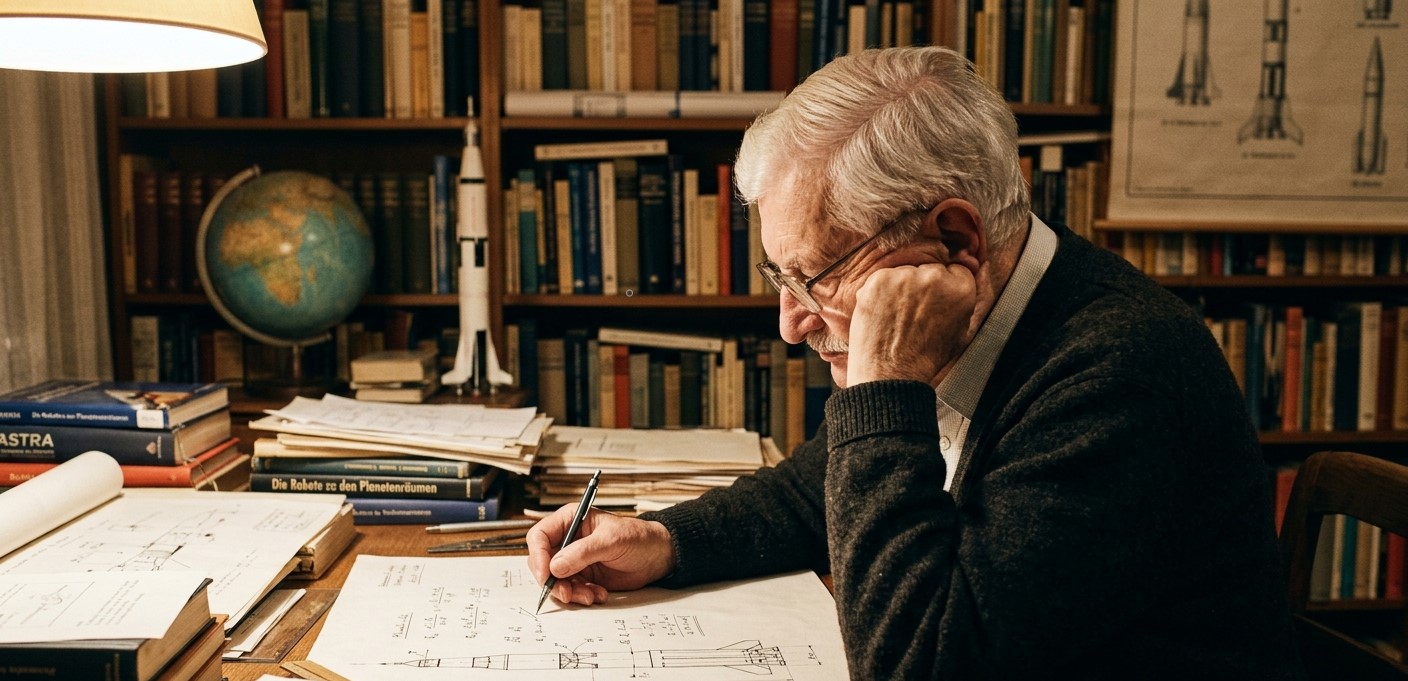
To understand the engines pushing Artemis toward the lunar South Pole, we must travel back in time to a small room in Sighișoara (see more), Romania. It was there that a young man named Hermann Oberth (1894–1989) was proving, with nothing but a pencil and paper, that leaving Earth's atmosphere was not a fantasy, but a mathematical certainty.
While the names of astronauts are etched in history, the foundations for reaching the stars were laid by this visionary born in the heart of Transylvania. Today, Oberth is globally recognized as one of the three founding fathers of rocketry and astronautics, alongside Konstantin Tsiolkovsky and Robert Goddard—but his story truly began among the medieval towers of his Romanian homeland.
From Sibiu to the Stars
Born in Hermannstadt (Sibiu) and raised in Sighișoara, Oberth was a brilliant mind shaped by the academic rigor of Transylvanian Saxon culture. His journey into space began not in a lab, but in his imagination while reading Jules Verne’s From the Earth to the Moon. Unlike others, he didn't just dream; he calculated.
- The Math of Space: By the age of 14, Oberth had already envisioned a "recoil rocket" that could travel through the vacuum of space by expelled exhaust gases.
- The Rejected Thesis: In 1922, his doctoral dissertation on rocketry was rejected by the University of Heidelberg for being "too utopian." Undeterred, he published it privately as Die Rakete zu den Planetenräumen (The Rocket into Interplanetary Space), which became the "bible" of early rocket science.
Key Scientific Contributions
Oberth wasn't just a theorist; he provided the practical blueprints for space travel that are still used today:
- Multistage Rockets: He was the first to mathematically prove that a single-stage rocket could never reach orbit. He proposed the "step rocket" (multistage) design used by every modern launch vehicle, from the Saturn V to SpaceX's Starship.
- The Oberth Effect: A fundamental principle in astronautics. It states that a rocket engine generates more useful energy when traveling at high speed than at low speed. This is why spacecraft perform "burns" at their closest point to a planet (periapsis).
- Space Stations and Suits: Decades before they existed, Oberth designed ion propulsion systems, space suits with magnetic boots, and orbiting space stations with artificial gravity.
Hermann Oberth belongs in the Icons of Romania category not only for his scientific genius but for his enduring connection to his homeland. Even after moving to Germany and later the United States to work with his former student, Wernher von Braun (the architect of the Apollo program), Oberth often spoke of the intellectual spark he found in the schools of Transylvania.
- The Mentor: Wernher von Braun famously stated: "I myself owe him not only the guiding star of my life but also my first introduction to the theoretical and practical aspects of rocketry and space travel."
- Medias Memorial: Today, the Hermann Oberth Rocketry and Space Museum in Mediaș, Romania, stands as a testament to his work, housing models of his inventions and personal artifacts.
Birthplace: Sibiu (Hermannstadt), Transylvania.
Major Work: Ways to Spaceflight (1929), which won the first international prize for astronautics.
Impact: His theories directly enabled the Apollo 11 mission to the Moon in 1969.
Why He Matters Today
Hermann Oberth represents the power of perseverance. He was a man told by the greatest academic institutions of his time that his ideas were impossible. Today, every satellite providing GPS to our phones and every mission exploring Mars follows the mathematical paths he drew by hand in a small room in Sighișoara.
A stunning video of Artemis II launch
FAQ: Hermann Oberth – Pioneer of Space Exploration
Who was Hermann Oberth?
Hermann Oberth (1894–1989) was an Austro-Hungarian-born German physicist and engineer. Along with Konstantin Tsiolkovsky and Robert Goddard, he is recognized as one of the three "founding fathers" of astronautics.
What is his most famous work?
In 1923, Oberth published his seminal book, "Die Rakete zu den Planetenräumen" (The Rocket into Planetary Space). It was a groundbreaking scientific text that mathematically proved that a rocket could reach escape velocity and survive in a vacuum.
What were his major contributions to science?
The Oberth Effect: A phenomenon in astronautics where a rocket engine performs more efficiently when traveling at high speeds (specifically at the periapsis of an orbit).
Multistage Rockets: He was one of the first to provide a detailed mathematical explanation for why rockets should be built in stages to shed weight and reach higher altitudes.
Space Medicine: He theorized about the physical and psychological effects of space travel on the human body long before the first manned missions.
Did he work on the V-2 rocket?
Yes. During World War II, Oberth worked at the Peenemünde Army Research Center in Germany, where he contributed to the development of the V-2 rocket alongside his former student, Wernher von Braun.
Was he involved in the U.S. Space Program?
After the war, Oberth eventually moved to the United States in 1955. He worked for the Army Ballistic Missile Agency and later at NASA in Huntsville, Alabama, where he collaborated again with von Braun on the development of satellite launch vehicles.
Where can I learn more about him in Romania?
Because Oberth grew up and was educated in Mediaș, Transylvania, there is a dedicated museum there: The Hermann Oberth Memorial House. It showcases his original documents, models, and personal items related to his early research.
What is his legacy?
Oberth’s legacy is the reality of modern space exploration. He famously stated:
"To make available for life every place where life is possible. To make inhabitable all worlds as yet uninhabitable, and all life purposeful."
His vision bridged the gap between science fiction and the actual engineering required to leave Earth's atmosphere.
