The Architect of the Cell
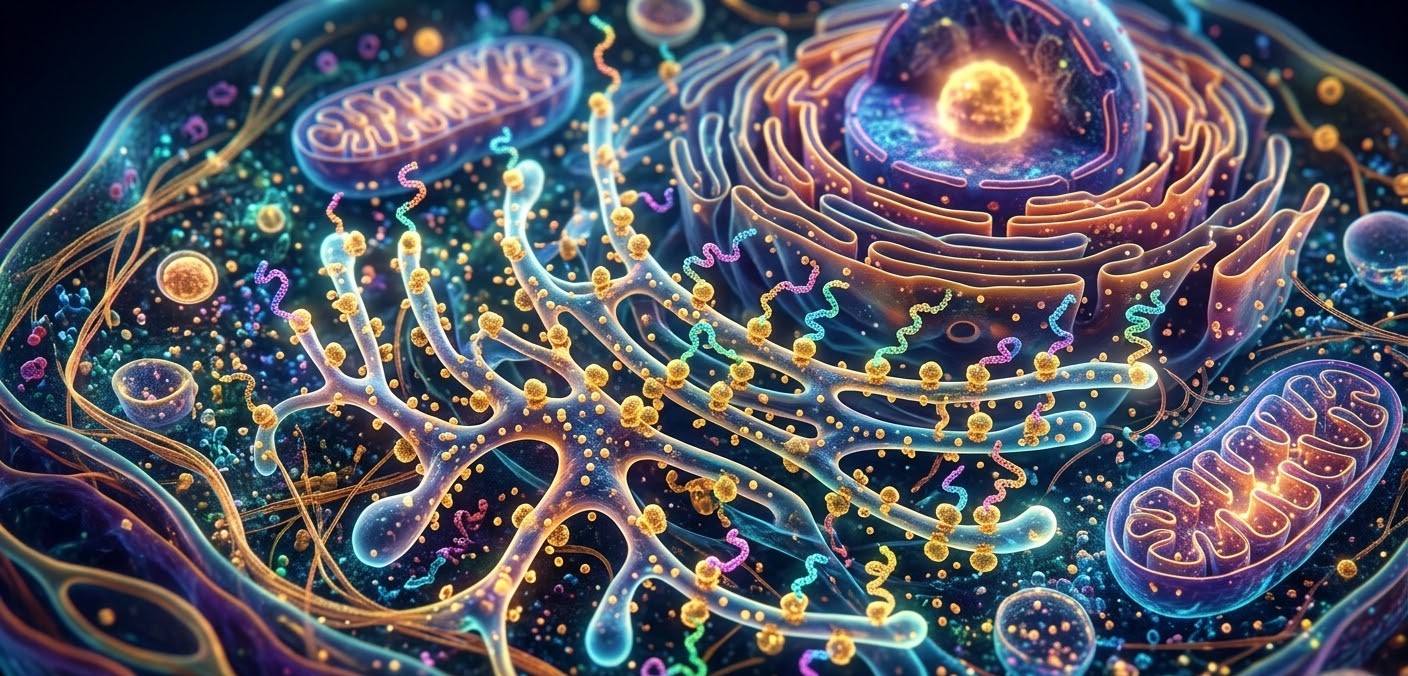
Before Palade, the inside of a cell was largely a mystery. Using the electron microscope with unprecedented precision, he discovered and described the functions of several key cellular components.
- Discovering the Ribosomes: He was the first to identify these tiny particles, which are the "protein factories" of the cell. For a long time, these were even called "Palade's particles" in his honor.
- Mapping the Secretory Pathway: He explained how proteins are produced, processed, and transported out of the cell, a process fundamental to everything from digestion to immune responses.
Legend & Legacy
While his life was dedicated to rigorous science, Palade is remembered as a "legend of the lens." He had an almost artistic eye for detail, often spending hours perfecting the preparation of biological samples to ensure the clearest possible image under the electron microscope.
- The Bridge Between Nations: Although he spent much of his career at Rockefeller University and Yale in the USA, he never forgot his roots. He is often cited as a prime example of the "Romanian School of Medicine," which emphasized strong clinical and anatomical foundations.
- Scientific Immortality: His discoveries are now found in every biology textbook in the world. He didn't just discover a fact; he founded an entire field: Modern Cell Biology.
- The "Palade Particles": Now known as ribosomes, these are the sites of protein synthesis.
- The Mitochondria: He provided the first high-resolution images of the inner membranes (cristae) of mitochondria, the "powerhouses" of the cell.
- Cell Fractionation: He helped develop the technique of spinning cell components in a centrifuge to separate them, allowing scientists to study each part of the cell individually.
- A Medical Doctor First: Palade graduated from the Faculty of Medicine in Bucharest in 1940. His deep understanding of human anatomy influenced how he viewed the microscopic anatomy of the cell.
- The 1974 Nobel Prize: He shared the prize with Albert Claude and Christian de Duve "for their discoveries concerning the structural and functional organization of the cell."
- A Passion for History: Outside the lab, Palade was a deeply cultured man with a great passion for history and the arts, often drawing parallels between the complexity of human society and the organization of the cell.
What exactly did George Emil Palade discover?
George Emil Palade was the first to identify and describe ribosomes (initially called "Palade's particles"), which are the protein-producing factories of the cell. He also mapped the "secretory pathway," explaining how proteins move through the cell's internal structures to be used or exported.
Why is he called the "Father of Modern Cell Biology"?
Before Palade, scientists mostly looked at the cell as a simple "bag" of components. By using the electron microscope with incredible precision, he combined anatomy with biochemistry, allowing us to see and understand the functional "machinery" inside the cell for the first time.
Did he win the Nobel Prize?
Yes. In 1974, George Emil Palade was awarded the Nobel Prize in Physiology or Medicine, sharing it with Albert Claude and Christian de Duve for their collective discoveries concerning the structural and functional organization of the cell.
Is he a Romanian citizen?
He was born in Iași, Romania, in 1912 and completed his medical studies in Bucharest. Although he moved to the United States in 1946 to continue his research at Rockefeller University and later Yale, he always remained deeply connected to his Romanian roots and is celebrated as one of the country's greatest intellectual exports.
How is he honored in Romania today?
His legacy is a point of immense national pride. Several prestigious institutions, including the University of Medicine, Pharmacy, Science and Technology in Târgu Mureș, are named after him, and his life story is a cornerstone of the Romanian medical curriculum.
What was his educational background?
Palade was a medical doctor by training. He graduated from the Faculty of Medicine in Bucharest in 1940. This medical background gave him a unique perspective, as he approached the microscopic world of the cell with the same detailed eye an anatomist uses for the human body.
