
An Incredible Life Cycle
The story of the Rusalia is one of extreme patience. Although their flight lasts only a few hours, the preparation for this moment takes years.
- Three Years in Darkness: The larvae of Palingenia longicauda live for three years digging tunnels in the clay or mud at the bottom of the river. They are excellent indicators of water purity, as they cannot survive in polluted environments.
- The Great Transformation: In a single evening, perfectly synchronized, the larvae rise to the surface, shed their skins, and become winged adults.
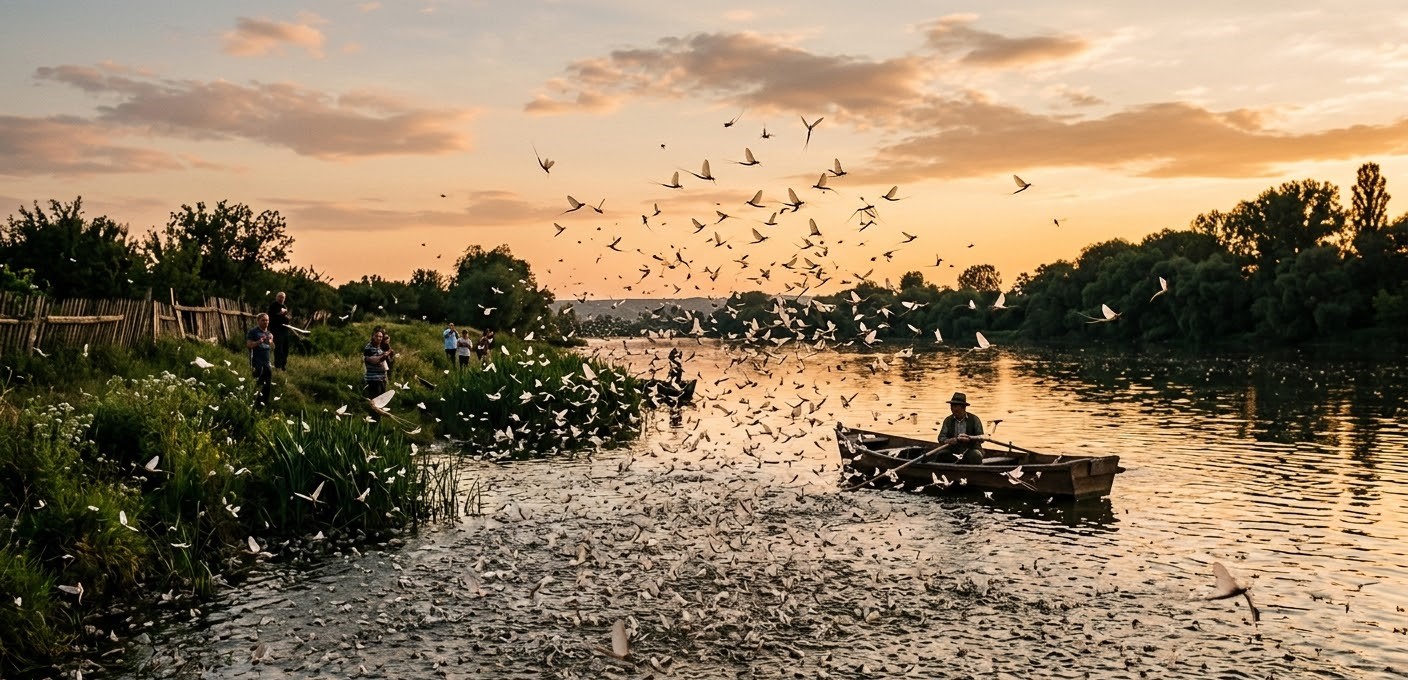
- The Nuptial Flight: The adults do not eat; they do not even have functional mouthparts. Their only goal is reproduction. The males perform a frantic dance over the water, forming living clouds that can cover immense areas.
Legends and Symbolism (The Legend of the Departed Souls)
The popular name Rusalia is not accidental. Beyond the timing with the religious calendar, there are deep-rooted beliefs in local folklore:
- The Spirits of the Young: It is said that these insects are the spirits of young people who passed away before they could marry. Once a year, they are allowed to descend to earth as mayflies to experience their "wedding" and love before returning to the afterlife.
- The Symbol of Ephemerality: The Rusalia is the ultimate symbol of a short but intense life. It reminds us that beauty may be fleeting, but its impact remains in the memory of those who witness it.
- The Tisza and Mureș Rivers: These are the classic locations where the density of insects is highest.
- The Danube Delta (see more): While less publicized than the Tisza, the phenomenon in the Delta is considered by specialists to be the most complex in Europe due to the region's vast biodiversity.
- Size: It is the largest mayfly in Europe, reaching up to 12 cm in length (including the long tails).
- Timing: Usually between June 10th and 20th, around sunset.
- Conservation Status: A protected species on the Red List, as it is extremely sensitive to pesticide pollution and riverbed alterations.
Frequently Asked Questions: The Long-Tailed Mayfly (Rusalia)
Why is the phenomenon called Rusalia?
The name is derived from the Christian holiday of Pentecost, known as Rusalii in Romania. The mass hatching of these insects almost always coincides with this religious celebration, usually occurring between late May and mid-June. In local folklore, the insects are often associated with the spirits of the departed.
Where is the best place in Romania to see this?
The most spectacular displays occur on the Tisza and Mures rivers, particularly in areas with clay banks where the larvae live for years. Significant hatchings also take place in the Danube Delta, though these are often harder to reach without a boat.
How long does the "blooming of the river" last?
The entire event for a specific river section typically lasts only 3 to 4 days. However, for an individual insect, the adult life stage lasts only a few hours—just long enough to mate and lay eggs before they perish.
Is the date of the hatching predictable?
It is very difficult to pinpoint the exact day in advance. The emergence depends on several natural factors, including water temperature, air pressure, and the speed of the river current. Local fishermen are usually the first to provide a 24-hour notice when they see the larvae beginning to move toward the surface.
Are these insects dangerous or do they bite?
No. As adults, these mayflies do not have functional mouthparts or a digestive system. They cannot bite, sting, or cause any harm to humans or animals. Their only biological purpose during their few hours of flight is reproduction.
Why is this considered a rare phenomenon?
Palingenia longicauda is a bio-indicator species. They can only survive in very clean water and natural, unpolluted riverbeds. Due to industrial pollution and the damming of rivers across Europe, this species has disappeared from most of the continent, making the Romanian and Hungarian populations some of the last remaining in the world.
Can I take photos or videos of the event?
Yes, it is a dream for nature photographers. The best time is during the "golden hour" just before sunset, when the insects reflect the orange light as they dance over the water. However, be prepared for a very chaotic and fast-moving environment.
