
The "Double Election": A Masterstroke of Diplomacy
In 1859, the Great Powers of Europe had agreed that Moldavia and Wallachia could have similar administrations but must remain separate, with two different rulers. On January 5th, Cuza was elected Prince of Moldavia. In a brilliant move of political defiance and national unity, the elective assembly in Bucharest also chose him as Prince of Wallachia on January 24th.
This "Double Election" effectively united the two provinces, creating the modern nation-state of Romania and presenting Europe with a fait accompli that they eventually had to recognize.
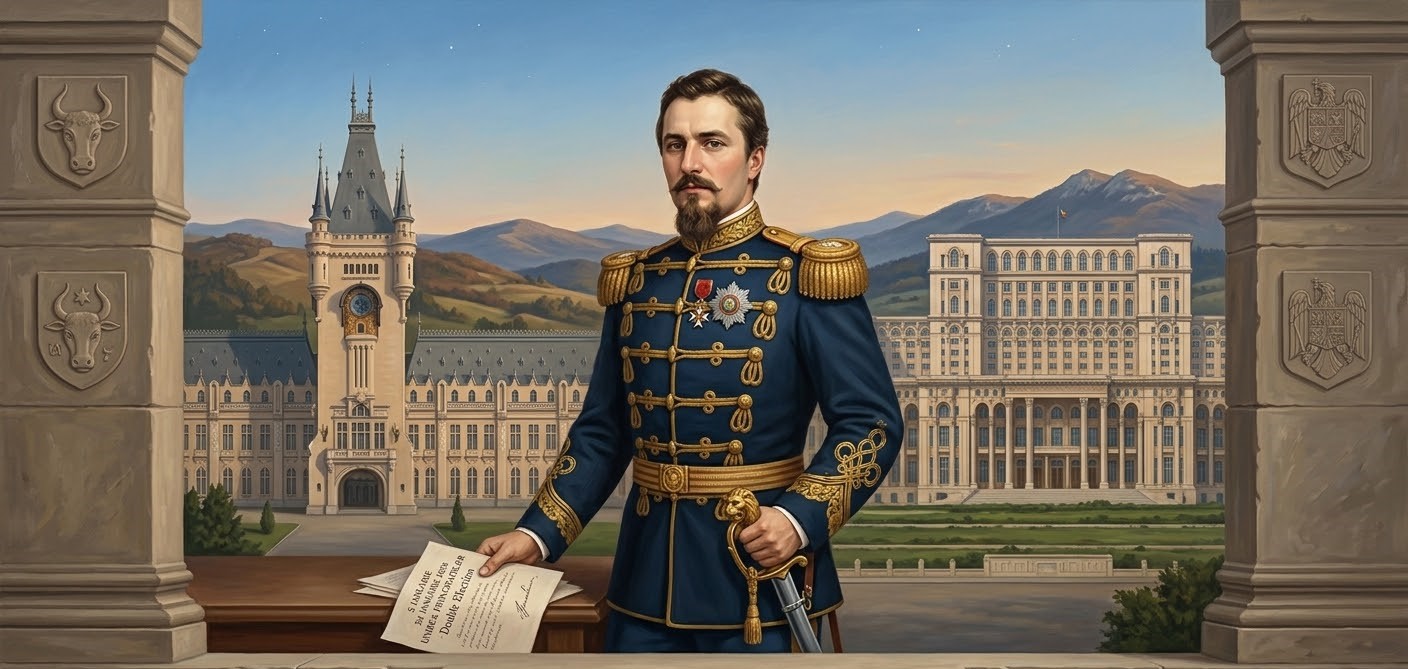
Revolutionary Reforms: Building a Nation from Scratch
Cuza’s reign (1859–1866) was a whirlwind of modernization. He understood that a nation is built on its people and its laws:
- The Land Reform: He emancipated the peasants from serfdom and distributed land to over 400,000 families, forever changing the social fabric of the country.
- Education for All: Cuza introduced the first law on public instruction, making primary education compulsory and free. He also founded the first two modern universities: Iași (1860) and Bucharest (1864).
- The Civil Code: He implemented a modern legal system inspired by the Napoleonic Code, which unified the laws across the principalities.
- National Institutions: He created the National Bank, the Army, and the first unified postal and telegraph services.
In Romanian folklore, Cuza is remembered as a prince who walked among his people in disguise to ensure justice. The most famous legend is that of "Ocaua lui Cuza" (Cuza’s Measure).
The story goes that Cuza dressed as a simple peasant and went to a market to check if merchants were using the standard weight measures. He found a dishonest merchant using a smaller "ocă" (a traditional unit of volume) to cheat customers. Cuza revealed his identity, punished the merchant, and established a standard measure that symbolized fairness and honesty in the new Romanian state. To this day, the phrase "Cuza's measure" is synonymous with integrity.
Frequently Asked Questions: Alexandru Ioan Cuza
1. Who was Alexandru Ioan Cuza?
He was the first ruler (Domnitor) of the United Principalities of Moldavia and Wallachia between 1859 and 1866. He is considered the founder of the modern Romanian state due to his radical reforms and his role in the "Little Union."
2. What was the "Double Election"?
In 1859, the Great Powers allowed the principalities to unite in name but required two separate rulers. Romanians bypassed this by electing Cuza in Moldavia on January 5th and then again in Wallachia on January 24th. This clever political move forced Europe to accept a single ruler for both lands.
3. What were his most important reforms?
Cuza modernized Romania at an incredible pace. His key achievements include the Agrarian Reform (giving land to peasants), the Education Law (making primary school free and compulsory), and the founding of the first modern universities in Iași and Bucharest.
4. What is the legend of "Cuza's Measure" (Ocaua lui Cuza)?
It is a famous folk story where Cuza disguised himself as a peasant to catch a dishonest merchant using a smaller measure to cheat people. It symbolizes his commitment to justice and fairness for the common citizen.
5. Why did he abdicate?
His rapid reforms turned both the wealthy landowners and radical politicians against him. In 1866, a political coalition forced him to sign his abdication and leave the country. He was succeeded by Prince Carol I of Hohenzollern-Sigmaringen.
6. Where is he buried?
After dying in exile in Germany in 1873, his remains were brought back to Romania. He is currently buried at the Trei Ierarhi Monastery in Iași, a city that remained loyal to his memory.
