
The Legend of the "Star of the Meadow"
In Romanian village folklore, the white narcissus is often called the "Star of the Earth." A popular local legend tells of a beautiful mountain nymph who was so in love with the stars that she spent every night reaching toward the sky. Seeing her devotion, a falling star touched the ground where she stood.
Instead of burning the earth, the star's cold, silver light transformed into the first white narcissus. This is why, the elders say, the flowers always face slightly downward—as if the nymph is still modest after being touched by the heavens. In other regions, these flowers are associated with the "Iele" (mythical feminine creatures), who are said to dance in the meadows at night, leaving the scent of narcissus behind them.
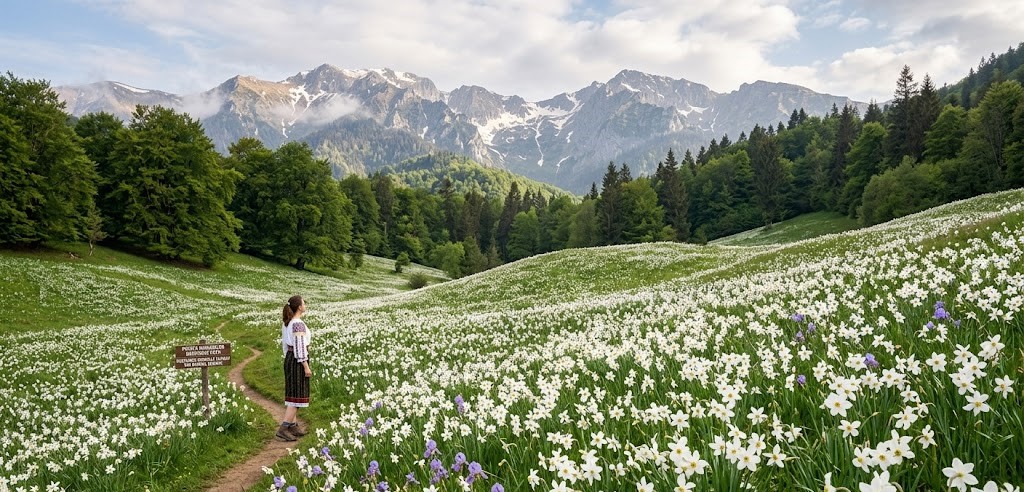
Biodiversity: A Protected Natural Treasure
The wild narcissus is a delicate species that requires very specific conditions to thrive, making its conservation vital:
- Protected Meadows: Many "Poieni cu Narcise" (Narcissus Meadows) are protected areas of national interest. The most famous ones are found in Negrileasa (Alba), Valea Alajului (Brașov), and Zervești (Caraș-Severin).
- High Altitude Adaptation: Unlike the garden variety, wild narcissi are incredibly resilient, growing at altitudes ranging from 400m up to 1,600m in the sub-alpine layers of the Carpathians.
- Fragrance Ecosystem: The intense, sweet perfume of millions of blooms attracts specific pollinators, including rare butterfly species, creating a unique micro-ecosystem during the blooming month of May.
- The Festival of Narcissi: Many Romanian villages celebrate the "Sărbătoarea Narciselor" in May. It is a time for traditional dances, folk costumes, and celebrating the rebirth of nature.
- A Rare Scent: The wild narcissus has a much more powerful and refined fragrance than the cultivated ones you find in flower shops. A single wild bloom can scent an entire room.
- Fragile Beauty: It is strictly forbidden to pick these flowers in protected areas. They are best enjoyed through a camera lens, as they wilt almost immediately after being removed from their natural habitat.
Frequently Asked Questions: The Wild White Narcissus
1. When is the best time to visit the Narcissus meadows?
The blooming season is brief and spectacular, usually occurring between mid-May and early June. The exact timing depends on the altitude of the meadow and the weather—warmer springs can trigger an early bloom in early May.
2. Where are the largest Narcissus meadows in Romania?
The most iconic sites include:
- Dumbrava Vadului (Brașov): Known as the "Oak Forest with Narcissi," it is the largest and most famous.
- Negrileasa (Alba): A stunning meadow located in the Apuseni Mountains (see more) at an altitude of over 1,000 meters.
- Zervești (Caraș-Severin): A beautiful protected area at the foot of the Tarcu Mountains (see more).
No. Most of these meadows are "Natural Monuments" or protected botanical reserves. Picking the flowers is strictly prohibited to ensure the survival of the species and to protect the delicate ecosystem.
4. Why do these flowers grow in such large "carpets"?
Wild narcissi thrive in humid, unplowed meadows that haven't been affected by intensive agriculture. Because they reproduce through bulbs, they tend to stay in the same area for centuries, eventually covering entire hillsides if left undisturbed.
5. Are these narcissi different from the ones in gardens?
Yes. The wild species (Narcissus stellaris) is smaller, more delicate, and has a much more intense and refined fragrance than commercial varieties. They have also adapted to survive the harsh winters of the Carpathian mountains.
6. Is there a "Festival of Narcissi"?
Yes! Many local communities near these meadows, such as those in Vad (Brașov) or Negrileasa, hold traditional festivals in May. These events celebrate local folklore, music, and the natural beauty of the blooming flowers.
